
The International Monetary Fund (IMF) has announced its global economic growth forecast for 2026 at 3.1%, sounding the alarm over economic polarization. This comes as the global economy is being divided by contrasting factors: downward pressure from the deteriorating situation in the Middle East and soaring energy prices, alongside the rapid expansion of artificial intelligence (AI)-related demand.
- Key takeaways: IMF revises growth forecasts and warns of growing polarization
- Main Downward Revision Risks and the Impact of Middle Eastern Geopolitical Shocks
- Structural Changes Supported by the Rapid Expansion of AI Demand and the Bright and Dark Sides of Growth
- Disparity in Growth Rates and Inflation Between Major and Emerging Economies
- Impact on the Japanese Economy and the Outlook for Expansionary Fiscal and Monetary Policy
- Future Outlook and Key Points: Policy Trends and Investment Divergence in an Era of Division
Key takeaways: IMF revises growth forecasts and warns of growing polarization
The International Monetary Fund (IMF) has released its latest World Economic Outlook (WEO), projecting global real economic growth for 2026 at 3.1%. Growth for 2027 is expected to reach 3.4%. The latest outlook points out that while robust global capital expenditure in the artificial intelligence (AI) sector is underpinning growth, fortunes are diverging across regions due to the adverse effects of soaring energy prices and varying degrees of impact from geopolitical risks, sounding a strong alarm bell over the polarization of the global economy.
Specifically, biases and characteristics in the structure of the world like the following are becoming clear.
- Concentrated Growth Structure: A skewed structure in which 95% of global economic growth is accounted for by just 32 countries and regions.
- Downward Revision of Forecasts: Economic growth forecasts have been revised downward in nearly half of all countries and regions.
- Divergence in growth drivers: A structural gap is widening between countries integrated into advanced technology value chains and developing countries dependent on primary commodity and energy imports.
Please refer to the figure below.
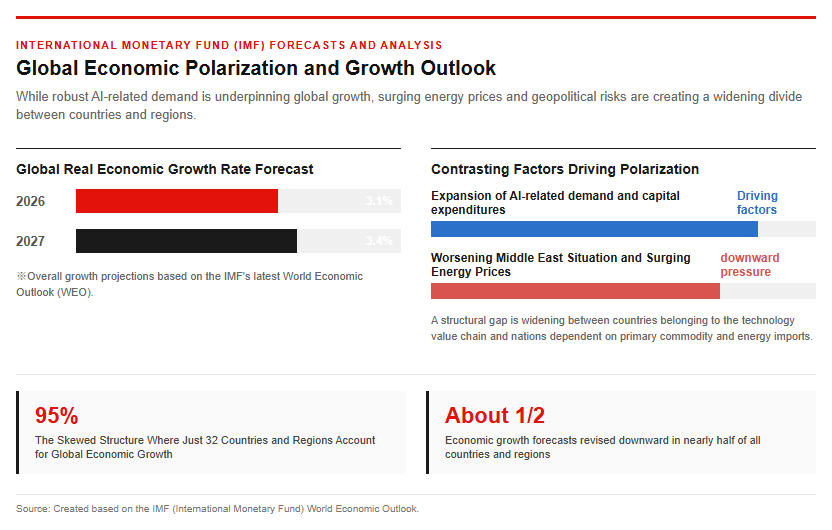
In this way, a K-shaped divergence is underway between certain developed and IT-driven nations that are able to reap the fruits of growth, and emerging economies that are slowing down under the pressure of energy shocks and inflation.
Main Downward Revision Risks and the Impact of Middle Eastern Geopolitical Shocks
The biggest volatile factor in concerns over a downside deviation in the global economy is the deterioration of the geopolitical situation in the Middle East region and the resulting risk of an energy crisis. This time, in addition to its baseline forecast, the IMF formulated multiple scenarios (reference, worsening, and severe) according to the progression of the Middle Eastern situation, and analyzed the impact of international price adjustments and supply disruptions.
The key points regarding the economic impacts and scenarios associated with geopolitical risks are as follows:
- Crude oil price trends: The baseline scenario estimates the average crude oil price in 2026 at $89 per barrel, while the severe scenario of a prolonged conflict anticipates a surge from over $110 to $125.
- Deceleration of global growth: In the event of a severe scenario, global growth in 2026 could deteriorate significantly to 2.0%, with warnings that it risks pushing the world to the brink of a global recession.
- Fears of resurgent inflation: While the global inflation rate for 2026 is projected at 4.7%, if energy supply disruptions are prolonged, there is a risk it will remain high in the 5.8% to 6.1% range.
Due to these factors, emerging economies and European countries, which have a high dependence on energy imports and fragile self-sufficiency and stockpiling systems, are facing a double whammy of rising import costs and declining purchasing power.
Structural Changes Supported by the Rapid Expansion of AI Demand and the Bright and Dark Sides of Growth
Acting as a professional Japanese-to-English translator for a tech/business news blog, I will translate the given text accurately, completely, and naturally, preserving the original markdown, punctuation, and structure.
Input text:
地政学ショックや原油高による下押し圧力を相殺し、世界経済の急落を防ぐ最大の牽引車となっているのが人工知能(AI)関連の巨大な需要です。半導体やデータセンター等のインフラに対する世界的な投資ブームが、主要国の設備投資と輸出を力強く押し上げています。
Translation:
The greatest driving force offsetting the downward pressure caused by geopolitical shocks and soaring crude oil prices and preventing a sharp downturn in the global economy is the massive demand related to artificial intelligence (AI). A global investment boom in infrastructure such as semiconductors and data centers is powerfully boosting capital expenditure and exports in major countries.
The structural changes and challenges brought by the AI boom can be summarized into the following elements.
- Productivity improvement effect: In the United States and other countries where the societal implementation of AI is progressing, a virtuous cycle is expected in which improvements in labor productivity absorb inflationary pressures.
- Supply Chain Benefits: Tech nations and developed countries that underpin the supply chain for AI-related equipment are maximizing the direct benefits of surging global demand.
- Risk of investment pullback: Warnings have been issued that if excessive AI expectations are reassessed or if the current investment cycle runs its course, it risks leading to reduced investment and market adjustment.
Please refer to the figure below.
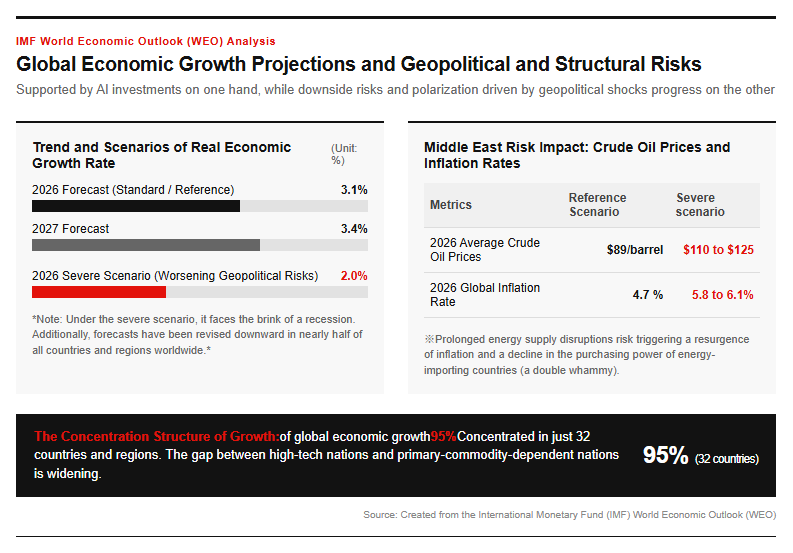
While the benefits of the AI boom are disproportionately concentrated in a few countries and large corporations with advanced technology, the structure in which developing countries without a technological foundation are left behind is becoming a factor that further solidifies global division.
Regional Economic Scenarios and Future Outlook
Disparity in Growth Rates and Inflation Between Major and Emerging Economies
An overview of regional economic forecasts forthought
the global economy reveals a stark divergence in growth momentum and inflation trends, driven by differences in macroeconomic policies and industrial structures across countries and regions.
Here is an overview of the economic situation in major countries and regions in 2026:
- US: Supported by tax cuts and AI-related investment, real growth will remain solid at 2.4% (up from 2.3%), and the FRB (Federal Reserve Board) is expected to implement two rate cuts within the year.
- Eurozone: Growth remains between 0.9% and 1.4%, and despite expansionary measures in defense and infrastructure investment, soaring energy prices and lagging digitalization are weighing on the economy.
- China: Due to the prolonged real estate slump and stagnant domestic demand, the growth rate has slowed from 4.1% to 4.6%, and product exports driven by overcapacity are acting as a deflationary factor for neighboring countries.
- Emerging Asia and the Middle East: Asia is projected to see a gradual slowdown in AI-related export momentum, while Middle Eastern countries are facing a sharp decline in energy exports due to geopolitical crises and a wave of reconstruction.
The widening growth gap among developed countries is also having diverse effects on the conduct of monetary policy by central banks.
Impact on the Japanese Economy and the Outlook for Expansionary Fiscal and Monetary Policy
Japan’s real GDP growth rate for fiscal 2026 is projected to range from +0.7% to +1.0%, with the government’s comprehensive economic measures and robust wage increases supporting domestic demand-led economic expansion. However, regarding external demand, shifts in the international environment and trends in Japan-China relations remain points of concern.
The key points regarding Japan’s economic trends and policy management are as follows.
- Economic measures and capital investment: Crisis management and growth investments (on a scale of 1.7 trillion yen) targeting strategic fields such as semiconductors and AI infrastructure, along with capital investment tax incentives, are strongly boosting corporate investment.
- Downside risks to external demand: Concerns such as rare earth supply restrictions from China and sluggish inbound tourism have led to estimates that the growth rate for fiscal 2026 will be pushed down by about 0.2%.
- Prices and the BOJ’s Monetary Policy: Core CPI is projected to temporarily slow down in the first half of fiscal 2026 before rising again toward the 2% range in the second half of the fiscal year, with the Bank of Japan expected to implement phased additional interest rate hikes (to 1.0%–1.25% or higher) toward June 2026 or 2027.
The dollar-yen exchange rate is expected to remain at a weak level in the 150-yen range, driven by the interest rate differential between Japan and the U.S. and low real interest rates.
Future Outlook and Key Points: Policy Trends and Investment Divergence in an Era of Division
Whether the global economy returns to a stable growth trajectory or fragmentation deepens further depends on each country’s industrial policy and ability to manage geopolitical risks. Amid the growing trend of state capitalism (big government) that prioritizes national security above all else, structural changes that do not rely solely on market self-regulation are becoming firmly established.
The key points to monitor for medium- to long-term market and investment decisions are as follows.
- Geopolitics and the Recovery of Energy Routes: Whether the stabilization of the Middle East, shipping conditions in the Strait of Hormuz, and crude oil prices can dispel uncertainty will be the major turning point for the investment environment.
- Fiscal credibility and rising long-term interest rates: The balance between fiscal discipline and growth investment is being questioned as to whether increased government bond issuance accompanying fiscal expansion in various countries might trigger a surge in long-term interest rates or currency depreciation.
- Contribution of AI implementation to the real economy: Moving beyond mere thematic buying, whether productivity gains and earnings contributions from the practical implementation of AI can be confirmed will determine the sustainability of stock prices.
Market participants are required to adopt a flexible asset allocation that does not rely on a single scenario, but rather identifies the intersection of geopolitical risk and technological innovation.
Reference page
- [IMF (International Monetary Fund) World Economic Outlook] https://www.imf.org/ja/publications/weo/issues/2026/07/08/world-economic-outlook-update-july-2026
【#IMF #WorldEconomicOutlook #EconomicPolarization #AIDemand #GeopoliticalRisks #JapaneseEconomy】

コメント