In September 2026, Japan’s Ministry of Agriculture, Forestry and Fisheries officially decided to buy back 210,000 metric tons of government reserve rice starting September 18, following its emergency release in 2025. This move aims to prevent a sharp drop in new crop rice prices driven by record-high private inventories, while restoring state reserves to target levels for national food security.
- Details of the 210,000-Ton Buyback Decision and Timeline
- How the Government Reserve System Works and the Target of 1 Million Tons
- The Reiwa Rice Panic and Record-High Private Inventories
- Fears of Price Plunges and Growing Alarm Among Farmers and JA
- Floor-Price Support Effects vs. Consumer Household Concerns
- Medium-to-Long-Term Outlook Under the Revised Food Act
Details of the 210,000-Ton Buyback Decision and Timeline
On September 2, 2026, the Ministry of Agriculture, Forestry and Fisheries (MAFF) officially finalized a policy at a Council for Food, Agriculture and Rural Area Policies meeting to buy back 210,000 metric tons of 2025 (Reiwa 7) crop rice, drawn from the government reserves previously released to the market. Minister of Agriculture Norikazu Suzuki had announced this plan during a press conference on September 1, and formal buyback procedures with distributors and shipping agencies will begin on September 18.
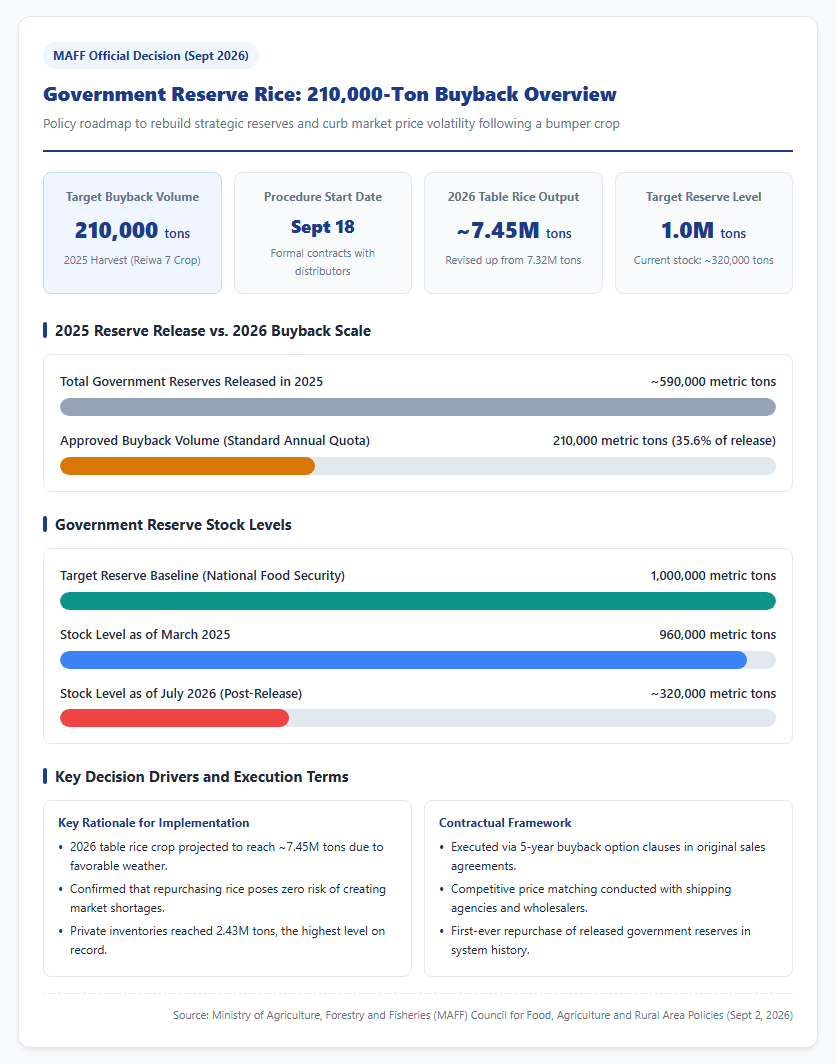
Key highlights of the buyback initiative include:
– The target volume is 210,000 metric tons out of the approximately 590,000 metric tons released in 2025, matching the standard annual government procurement quota.
– The process will be conducted through competitive price matching based on contracts that include a buyback option clause valid within five years of sale.
– The decision was made after confirming that the 2026 table rice harvest is projected to increase to around 7.45 million metric tons, eliminating concerns over potential market supply shortages.
This marks the first time since the establishment of the government reserve system that the state will repurchase rice previously released into the commercial market. While MAFF aims to systematically restore strategic reserves without causing market deficits, industry observers are closely watching the psychological impact on market sentiment and future price trajectories.
How the Government Reserve System Works and the Target of 1 Million Tons
Established under the Staples Supply Act of 1995 following the 1993 Heisei Rice Crisis, the government reserve rice program is designed to safeguard the nation against severe supply disruptions caused by crop failures or extreme weather. The ideal reserve target is set at approximately 1 million metric tons—a volume deemed sufficient to handle a once-in-a-decade severe failure or two consecutive years of moderate crop damage using domestic stocks alone.
In normal times, the system operates under a reserve shelf mechanism, wherein the government purchases roughly 200,000 metric tons of new rice annually, stores it for about five years, and then sells it for non-staple uses such as livestock feed. However, to combat surging rice prices and acute distribution shortages between 2024 and 2025, the government released a record total of approximately 590,000 metric tons of stockpiled rice into the commercial market starting in March 2025.
As a result of this massive release, government stockpiles plunged from 960,000 metric tons at the end of March 2025 to approximately 320,000 metric tons by July 2026. Step-by-step restoration of reserves to the designated 1-million-ton baseline has become an urgent national food security priority, with this 210,000-ton repurchase representing the initial phase of recovery.
Market Shift from Scarcity to Oversupply and Underlying Drivers
The Reiwa Rice Panic and Record-High Private Inventories
From summer 2024 through early 2025, Japan experienced the Reiwa Rice Panic, characterized by widespread supermarket shortages and soaring retail prices. Retail prices spiked above 4,000 yen per 5 kg bag, placing a heavy financial strain on households. In response, farmers expanded their acreage for table rice, and favorable growing weather subsequently led to a rapid recovery in supply.
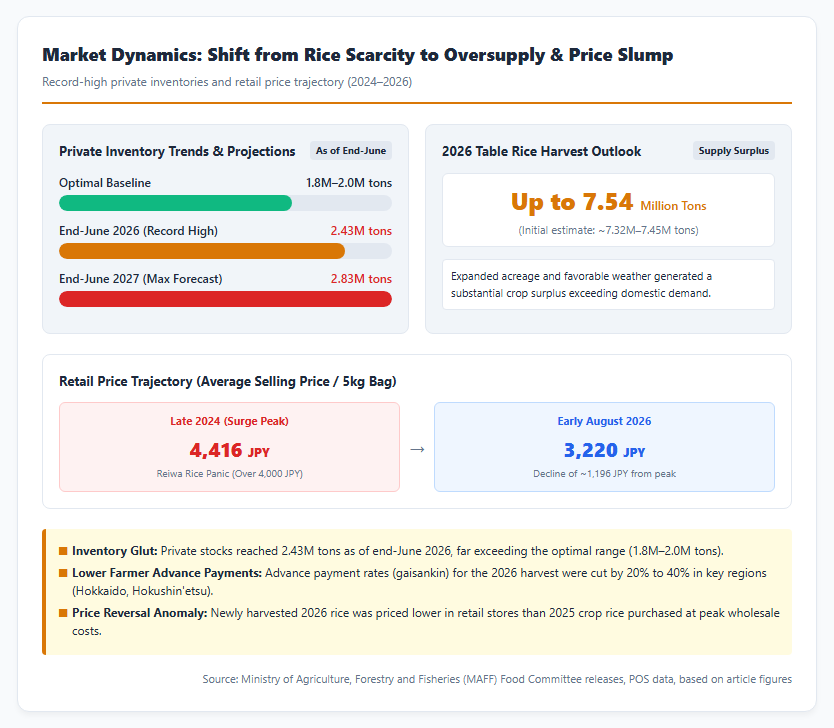
However, this dramatic swing pushed the market’s supply-demand balance into a significant surplus. According to MAFF data, private inventories reached 2.43 million metric tons at the end of June 2026, marking the highest level on record since tracking began. This far exceeds the industry’s ideal benchmark of 1.8 million to 2.0 million metric tons, with forecasts indicating that private stocks could reach up to 2.83 million metric tons by the end of June 2027.
Several key factors contributed to this shift:
– Soaring prices led consumers to curb purchases or switch to alternative staple grains, resulting in lower retail sales volumes despite increased shipments from farms.
– The 2026 table rice crop is projected to reach up to 7.54 million metric tons, far surpassing anticipated consumer demand and creating a substantial supply glut.
– Distributors are facing an inventory backlog, struggling to sell older stocks acquired at peak wholesale prices just as the new harvest arrives.
This sharp 180-degree turn from severe shortage to acute oversupply within just one to two years forms the core background of the government’s latest policy decision.
Fears of Price Plunges and Growing Alarm Among Farmers and JA
The surge in private inventory combined with forecasts of a bumper crop in 2026 ignited widespread fears of a collapse in rice prices across agricultural and distribution sectors. In August 2026, when the JA Group announced its advance payment rates (gaisankin) to farmers for the new harvest, major producing regions such as Hokkaido and Hokushin’etsu slashed rates by 20% to 40% compared to the previous year.
Retail prices have also registered unusual anomalies. After peaking at a record high of 4,416 yen per 5 kg bag at the end of 2024, average retail prices steadily declined, falling to 3,220 yen by early August 2026. In some supermarkets, a price reversal occurred where newly harvested 2026 rice was priced lower than 2025 crop rice purchased earlier at inflated wholesale rates.
With production costs for fertilizer, fuel, and farm machinery continuing to rise, a sharp drop in grain prices poses a direct threat to the financial viability of farming operations. In response, major producing regions including JA Zen-Noh and Niigata Prefecture, alongside the Liberal Democratic Party’s agricultural committee, issued urgent resolutions calling on the government to initiate an early buyback of released reserves to tighten supply and stabilize prices.
Policy Impacts, Debates, and Future Outlook
Floor-Price Support Effects vs. Consumer Household Concerns
By purchasing 210,000 metric tons of commercial rice from the private sector, the government buyback effectively absorbs market supply, serving as a theoretical floor to curb further price declines. Agricultural organizations, including JA, welcomed the decision, expressing hopes that it would tighten market liquidity and halt the downward price spiral.
However, the policy has sparked intense debate and policy dilemmas. Former MAFF officials and economic analysts criticize the move, arguing that releasing reserves when prices are high and repurchasing them when prices drop amounts to artificial government price manipulation. Conversely, consumers and restaurant operators struggling with broader inflation fear that the intervention will stall much-needed relief in food prices.
Key points of debate include:
– Analysts note that a 210,000-ton buyback is relatively modest compared to the massive 2.43-million-ton private inventory, suggesting its ability to spark a major price rebound may be limited.
– Restricting price declines may deprive consumers of affordable food options, creating a contradiction between agricultural support policies and broader anti-inflation measures.
– Critics contend that heavy state intervention as both a major seller and buyer distorts natural market price discovery.
Medium-to-Long-Term Outlook Under the Revised Food Act
Following this buyback decision and recent market volatility, Japanese agricultural policy stands at a historic crossroads. On July 8, 2026, Japan passed the Revised Food Act—the first major overhaul of its staple food law in nearly 30 years. The revision formally eliminated legacy production adjustment (acreage reduction or gentan) provisions premised on declining demand, shifting the policy focus toward market-driven production aligned with actual consumer demand.
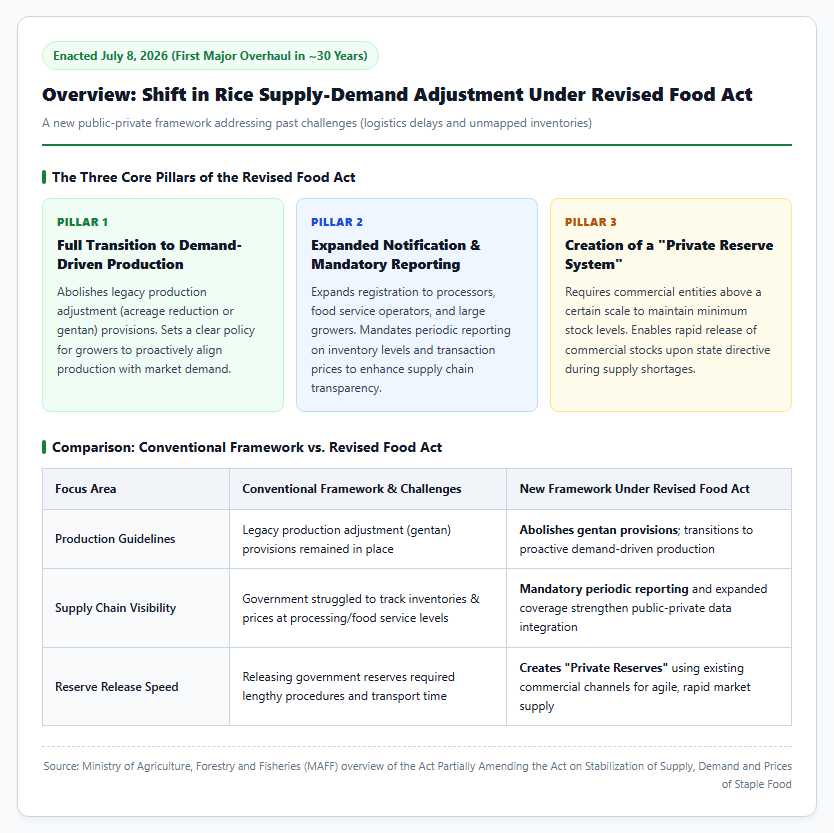
The Revised Food Act mandates regular inventory and price reporting from processors, wholesalers, and food service operators to enhance supply chain transparency. It also establishes a Private Reserve System allowing the state to quickly mobilize commercial stocks during supply shocks. Addressing logistics delays highlighted during the 2025 reserve release, the government is moving toward a more agile, public-private supply-demand stabilization framework.
Key points to watch moving forward include:
– The progress of buyback procedures starting September 18, 2026, and their immediate impact on new crop retail prices and farmer advance payments.
– How long private inventory accumulation persists, and whether voluntary, demand-driven production adjustments take root among growers.
– The concrete implementation of regulations under the Revised Food Act enacted in July 2026, particularly regarding mandatory reporting and private reserve benchmarks.
As Japan seeks to balance food security, price stability, and the interests of both producers and consumers, the evolution of market dynamics and government policy will remain a critical focus area.
Reference Pages
- [Ministry of Agriculture, Forestry and Fisheries] Overview of Buyback-Option Sales of Government Reserve Rice
政府備蓄米の買戻し条件付売渡しについて:農林水産省www.maff.go.jp - [Ministry of Agriculture, Forestry and Fisheries] About the Rice Reserve System
備蓄米制度(びちくまいせいど)について教えてください。:農林水産省www.maff.go.jp - [Ministry of Agriculture, Forestry and Fisheries] Summary of the Bill to Partially Amend the Act on Stabilization of Supply, Demand and Prices of Staple Food
https://www.maff.go.jp/j/law/bill/attach/pdf/221-42.pdf


【#GovernmentReserveRice #MAFF #RicePrices #FoodAct #FoodSecurity】

コメント