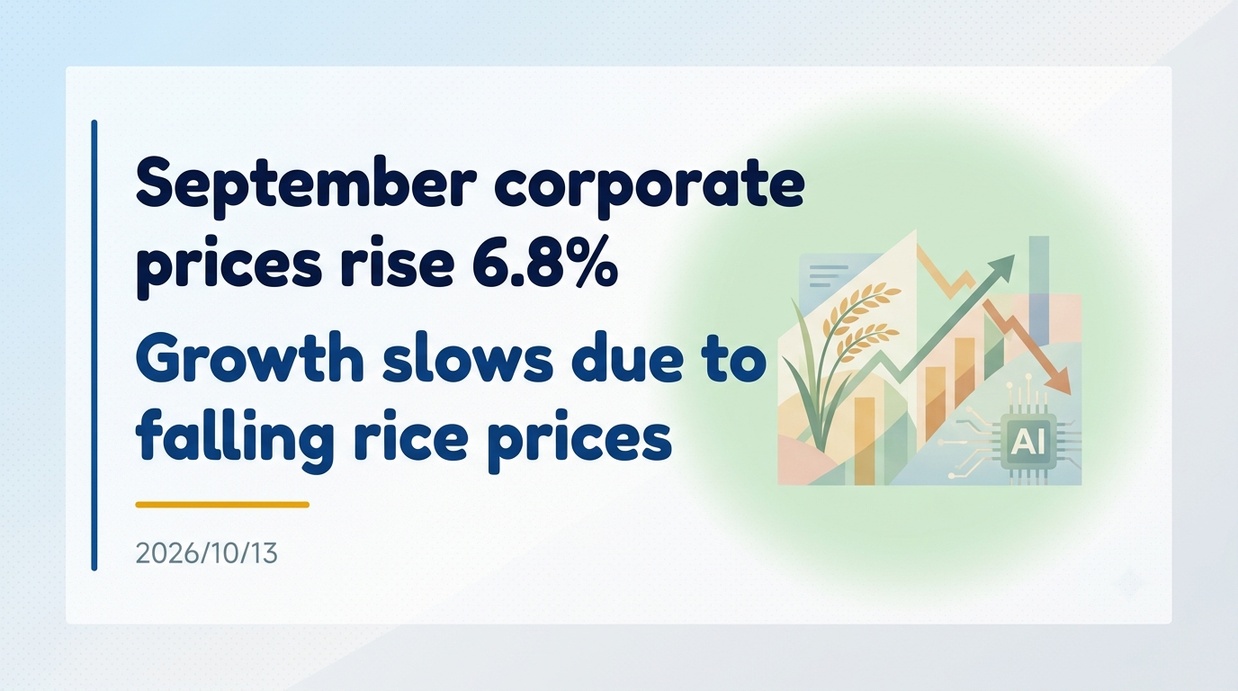
The Domestic Corporate Goods Price Index for September 2026 released by the Bank of Japan rose 6.8% from the same month last year to 135.7, narrowing its rate of increase from the 7.6% growth recorded in the previous month. Behind this are falling rice prices accompanying the distribution of newly harvested rice and a lull in the yen’s appreciation and high resource prices; however, upward pressure driven by AI-related demand and stubbornly high energy prices remains persistently strong.
- Key point of the event: September corporate goods price index slows to 6.8% increase
- Decline in Rice Prices and Sharp Drop in the Agriculture, Forestry, and Fisheries Category
- Rapid Expansion of AI Demand and Surge in Non-Ferrous Metals and Information/Communication Equipment
- Persistent High Crude Oil Prices and Their Spillover into Chemical and Plastic Products
- Speculation Over Additional BOJ Rate Hikes and the September Monetary Policy Meeting
- Future Outlook and Key Points: Spillover to Consumer Prices and Policy Decisions
Key point of the event: September corporate goods price index slows to 6.8% increase
According to the Domestic Corporate Goods Price Index (2020 average = 100, preliminary figures) for September 2026 released by the Bank of Japan on October 13, 2026, the index stood at 135.7, a 6.8% increase compared to the same month of the previous year. The growth rate narrowed by 0.8 points from the previous month’s revised figure of 7.6% for August 2026, falling below the median market expectation of 7.6%. On a month-on-month basis, the index declined by 0.3%, marking a negative trend for the second consecutive month. In this index, which indicates the overall prices of goods traded among corporations, approximately 90%—or 460 out of the 515 surveyed items—increased compared to the same period last year, showing that the trend of high price persistence continues.
The main factors behind the current slowdown include the decline in imported raw material costs driven by the recent appreciation of the yen, and the stabilization of the soaring crude oil and energy markets. However, corporate goods prices stand at 135.7 relative to the base year—a historically high level that highlights the deep-seated nature of the upward cost pressures accumulated since 2020. The following graph shows the trends in the Domestic Corporate Goods Price Index and changes in its major components over the past few years.
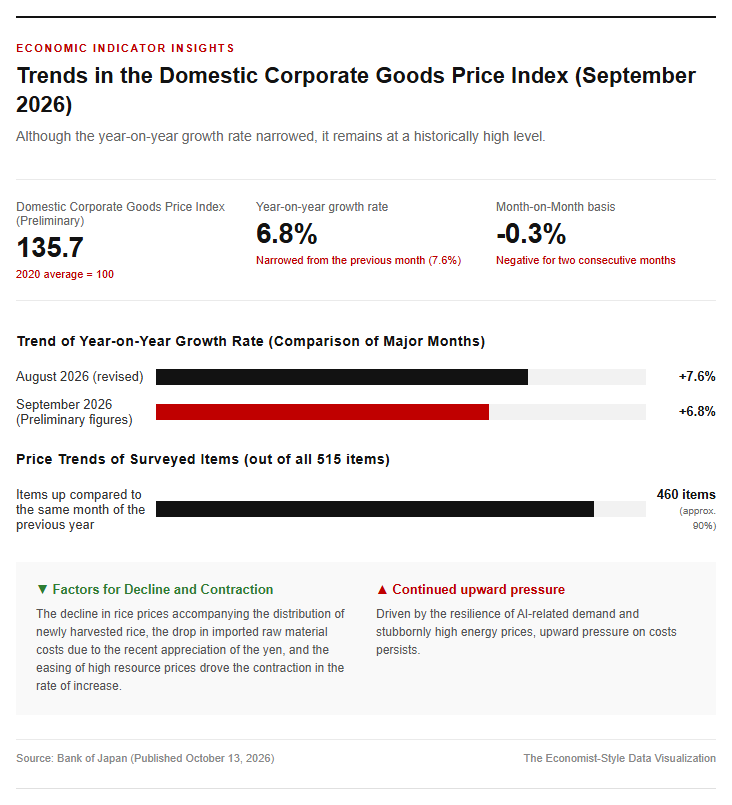
The slowdown in corporate goods price growth suggests that intense cost-push inflation may be peaking, while price pass-through to downstream goods continues to progress steadily.
Decline in Rice Prices and Sharp Drop in the Agriculture, Forestry, and Fisheries Category
In the Domestic Corporate Goods Price Index for September, a major factor that significantly pushed down the overall growth rate was the sharp drop in the agriculture, forestry, and fishery products category. The agriculture, forestry, and fishery products category fell 13.3% year-on-year (and dropped 8.8% month-on-month), recording the largest downward contribution among all categories (a month-on-month contribution of -0.42 percentage points). Specifically, the prices of rice items such as brown rice and polished rice have dropped significantly. The direct background for this is that, in addition to the reactionary effect (base effect) of soaring rice prices associated with extreme heat and supply concerns during the same period of the previous year, the tightness in supply and demand has eased as newly harvested rice from the 2026 crop has begun to successively circulate in the market.
The decline in rice prices, which had been a symbol of food inflation, has the effect of easing the procurement cost burden on related food and beverage manufacturers and the restaurant industry. At major convenience store chains, moves have been seen to sequentially lower prices on some rice ball products starting in early autumn, and it has also been pointed out that this could potentially lead to stable menu prices or partial price reductions at restaurant chains.
However, there is a limit to the share of rice spending within fresh foods and raw materials as a whole, and price revisions reflecting rising labor and logistics costs continue for other general foodstuffs and seasonings. In terms of consumer psychology, close attention is being paid to whether a drop in the price of frequently purchased rice will bring about the psychological effect of easing the entrenched mindset of rising prices.
Factors Driving Up Prices and Corporate Price Pass-Through
Rapid Expansion of AI Demand and Surge in Non-Ferrous Metals and Information/Communication Equipment
Although the overall growth rate has decelerated, the soaring prices of materials and equipment in specific sectors, driven by the expansion of global artificial intelligence (AI) demand, maintain an extremely strong momentum. According to September’s itemized data, “non-ferrous metals” surged 40.2% year-on-year, fueled by a sharp increase in copper demand stemming from the construction of AI data centers and the expansion of power cables and electrical facilities. In addition, “information and communication equipment,” supported by demand for data servers and high-performance semiconductors, increased by 15.3% year-on-year, and “electrical equipment” also rose by 5.1%, with IT and digital-related goods serving as a powerful driving force behind rising prices.
In the export price index (contract currency basis), electrical and electronic equipment also rose by 1.4% month-on-month (contributing +0.80%), with notable price surges in MOS-type memory integrated circuits and industrial instruments. As analyzed in the Bank of Japan’s Outlook Report and elsewhere, the global AI investment boom is not merely a temporary market fluctuation; rather, it is acting as a structural demand shock that directly drives up domestic producer prices through global supply chains for copper, rare metals, electronic components, and other materials.
The figure below provides a conceptual summary of the transmission channels through which the expansion of global AI demand affects the prices of major domestic manufacturers and related materials.
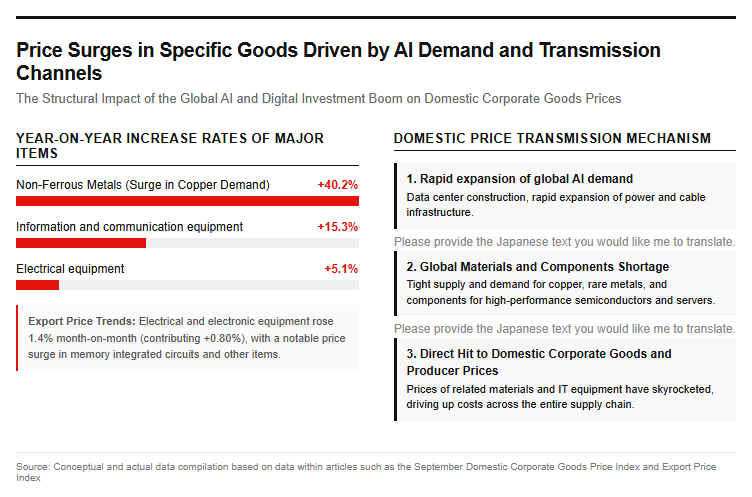
Thus, even as energy prices show signs of settling, structural material cost hikes in the high-tech sector are strongly propping up business-to-business transaction prices.
Persistent High Crude Oil Prices and Their Spillover into Chemical and Plastic Products
In the energy and raw materials markets, while the volatility of naphtha and crude oil prices—which surged earlier this spring amid escalating tensions in the Middle East—has subsided compared to some time ago, they continue to remain at stubbornly high levels. Consequently, high raw material costs generated at the upstream level are continuing to ripple through with a time lag to intermediate and final goods (midstream and downstream levels), such as chemical and plastic products. According to the September Corporate Goods Price Index, “chemical products” increased by 13.3% and “plastic products” rose by 12.8% year-on-year, confirming price hikes across a broad range of items including plastic containers and resin parts for transportation equipment.
Chemical manufacturers are reviewing formula contracts and introducing various surcharges in response to rising raw material prices and transportation costs, passing on costs at a faster pace than ever before. The import price index (on a yen basis) remains at a high level, rising 24.5% year-on-year, with the burden of overseas import costs—centered on petroleum, coal, and natural gas (up 43.6% year-on-year)—weighing heavily.
Plastic products and packaging materials are used extensively across all kinds of industries, ranging from food processing, daily goods, and general manufacturing to logistics materials. Rising costs for these various materials carry the risk of eventually being broadly passed on to the retail prices of a wide variety of processed foods and daily necessities purchased by consumers.
Monetary Policy and the Medium- to Long-Term Economic Outlook
Speculation Over Additional BOJ Rate Hikes and the September Monetary Policy Meeting
Although the corporate goods price inflation rate in September slowed to 6.8%, it remains at a historically high level, meaning that expectations in financial markets for an additional rate hike by the Bank of Japan remain firmly entrenched. At the Monetary Policy Meeting held on September 17 and 18, 2026, the BOJ decided to raise the policy interest rate, the uncollateralized overnight call rate, by 0.25 percentage points to 1.25%. The interval since the previous rate hike at the June 2026 meeting was about three months, showing that the pace of policy change is accelerating from the conventional six-month pace.
In a press conference, Governor Kazuo Ueda clearly indicated his recognition that “the policy phase has changed,” citing upward pressure on corporate goods prices driven by rising crude oil prices and expanding AI demand, as well as increasingly proactive price-setting behavior. Because real interest rates remain in negative territory and financial conditions are sufficiently accommodative, the BOJ is wary of the risk that inflation will become entrenched and overshoot the 2% target.
Market participants are focusing on whether the outlook for the underlying inflation rate will be upwardly revised in the “Outlook for Economic Activity and Prices” (Outlook Report) to be released at the Monetary Policy Meeting in late October 2026. As for the timing of the next rate hike, the December 2026 meeting—marking three months since the previous rate hike—is seen as a strong possibility, with the prevailing view being that the policy interest rate will be raised to around 1.50%.
Future Outlook and Key Points: Spillover to Consumer Prices and Policy Decisions
The key point of focus when forecasting the future Japanese economy and price trends is to what extent the upward price pressure—which has remained confined to the corporate goods price level—will ripple through to consumer prices (CPI), and what impact this will have on private consumption and real wages. Up until now, government cushioning measures against soaring electricity and gas bills and fuel oil have kept the growth rate of consumer prices (excluding fresh food) suppressed in the mid-1% to around 2% range. However, due to the reduction or abolition of supplementary budgets and subsidies, as well as the progressing pass-through to plastic materials and various service prices, concerns are growing over a scenario in which the CPI will accelerate toward nearly 3% again from the latter half of fiscal 2026 onward.
From the perspective of corporate behavior, following the realization of solid wage increases in the 2026 spring labor talks, a “virtuous cycle of wages and prices”—in which rising labor and logistics costs are appropriately passed on to selling prices—is taking root. On the other hand, how the decline in prices of certain food items, symbolized by falling rice prices, will impact the long-standing consumer mindset of “accepting price hikes” will also be a crucial point to watch.
Key factors in future policy decisions will be the depreciation of the yen in the foreign exchange market, the volatility of international commodity markets driven by the situation in the Middle East, and the policy distance from the fiscal and monetary policies under the Takaichi administration. Domestic and foreign market participants are closely watching at what pace the Bank of Japan will proceed with monetary normalization while balancing the achievement of its price stability target with the maintenance of economic growth.
Reference Page
- [Bank of Japan] Corporate Goods Price Index (September 2026 Preliminary)
[suspicious link removed]
[#CorporateGoodsPriceIndex #BankOfJapan #Inflation #MonetaryPolicy #InterestRateHike #RicePrices #HighCrudeOilPrices #AIDemand]

コメント