Micron Technology’s latest financial results demonstrated astonishingly high profitability, alongside an outlook indicating that the semiconductor memory shortage will be prolonged until 2028. This is driven by an explosive surge in demand for High Bandwidth Memory (HBM) for AI servers and the physical limits of global production capacity.
- Record-High Gross Profit Margin of 86.25% and Severe Supply Shortage Lasting Until 2028
- Structural Bottlenecks Caused by the Surge in AI Server Demand and Priority Production of HBM
- The Market Share Battle Among the Three Major Memory Manufacturers and the Rise of Micron
- The Impact on Supply Caused by Capital Investment Barriers and Restrictions on Chinese Manufacturers
- Wall Street’s Bullish Forecasts and the Shift in Market Valuation Driven by Shareholder Return Policies
- The Endless Semiconductor Supercycle: Future Outlook and Risks to Monitor
Record-High Gross Profit Margin of 86.25% and Severe Supply Shortage Lasting Until 2028
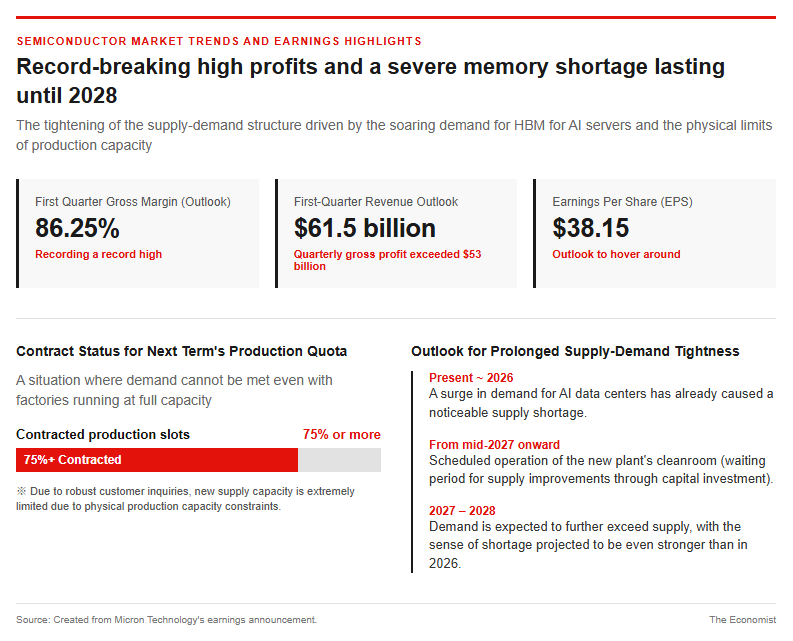
The financial results announced by major U.S. semiconductor company Micron Technology vividly demonstrated to the market the severity of the global memory shortage and the company’s record-breaking profitability. The company announced a first-quarter revenue forecast of $61.5 billion and stated that its gross margin will reach a record 86.25%. As a result, quarterly gross profit is projected to exceed $53 billion, with earnings per share (EPS) expected to reach around $38.15. Behind this phenomenal performance is the booming construction of artificial intelligence (AI) data centers heating up around the world. However, the future outlook revealed by CEO Sanjay Mehrotra was grim for client companies. The company projects that in 2027 and 2028, memory demand will further exceed supply, and the sense of shortage will become even more severe than in 2026. Over 75% of next fiscal year’s production slots are already filled by contracts, and even with factories running at full capacity, the situation persists where customer demand cannot be met. The operation of clean rooms in new plants through capital investments will have to wait until mid-2027 or later, and there is no clear path to resolving this structural over-demand in either the short or medium term. Please refer to the figure below.
Structural Bottlenecks Caused by the Surge in AI Server Demand and Priority Production of HBM
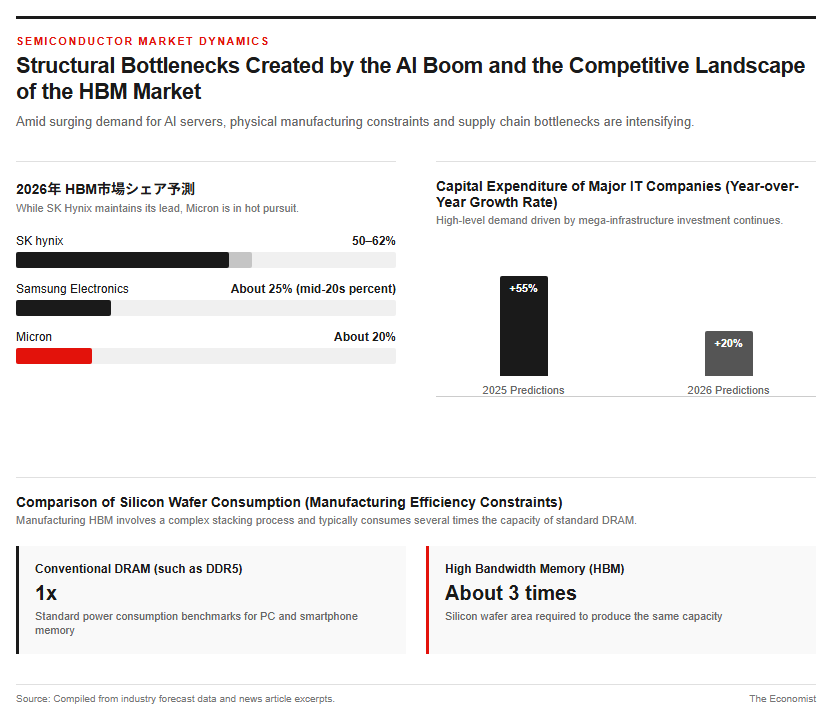
The primary cause of the historic supply-demand gap currently underway in the memory market is the concentration of demand on High Bandwidth Memory (HBM), which is essential for AI computing. Large amounts of HBM are indispensable for the latest AI chips provided by GPU makers such as NVIDIA, and the secured volume of HBM directly serves as a bottleneck that determines the shipment volume of AI servers. Manufacturing HBM requires approximately three times the silicon wafer area compared to conventional DRAM (such as DDR5). Consequently, major memory makers are preferentially expanding and adding production lines for highly profitable HBM, resulting in a phenomenon where the production capacity for standard DRAM and NAND flash memory—supplied for regular PCs, smartphones, and various consumer products—is being squeezed. Mega-infrastructure investments by major cloud providers and emerging neo-cloud companies (such as OpenAI, Oracle, and CoreWeave) show no signs of slowing down, with projections indicating that major IT companies’ capital expenditures will increase by 55% year-over-year in 2025 and remain at high levels with another 20% increase in 2026. Amidst the successive emergence of advanced packaging technologies and memory bandwidth limitations as bottlenecks, the memory supply shortage is developing into a structural issue affecting not only the AI-related market but the entire IT industry.
Shifts in the Competitive Landscape of the Global Semiconductor and HBM Markets
The Market Share Battle Among the Three Major Memory Manufacturers and the Rise of Micron
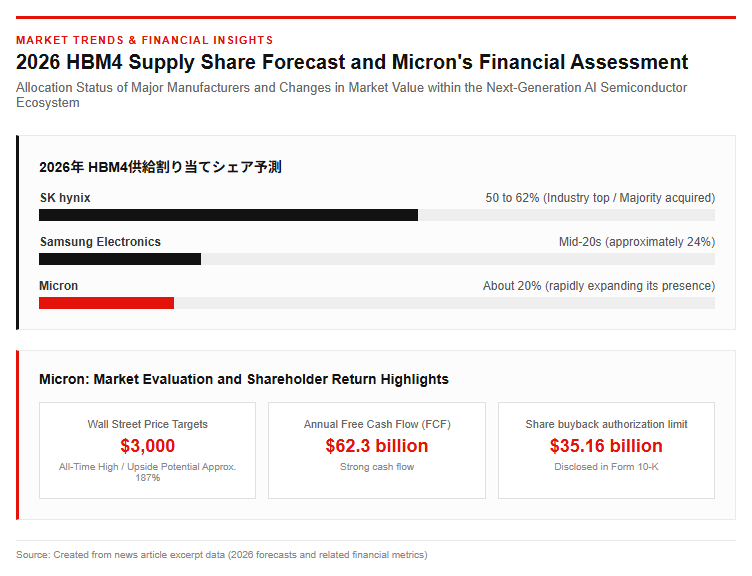
The global HBM market is dominated by three major players: South Korea’s SK Hynix, Samsung Electronics, and U.S.-based Micron. According to market share forecasts for 2026, SK Hynix is leading the industry by a wide margin with a 50–62% share, and has also secured the majority of supply allocations for NVIDIA’s next-generation HBM4 standard. However, the biggest surprise in this cycle is that Micron has surpassed its rival Samsung Electronics in certain supply allocations, rapidly increasing its presence. Micron secured about a 20% allocation of the HBM4 supply quota, gaining a share close to that of Samsung Electronics (in the mid-20% range). Compared to the conventional HBM3E, HBM4 doubles the interface width to 2,048 bits, and the transfer speed per stack surges to 1.5–2 TB/s. Micron has begun providing samples reaching up to 11 Gbps, enhancing its reputation in both technological development and supply track record. Although Micron has traditionally tended to be viewed as “just a memory maker,” it has successfully established an indispensable positioning as a core part of the AI semiconductor ecosystem. Please refer to the figure below.
The Impact on Supply Caused by Capital Investment Barriers and Restrictions on Chinese Manufacturers
To address the chronic memory shortage, manufacturers are making massive capital investments to increase production, but a sudden surge in supply remains difficult. The average days of inventory for products among major DRAM manufacturers has fallen to just around 3 weeks, leaving a state where virtually no buffer exists. In past supply and demand cycles, large-scale expansions by major Chinese DRAM makers such as CXMT were factors that triggered price drops. However, today, the U.S.’s tightened export controls on advanced semiconductor manufacturing equipment to China have significantly limited CXMT’s ability to expand production capacity. The company’s monthly production capacity has been revised downward from the initially projected 300K/M to around 280K/M, and the pace of production increase has slowed remarkably. Furthermore, constructing a single cutting-edge semiconductor fabrication plant (fab) requires massive funds on the scale of $20 billion and several years of time, making it impossible to quickly catch up with demand. In addition, geopolitical risks such as tightened export controls by the U.S., Japan, and the Netherlands are compounding the situation, making supply constraints in the global semiconductor supply chain an unavoidable factor for the long term.
Impact on Corporate Performance and Market Value, and Future Outlook
Wall Street’s Bullish Forecasts and the Shift in Market Valuation Driven by Shareholder Return Policies
Driven by Micron’s historic stellar earnings and outlook for supply shortages, the financial market’s valuation of the company is undergoing a dramatic shift. Analysts at a major investment bank maintained their “buy” rating on Micron while significantly raising their price target from the previous $2,100 to a Wall Street-high of $3,000. This suggests an upside potential of approximately 187% compared to the most recent stock price, further fueling the momentum of a stock that has risen more than 260% year-to-date. Market participants point out that “as AI models become more sophisticated, the importance of memory capacity and bandwidth is increasing, and investors have not yet fully and correctly priced in Micron’s intrinsic corporate value.” Furthermore, the company disclosed in its Form 10-K (annual report) filed in October 2026 that it has expanded its share buyback authorization limit to $35.16 billion. Backed by abundant free cash flow (FCF) reaching $62.3 billion annually, this robust shareholder return policy is being welcomed by the market as evidence of a transition from the traditional, highly volatile stock structure at the mercy of the silicon cycle into a stable, high-margin enterprise. Please refer to the figure below.
The Endless Semiconductor Supercycle: Future Outlook and Risks to Monitor
The semiconductor supercycle, arriving roughly a decade after the cloud expansion boom of 2016, has entered a new phase that transcends traditional cyclical demand fluctuations. With an increasing number of long-term customer contracts incorporating price floors, a stable revenue structure is taking shape that allows manufacturers to maintain high profit margins even during downturns in memory prices. Looking ahead, attention is focused on the risk that surging demand for AI servers could trigger price increases and shortages in consumer products like PCs and smartphones, driving up costs across the broader industry. The rising prices of general-consumer products such as DDR5 memory are already notable, raising concerns that this could increase the burden on end-users and curb PC shipments. At the same time, uncertainties that could alter the supply-demand balance remain, including the technological catch-up of Chinese manufacturers like CXMT and the timing of future capital expenditure adjustments by Big Tech. For the time being, assuming supply shortages will persist beyond 2027, it is crucial to carefully evaluate the sustainability of AI demand and its cost ripple effects across the entire supply chain.
Reference page
- 【Tom’s Hardware】https://www.tomshardware.com/pc-components/dram/micron-projects-tightening-ram-shortages-through-2028-as-it-generates-record-profit-record-86-25-percent-gross-margin-drives-over-usd53-billion-in-quarterly-profit
[#Micron #Semiconductors #HBM #AIServers #FinancialResults #StockInvesting]


コメント