
Bank of Japan Governor Kazuo Ueda indicated that the underlying inflation rate is approaching the 2% price stability target, and implemented an interest rate hike. This move is backed by the strengthening of the virtuous cycle between wages and prices, as well as the need for preemptive adjustments against upside risks to inflation.
- Key takeaways: Underlying inflation approaches 2% and the decision to raise interest rates
- A Multi-Faceted Approach to Measuring Underlying Price Trends and Assessment of the Current Situation
- Shift in Policy Framework: The Background of the “Phase Change” Toward Goal Achievement
- The Degree of Easing in Financial Conditions and Criteria for Additional Rate Hikes
- Impact on Households and Businesses, and Challenges in the Virtuous Cycle of Wages and Prices
- Future Outlook and Key Points: Reaching the Neutral Rate and Risk Factors
Key takeaways: Underlying inflation approaches 2% and the decision to raise interest rates
At its Monetary Policy Meeting, the Bank of Japan decided to raise the target for the uncollateralized overnight call rate to around 1.25%. Previously, it had encouraged the rate to remain at around 1.0%, but it made the decision to appropriately adjust the degree of monetary easing from the perspective of sustainably and stably achieving the 2% price stability target. In a press conference and submitted materials, Governor Kazuo Ueda emphasized that the underlying inflation rate is progressing steadily toward the 2% target. In addition to high growth in domestic corporate goods prices, this upward price pressure is gradually beginning to ripple through to the consumer stage, and medium- to long-term inflation expectations are also maintaining an upward trend. Furthermore, while the economy is supported by an increase in global AI-related demand and improvements in the employment and income environment—despite downward pressures such as the rise in crude oil prices since early spring—Japan’s economy as a whole continues on a moderate recovery trend. Under these circumstances, if the conventional accommodative financial environment were to be maintained as is, there would be a risk that underlying prices would overshoot above 2%, thus demonstrating a stance to proceed with early interest rate adjustments. Please refer to the figure below.
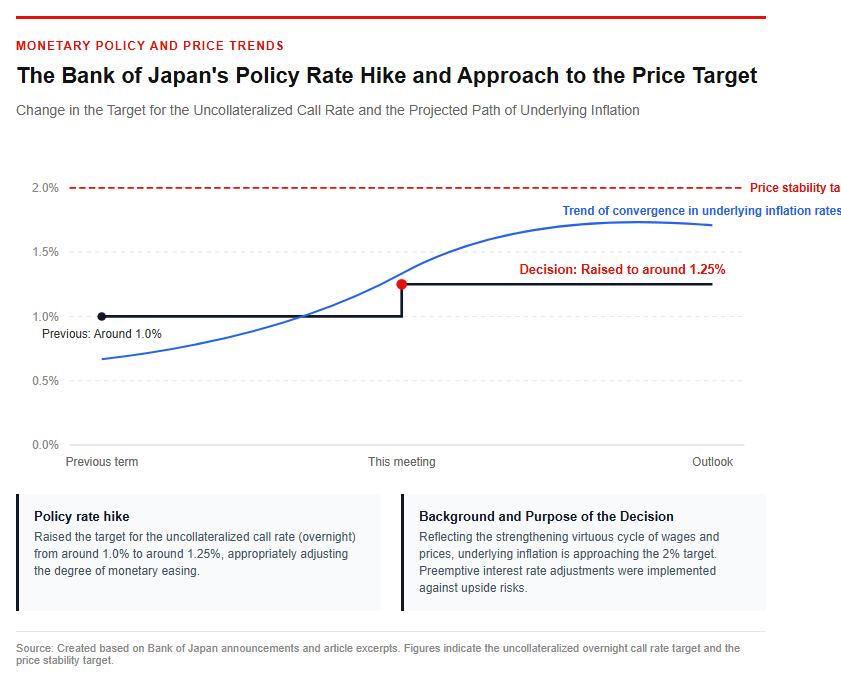
A Multi-Faceted Approach to Measuring Underlying Price Trends and Assessment of the Current Situation
To appropriately forecast future price trends, it is extremely important to assess the underlying trend of prices by excluding the effects of temporary price fluctuations such as raw material prices and energy. The Bank of Japan captures underlying inflation through three main approaches: focusing on low-volatility items less susceptible to temporary factors and service prices with a high labor cost ratio; aggregating expected inflation rates targeting households, corporations, and experts; and estimating trend inflation rates using economic models. While the impact of external shocks, such as food and energy, is diminishing, sustained upward pressure on prices centered on the interrelationship between wage increases and price pass-through is intensifying. Specifically, estimates from various economic models, such as time-varying VAR models and semi-structural models, confirm that trend inflation is gradually rising toward 2 percent. These comprehensive analytical results strongly support the view that Japan’s underlying inflation is increasing, serving as a crucial rationale for justifying the Bank of Japan’s shift toward normalizing monetary policy.
Shift in Monetary Policy Phases and the Background of Accelerated Rate Hikes
Shift in Policy Framework: The Background of the “Phase Change” Toward Goal Achievement
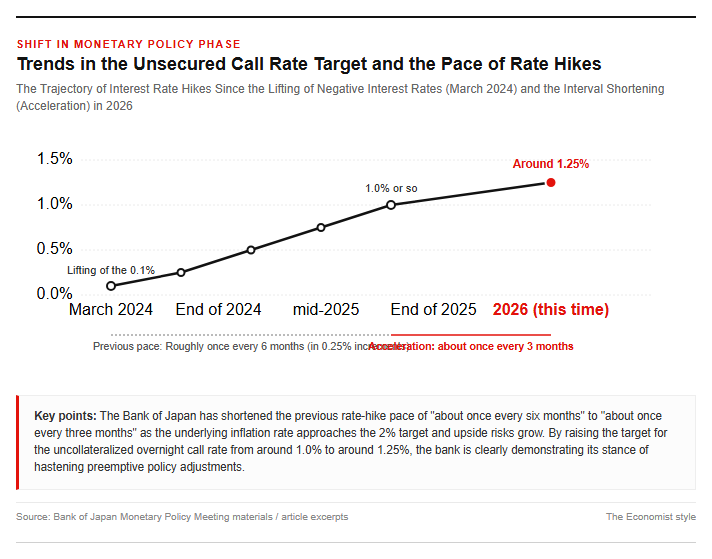
This monetary adjustment represents a major “phase shift” in the context of conventional monetary policy. Since the Bank of Japan stepped toward normalization by lifting the negative interest rate policy in March 2024, rate hikes have been implemented gradually at a pace of 0.25 percentage points roughly once every six months. However, the shortening of the rate hike interval to three months entering 2026 indicates that the pace of policy execution is clearly accelerating. Up to this point, rate hikes have been a process of correcting excessively low interest rate levels while increasing the certainty that the underlying inflation rate will rise toward 2%. However, now that we have reached the stage where the underlying inflation rate actually reaches 2%, continuing to maintain easing at the same pace as before increases the risk that prices will overshoot the target and rise excessively. Consequently, as a “preventive measure” to preemptively ward off upside risks, it has become necessary to accelerate the adjustment speed of monetary easing. This strategic pivot goes beyond a mere adjustment of interest rate levels and is an indispensable step for ensuring sustainable economic growth while cementing the price target. Please take a look at the structural diagram below.
The Degree of Easing in Financial Conditions and Criteria for Additional Rate Hikes
A newly emphasized concept by the Bank of Japan (BOJ) in determining additional policy rate hikes is the state of the “financial environment.” Financial conditions refer to a comprehensive concept that includes not only interest rate levels such as policy rates and long-term interest rates, but also the lending posture of banks and the conditions of asset markets as a whole, including stock prices and exchange rates. Even after raising the policy rate to 1.25%, corporate demand for funds remains robust and financial institutions maintain an active lending attitude, meaning that Japan’s financial environment remains in a sufficiently accommodative state. Even if the underlying inflation rate stabilizes near 2%, if the overall financial environment is overly accommodative, it risks continuing to provide excessive stimulus to the economy and triggering a resurgence of inflation. Since the wealth effect from higher stock prices and the increased availability of funds from a weaker yen also bring about a substantial easing effect, the BOJ is comprehensively reviewing these factors. Therefore, even after the policy rate is raised to the level considered to be the neutral rate, further rate hikes may be considered from the perspective of neutralizing the financial environment.
Macroeconomic Impact and Future Outlook
Impact on Households and Businesses, and Challenges in the Virtuous Cycle of Wages and Prices
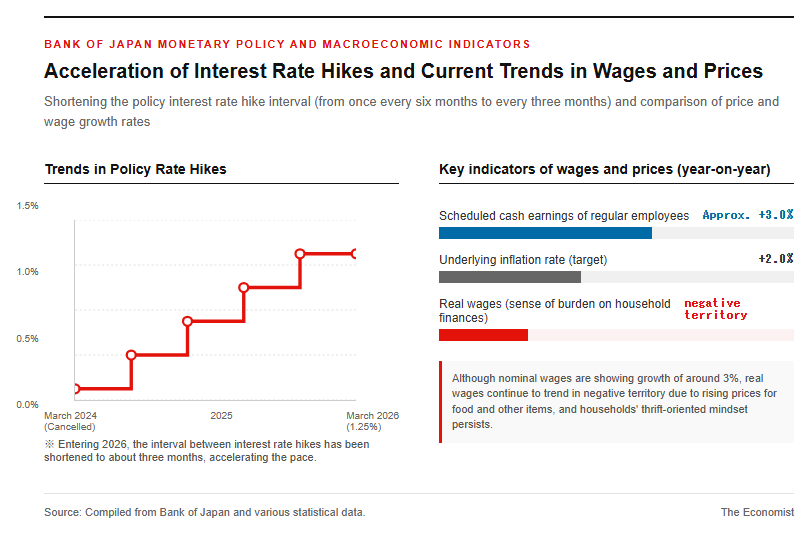
While the implementation of interest rate hikes will have diverse impacts on the real economy, the ultimate key is whether a virtuous cycle of wages and prices can be maintained, particularly in the household and corporate sectors. Nominal wages are trending upward year-on-year, with the growth of scheduled earnings for general workers reaching around the 3% level, coming into a range consistent with the inflation target. However, because prices for fresh food, such as rice, and daily necessities continue to rise, real wages—adjusted for price increases—often remain in negative territory, and households’ inclination to save remains strong. Particularly among low-income and child-rearing households, the burden of groceries and daily necessities is heavy, leading to a worsened perception of economic conditions. In the corporate sector, while wage hikes are spreading against the backdrop of a historic labor shortage, the challenge for small and medium-sized enterprises is whether they can create added value, improve labor productivity, and appropriately pass on rising labor costs to prices. There is a strong demand to strengthen a positive cycle in which wage increases are not merely cost increases, but lead to a sustained recovery in consumption through the expansion of purchasing power. Please refer to the following graphic showing the relevant data.
Future Outlook and Key Points: Reaching the Neutral Rate and Risk Factors
In future monetary policy management, the primary focus will be whether the underlying inflation rate settles at a level consistent with the 2% target from the latter half of fiscal 2026 through fiscal 2027. According to the BOJ’s outlook, factors such as soaring crude oil prices due to the situation in the Middle East, rising semiconductor prices driven by AI-related demand, and the weak yen trend are cited as pushing up prices in the latter half of fiscal 2026. In the market, expectations are growing that the policy rate will be raised in stages, eventually moving toward a neutral interest rate level of around 1.75%, which is considered the terminal rate. However, even greater vigilance is required regarding upside risks to prices, such as the re-acceleration of energy prices due to geopolitical risks and the amplification of imported inflation accompanying rapid foreign exchange fluctuations. At upcoming policy meetings, the BOJ plans to agilely determine the timing and pace of interest rate adjustments while verifying the probability of realizing the baseline outlook for the economy and prices, and carefully assessing developments in the Middle East and international financial markets.
Reference page
- [Bank of Japan: “Decisions Made at the September 2026 Monetary Policy Meeting”] https://www.boj.or.jp
- 【House of Councillors: “Background and Issues Surrounding the Bank of Japan’s ‘Price Stability Target'”】[suspicious link removed]
- 【Cabinet Office “2025 Japan Economic Report”】[suspicious link removed]
- [Bank of Japan: “(Box 4) How to View the ‘Underlying Trend in Inflation'”] https://www.boj.or.jp
- 【Bank of Japan Planning and Coordination Department, “Financials and Future Projections of the Bank of Japan”】https://www.boj.or.jp
【#BankofJapan #MonetaryPolicy #PriceStabilityTarget #InterestRateHike #JapaneseEconomy #InflationRate】

コメント