The Japanese government is finalizing plans to designate the recent heavy rain disaster in the Hokuriku region as a “Disaster of Extreme Severity” to cover agricultural land restoration projects. This decision is driven by the government’s assessment of the storms as part of a continuous weather system that also caused the Chiba torrential rains, aiming to alleviate the financial burden on affected local governments and accelerate recovery efforts.
- The Late August 2026 Torrential Rains and Government Designation Policy
- Assessment as a Single Continuous System and Similarities with the Chiba Rains
- National versus Local Designations and the Elevation of National Subsidies
- Special Financing and Relief Measures for Affected SMEs and Agricultural Businesses
- Leading Construction, General Contractor, and Specialty Engineering Stocks
- Road Paving, Soil Investigation, and Ground Improvement Sectors
- Rapidly Deteriorating Infrastructure and Growing Public Anxiety
- The Looming Deficit of Construction Managers and Skilled Workers by 2030
- Rebuilding Infrastructure and Livelihoods in Noto After Twin Disasters
- Multi-layered Protection through Pre-disaster Forecasts and Post-disaster Insurance
The Late August 2026 Torrential Rains and Government Designation Policy
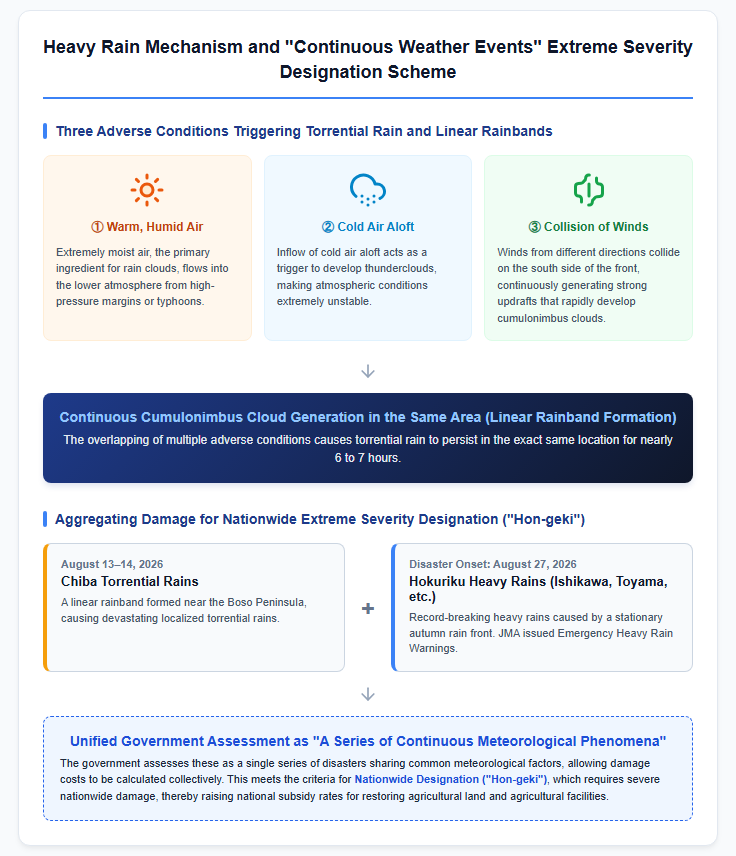
On August 27, 2026, a stationary autumn rain front combined with typhoons triggered record-breaking rainfall across the Hokuriku region, severely affecting Toyama, Ishikawa, and Fukui prefectures. On the same day, the Japan Meteorological Agency and the Ministry of Land, Infrastructure, Transport and Tourism jointly issued Level 5 emergency heavy rain warnings for several municipalities in Ishikawa and Toyama prefectures, confirming the formation of multiple linear rainbands that created life-threatening situations. In response to this crisis, Prime Minister Sanae Takaichi announced on September 4, 2026, that the government expects to designate the late-August heavy rains in Hokuriku as a “Disaster of Extreme Severity.” Specifically, agricultural land and agricultural facilities are expected to receive a “national designation” (known as hon-geki), which applies to the disaster itself regardless of the location. By receiving this designation, the national subsidy rate for disaster recovery projects implemented by local governments will be significantly increased. Alleviating the financial pressure on local governments and affected agricultural and fishery businesses is expected to rapidly advance community rebuilding and the resumption of local farming.
Assessment as a Single Continuous System and Similarities with the Chiba Rains
The government determined that the torrential rains in the Hokuriku region were part of a single, continuous meteorological system that also caused the severe Chiba torrential rains in mid-August 2026. Between August 13 and 14, 2026, a series of linear rainbands dumped catastrophic amounts of water on Chiba Prefecture, which shared identical meteorological conditions with the subsequent Hokuriku storm, including the active autumn rain front and an influx of highly humid air. Consolidating multiple heavy rain events into a single abnormal weather phenomenon allows the total estimated damage to meet the strict criteria required for a national designation of extreme severity. Weather experts have pointed out that the conditions for linear rainband formation—extremely warm, humid air in the lower atmosphere, cold air aloft, and the collision of opposing winds—were identical, occurring over the Boso Peninsula in Chiba first and then by chance over Ishikawa and Toyama prefectures. Even after the rain weakens, landslide risks remain extremely high due to saturated soil, making early evacuation decisions using real-time hazard maps essential. Please refer to the following conference materials.
The Mechanism of the Extreme Severity Disaster System and Special Financial Aid
National versus Local Designations and the Elevation of National Subsidies
The Disaster of Extreme Severity System is established under the Act on Special Financial Assistance etc. to Deal with Extreme Severity Disasters to ease the financial burden on local governments and disaster victims. There are two primary types of designations: “national designation” (hon-geki), issued when a disaster exceeds nationwide damage thresholds based on the cause of the disaster, and “local designation” (kyoku-geki), applied to specific municipalities when the damage is extremely severe relative to their financial capacity, measured by standard tax revenues. While the national designation covers all affected areas across the country and the local designation is restricted to specified municipalities, both provide identical financial assistance and subsidy rate increases for the same types of projects. Under normal circumstances, local governments receive standard national subsidies for restoring public civil engineering facilities and agricultural land, but an extreme severity designation elevates these national subsidy rates. For public civil engineering restoration, the national subsidy rate is progressively increased based on the ratio of disaster recovery costs to the municipality’s standard tax revenue. This mechanism allows even financially vulnerable municipalities to confidently initiate recovery contracts without worrying about budget deficits.
Special Financing and Relief Measures for Affected SMEs and Agricultural Businesses
Special provisions under the extreme severity designation extend beyond public infrastructure restoration to provide multifaceted financial assistance to private operators, particularly small and medium-sized enterprises (SMEs) and agricultural businesses that support local economies. For affected SMEs, the government applies special provisions for disaster-related guarantees under the Small and Medium Enterprise Credit Insurance Act. This allows businesses to secure guarantees outside of their normal credit limits, providing an additional 200 million yen for general insurance, 80 million yen for unsecured insurance, and 20 million yen for special small-sum insurance. Furthermore, the coverage rate is raised from 70% to 80%, and insurance premiums are significantly reduced to support cash flow. For affected farmers, foresters, and fishermen, the mayors of local municipalities can issue damage certificates based on crop loss or facility destruction, enabling access to special financing under the Act on Temporary Measures concerning Finance for Disaster-Stricken Farmers, Foresters, and Fishermen. This extreme severity designation raises the borrowing limits of these emergency funds and extends the repayment periods from the standard 3-to-6 years to 4-to-7 years, ensuring that local business owners can secure working capital without being crushed by immediate debt.
Disaster Recovery Industries and Stock Market Implications
Leading Construction, General Contractor, and Specialty Engineering Stocks
As reconstruction efforts move into full swing following a disaster, the stock market often turns its attention to disaster recovery-related stocks—companies specializing in rebuilding damaged regional infrastructure. At the core of this sector are major general contractors capable of executing large-scale public and civil engineering projects. Investors closely watch super-general contractors such as Kajima (1812), Shimizu Corporation (1803), Obayashi Corporation (1802), and Taisei Corporation (1801), which typically lead large-scale infrastructure reconstruction. Mid-sized contractors also play critical roles, including Nishimatsu Construction (1820), which excels in civil engineering projects like dams and tunnels; Okumura Corporation (1833), renowned for its proprietary seismic isolation technologies; and Tobishima Corporation (1805), known as a leader in disaster emergency response. In addition, specialty engineering companies such as Sho-Bond Holdings (1414), which dominates the market for repairing and reinforcing concrete structures like bridges and highways, and Vertex Corporation (5290), a manufacturer of precast concrete products for roads and sewerage systems, are highly valued for their indispensable contributions to infrastructure lifecycle management.
Road Paving, Soil Investigation, and Ground Improvement Sectors
Heavy rains and earthquakes cause extensive surface damage, including eroded roads, landslides, and weakened foundations, requiring specialized earthwork and paving technologies to restore safety. In the road paving sector, independent leaders such as Toa Road Industries (1882), which holds the top share in asphalt emulsions, along with Shimizu-affiliated The Nippon Road (1884) and mid-sized Sato Watanabe (1807), are key players in restoring damaged transport networks. Material suppliers like Nichireki (5011) and Fuji Kosan (5009), which provide the essential modified asphalt and emulsions for these paving projects, also see increased relevance. In the fields of landslide prevention and ground improvement—critical for addressing soil liquefaction and slope failures—the geological expertise of OYO Corporation (9755), the market leader in geological surveys, is highly sought after. Specialty contractors like Nittoc Construction (1929), known for slope protection and grouting, and Japan Foundation Engineering (1914), an expert in foundation works, also deploy their proprietary technologies. These companies form the backbone of both national resilience disaster-prevention projects and post-disaster recovery, representing a sector with long-term strategic growth.
Aging Social Infrastructure and the Construction Labor Shortage
Rapidly Deteriorating Infrastructure and Growing Public Anxiety
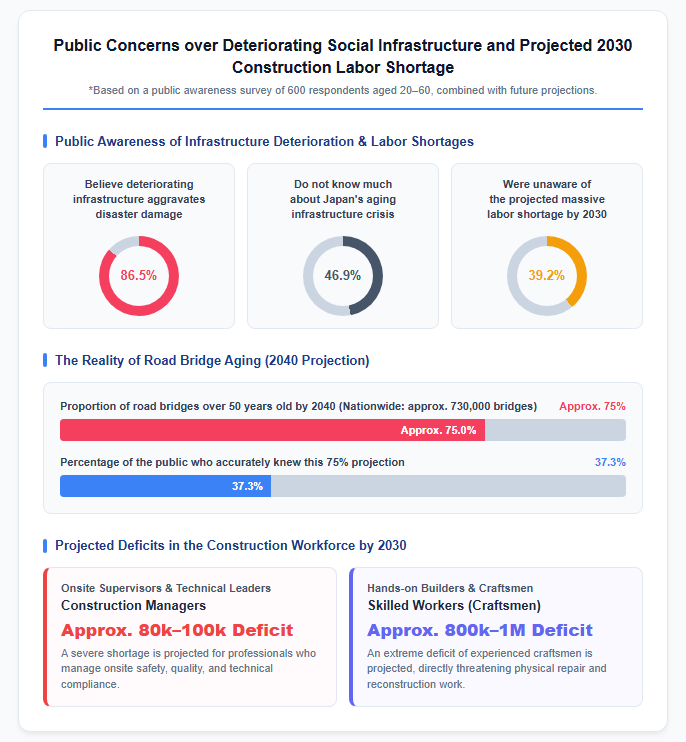
The social infrastructure built during Japan’s high-economic-growth era is reaching a critical wave of aging. On July 16, 2026, human resources firm Narel Group released a public awareness survey showing that 86.5% of the 600 respondents aged 20 to 60 believe that during typhoons or heavy rains, deteriorated bridges, roads, and drainage systems aggravate the scale of disaster damage. Despite this widespread anxiety, 46.9% of those surveyed admitted they were not familiar with the details of the infrastructure aging crisis, revealing a gap between immediate fear and long-term understanding. According to data from the Ministry of Land, Infrastructure, Transport and Tourism, of the approximately 730,000 road bridges in Japan, an alarming 75% will be over 50 years old by the year 2040. However, only 37.3% of the public was aware of this statistic. The deterioration of essential infrastructure remains a silent but severe threat that directly impacts daily life and safety during extreme weather events. Please refer to the following survey data.
The Looming Deficit of Construction Managers and Skilled Workers by 2030
Safely inspecting, repairing, and replacing aging roads, bridges, and sewers to ensure rapid recovery during disasters requires a robust construction workforce. However, the construction industry faces a severe and structural labor shortage. The Narel Group survey revealed that 39.2% of respondents were unaware of the projected massive labor shortage in the construction industry by 2030, showing that the public does not fully comprehend the difficulty of maintaining safe infrastructure. The construction sector is experiencing a simultaneous rapid aging of its workforce and a decline in young entrants. By 2030, the industry is projected to face a shortage of 80,000 to 100,000 construction managers (who oversee site safety and technical compliance) and a deficit of 800,000 to 1,000,000 skilled construction workers and craftsmen. Without addressing this deficit, local governments may find it impossible to execute post-disaster recovery or routine preventative maintenance. Resolving the infrastructure crisis requires not only physical funding but also a concerted societal investment in recruiting and training the next generation of construction professionals.
Long-term Post-disaster Support and Sustainable Recovery Outlook
Rebuilding Infrastructure and Livelihoods in Noto After Twin Disasters
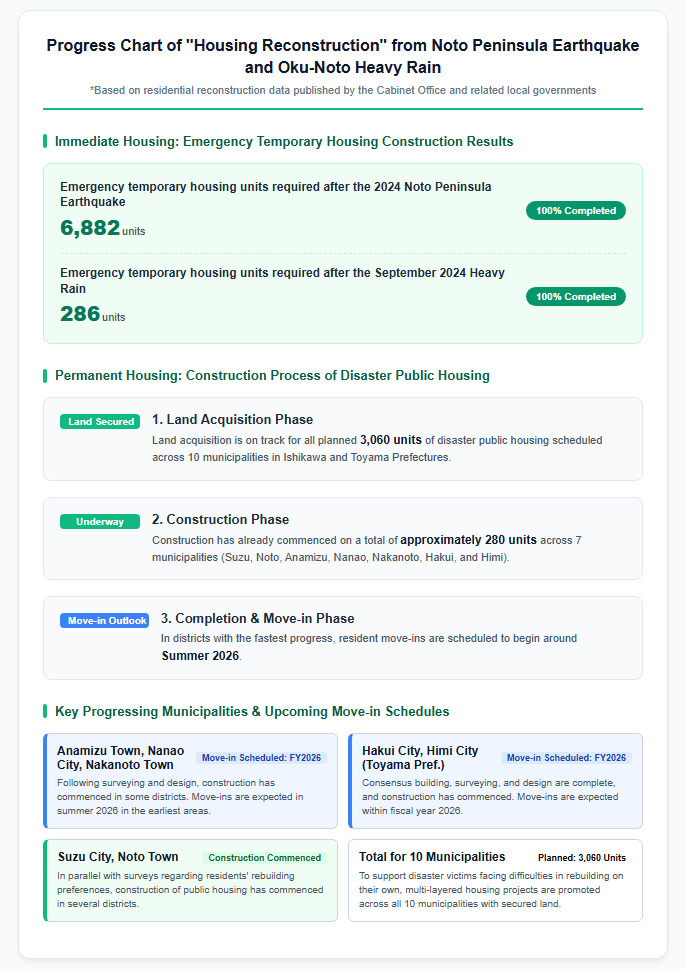
The Noto region of Ishikawa Prefecture has faced a long road to recovery after suffering twin disasters: the catastrophic Noto Peninsula Earthquake in January 2024, followed by the devastating Oku-Noto torrential rains in September of the same year. In 2026, the Cabinet Office, Ishikawa Prefecture, and local municipalities continue to collaborate closely on “creative reconstruction” aimed at building back better. According to a progress report compiled by the Cabinet Office as of May 31, 2026, all of the required temporary housing units have been completed, including 6,882 units necessitated by the earthquake and 286 units built after the heavy rains. To transition residents to permanent homes, local governments have planned disaster public housing for those unable to rebuild on their own. Across 10 municipalities in Ishikawa and Toyama prefectures, a total of 3,060 disaster public housing units are planned, with land acquisition now finalized for all target areas. Construction has already commenced on approximately 280 units across seven municipalities. The earliest completions are on track to welcome residents starting in the summer of 2026. Please refer to the following figure showing the construction progress.
Multi-layered Protection through Pre-disaster Forecasts and Post-disaster Insurance
With climate change intensifying the frequency of localized torrential rains, linear rainbands, and windstorms, protecting lives and properties requires a multi-layered strategy that integrates post-disaster financial protection with pre-disaster preventative action. According to a commentary article published by Weathernews on September 4, 2026, only about 38% of global economic losses from natural disasters are covered by insurance, meaning that more than 60% of the financial burden must be borne directly by affected households, businesses, and local governments. In Japan, standard fire insurance policies often exclude water damage, or may not cover household contents unless specifically added, while vehicle damage from flooding requires separate comprehensive car insurance. Therefore, reviewing and adjusting insurance coverage during normal times is a critical first step. Simultaneously, viewing weather forecasts not as simple weather predictions but as actionable data to secure “mitigation time” allows individuals to proactively move cars to high ground or elevate valuable appliances before flooding starts. Combining robust financial coverage with proactive, forecast-driven evacuation behavior represents the most effective defense for sustainable living.
Reference Pages
- 【Act on Special Financial Assistance etc. to Deal with Extreme Severity Disasters (e-Gov Law Search)】https://laws.e-gov.go.jp/law/337AC0000000150
- 【Disaster Recovery and Reconstruction Measures (Cabinet Office Disaster Management)】https://www.bousai.go.jp/taisaku/gekijinhukko/index.html
- 【Ishikawa Prefecture Jan 6 (2024) Noto Peninsula Earthquake and Oku-Noto Heavy Rain Recovery and Reconstruction Headquarters (Ishikawa Prefecture)】https://www.pref.ishikawa.lg.jp/kikaku/r6notohantoujishinfukkouhonbu.html
- 【Development of Disaster Public Housing (Ishikawa Prefecture)】https://www.pref.ishikawa.lg.jp/kenju/fukkou_kouei_seibi.html
【#DisasterOfExtremeSeverity #DisasterRecovery #HokurikuHeavyRain #InfrastructureAging #ConstructionIndustry #LaborShortage #FinancialSupport #BusinessTrends】


コメント