In September 2026, it was revealed that the Japanese and U.S. governments have entered negotiations to construct a semiconductor manufacturing plant in the United States as part of Japan’s \$550 billion investment pledge. Driven by efforts to avoid trade friction and bolster economic security, the core focus of bilateral cooperation is expanding significantly from energy infrastructure toward high-tech manufacturing and semiconductors.
- Latest Developments in $13B–$19B Semiconductor Fab Talks
- Evolution of the $550 Billion Investment Framework and the Role of Phase 3
- Structural Shifts Driven by Taiwan Concentration Risks and US-China Tech Friction
- Japan’s Chokepoint Technologies and Strengths in Global Supply Chains
- Market and Earnings Spillovers for Japanese Equipment Manufacturers
- Balancing Investment Recovery Risks with Inward and Outward Direct Investment Controls
Latest Developments in $13B–$19B Semiconductor Fab Talks
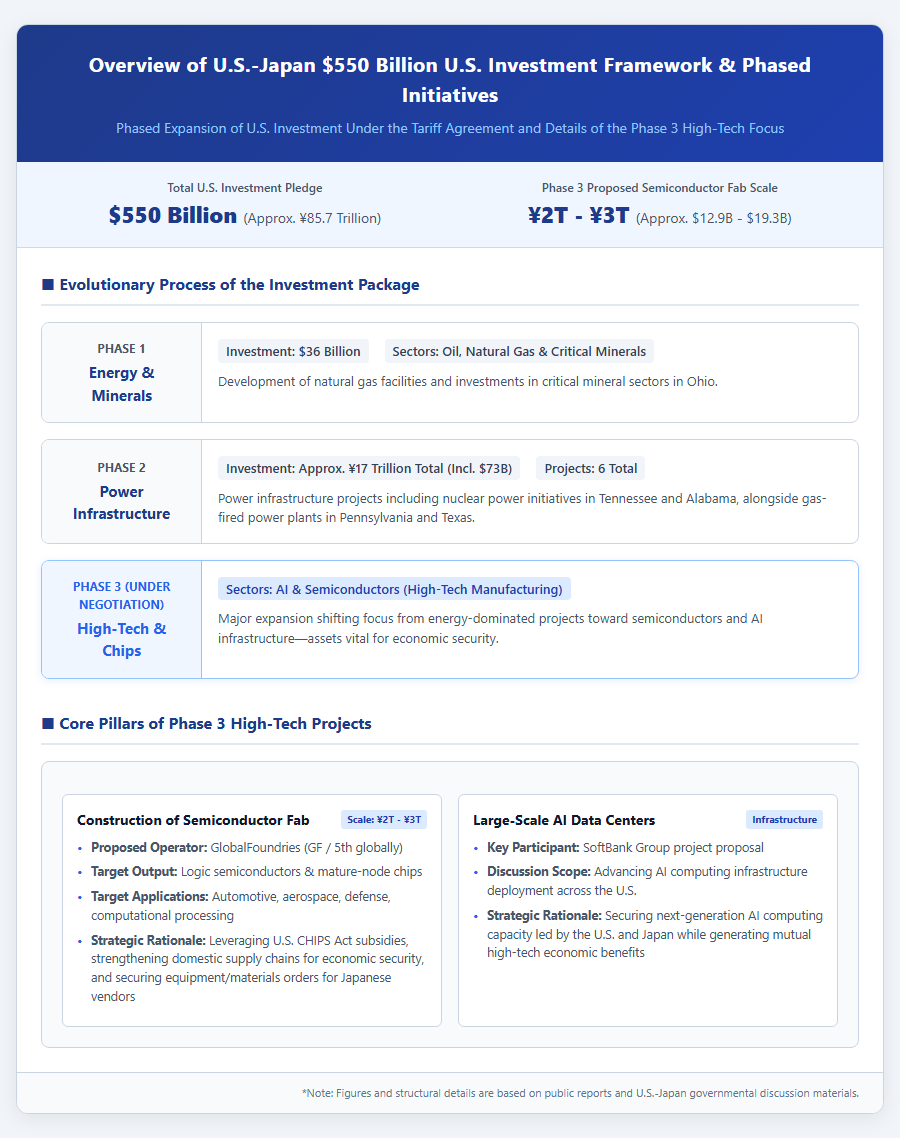
In September 2026, it emerged that the Japanese and U.S. governments are advancing negotiations to construct a semiconductor manufacturing plant in the United States under Japan’s \$550 billion (approx. 85.7 trillion yen) U.S. investment framework. This major project is expected to reach a scale of 2 trillion to 3 trillion yen (\$12.9 billion to \$19.3 billion), with working-level bilateral talks held between officials from September 14 to 15, 2026. U.S.-based GlobalFoundries (GF), the world’s fifth-largest semiconductor foundry, is widely considered the top candidate to operate the plant. The proposed facility is slated to produce logic semiconductors and mature-node chips in high demand for automotive, aerospace, defense, and computational processing applications. Furthermore, the discussions extend beyond semiconductor manufacturing, encompassing a large-scale AI data center construction project in which SoftBank Group is deeply involved. Aiming to secure advanced tech supply chains, public- and private-sector infrastructure investment plans between the two nations are moving into full gear. Please refer to the following image for the project structure overview.
Evolution of the $550 Billion Investment Framework and the Role of Phase 3
The joint semiconductor plant proposal forms the cornerstone of “Phase 3” within the \$550 billion U.S. investment initiative established under the U.S.-Japan tariff agreement. Looking back at prior commitments, Phase 1 directed \$36 billion into natural gas development and critical minerals in Ohio. Phase 2 allocated approximately 17 trillion yen across six energy and power infrastructure projects, including nuclear power initiatives in Tennessee and Alabama, as well as gas-fired power plants in Pennsylvania and Texas. Shifting away from energy-driven investments, Phase 3 substantially expands the target scope into high-tech manufacturing, specifically semiconductors and AI infrastructure—goods deemed vital to economic security. During a ministerial meeting in Washington, Japanese Minister of Economy, Trade and Industry Ryosei Akazawa conferred with U.S. Commerce Secretary Howard Lutnick and U.S. Trade Representative (USTR) Jamieson Greer, confirming that no additional tariffs would be imposed on Japan while emphasizing a policy of prioritizing high-tech investments that yield mutual economic benefits.
Economic Security Imperatives and the Backdrop of US-Japan Chip Cooperation
Structural Shifts Driven by Taiwan Concentration Risks and US-China Tech Friction
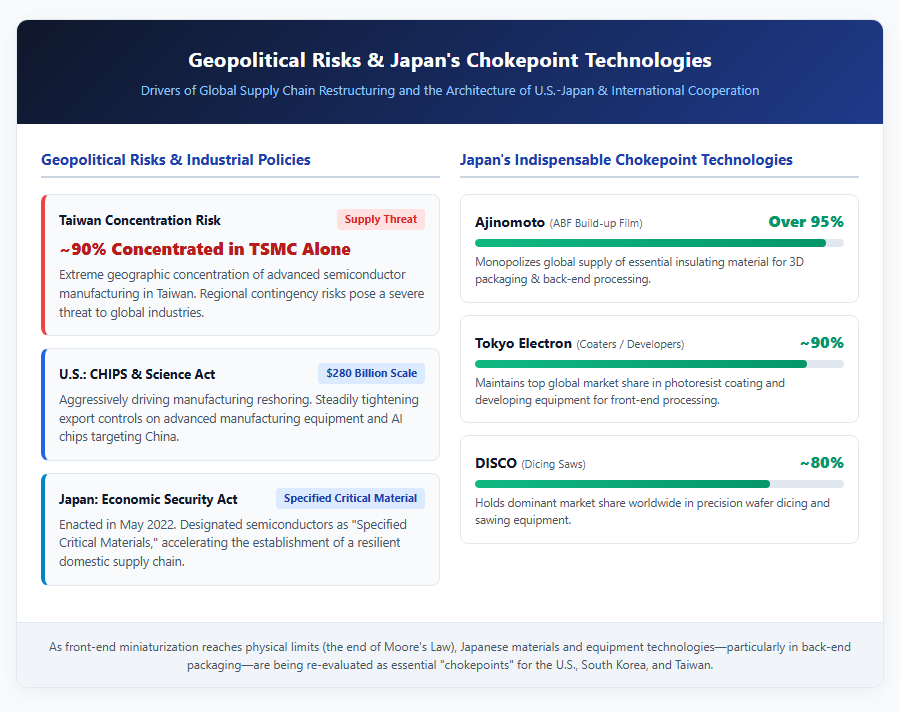
The rapid emergence of the semiconductor industry as a national security issue stems from heightened geopolitical risks and structural supply chain vulnerabilities. Currently, approximately 90% of the world’s most advanced semiconductors are manufactured by a single company, Taiwan’s TSMC. Consequently, contingency risks in the Taiwan Strait raise severe concerns over the potential to instantly paralyze global tech industries and social infrastructure. Amid escalating U.S.-China rivalry, the U.S. has used the 2022 CHIPS and Science Act (a \$280 billion initiative) to aggressively drive the reshoring of manufacturing while steadily tightening export controls on advanced manufacturing equipment and AI chips targeting China. Additionally, the global shortages experienced during the COVID-19 pandemic made nations acutely aware of the dangers of over-relying on specific countries, reinforcing the necessity of building self-sufficient supply chains among allies. In Japan, following the May 2022 passage of the Economic Security Promotion Act designating semiconductors as “Specified Critical Materials,” establishing resilient supply chains through close U.S.-Japan collaboration has become an urgent national imperative. Please refer to the diagram below for a comprehensive view of the supply chain restructuring.
Japan’s Chokepoint Technologies and Strengths in Global Supply Chains
As circuit miniaturization in front-end semiconductor processing approaches physical and economic limits, back-end packaging technologies—such as 3D packaging and chiplets that stack and connect multiple chips—are skyrocketing in importance. Japanese firms hold a commanding position in this domain. Specifically, Ajinomoto holds over 95% of the global market for Ajinomoto Build-up Film (ABF) insulation material, DISCO commands roughly 80% of the dicing saw market, and Tokyo Electron holds nearly 90% market share in coaters/developers. Japan thus controls indispensable chokepoints in the global supply chain. Under the 1980s U.S.-Japan Semiconductor Agreement and its strict numerical targets, Japan’s finished-goods manufacturing, such as DRAM, suffered a historical decline from its former world-leading share. Today, however, a mutually complementary relationship has formed wherein U.S. high-tech manufacturing and foundries cannot function without Japan’s superior equipment and materials technologies, culminating in a new industrial partnership where both allies leverage their respective strengths as equal partners.
Economic Spillovers, Challenges, and Long-Term Outlook
Market and Earnings Spillovers for Japanese Equipment Manufacturers
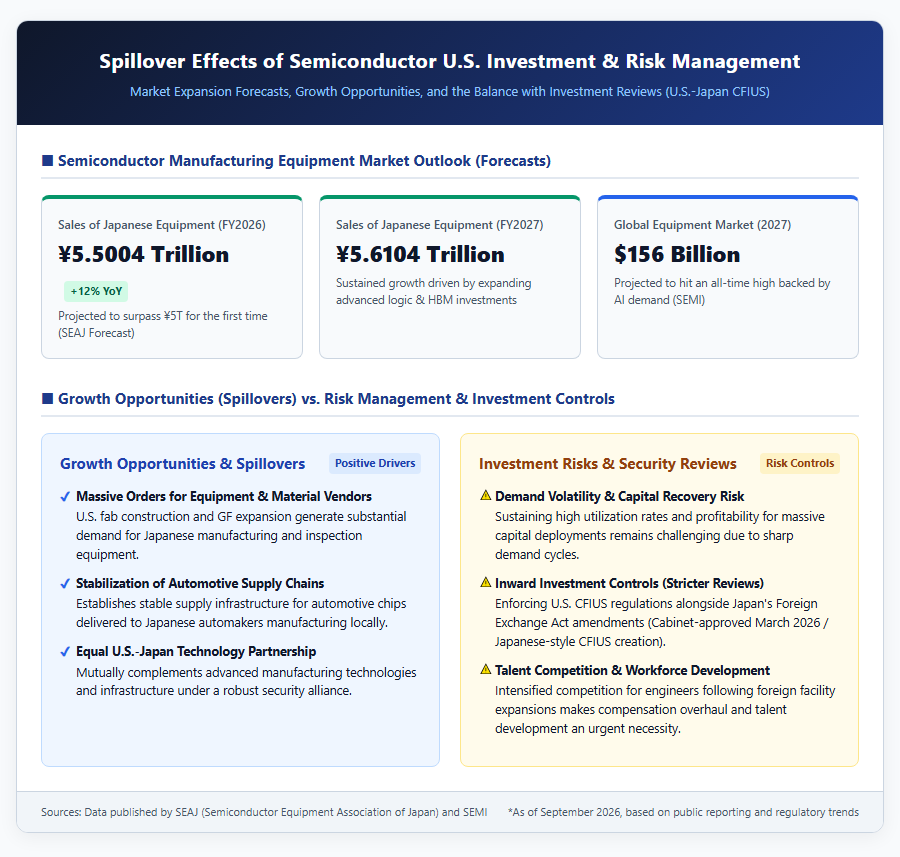
The construction of a 2 trillion to 3 trillion yen semiconductor plant in the U.S. and the expansion of GlobalFoundries’ capacity represent immense commercial opportunities for Japanese advanced equipment and materials suppliers. Mass orders for manufacturing and inspection equipment are anticipated. According to forecasts by the Semiconductor Equipment Association of Japan (SEAJ), sales of Japanese semiconductor manufacturing equipment are projected to expand to 5.5004 trillion yen in FY2026 and reach 5.6104 trillion yen in FY2027. Furthermore, if chips produced at this U.S. facility are supplied directly to local manufacturing plants of Japanese automakers, it will yield significant secondary benefits by stabilizing automotive supply chains. Conversely, the surge in mega-facility developments has intensified competition for elite semiconductor engineers and technical talent, making the overhaul of compensation packages and talent development systems a pressing challenge for Japanese manufacturers seeking sustainable growth.
Balancing Investment Recovery Risks with Inward and Outward Direct Investment Controls
In mega-projects involving substantial state and private capital, managing investment recovery risk amid volatile demand cycles is a paramount challenge. While massive construction subsidies alleviate initial capital burdens, profitability remains uncertain if high fab utilization rates and strong demand cannot be sustained post-completion. Simultaneously, national security investment reviews are tightening globally. In the United States, CFIUS (Committee on Foreign Investment in the United States) is enforcing stricter inward investment restrictions and technology leak prevention measures. In Japan, following the March 2026 cabinet approval of proposed Foreign Exchange Act amendments and the planned establishment of a “Japanese-style CFIUS,” policymakers face a delicate balancing act between maintaining a free investment climate and mitigating security risks. Ensuring that this initiative extends beyond a temporary investment boom to establish an institutional framework aligned with the long-term industrial interests of both nations will be critical. Please refer to the chart below for future outlook and key variables.
Reference Pages
- [Cabinet Decision on Foreign Exchange Act Amendments (Prime Minister’s Office of Japan)] https://www.kantei.go.jp/jp/kakugi/2026/kakugi-2026031701.html
- [The White House: America First Investment Policy] https://www.whitehouse.gov/presidential-actions/2025/02/america-first-investment-policy/
- [JETRO (Japan External Trade Organization)] https://www.jetro.go.jp/biznews/2024/02/c371d942ba3a0472.html
【#Semiconductors #USJapanInvestment #USJapanRelations #EconomicSecurity #GlobalFoundries #TokyoElectron #AIInfrastructure #ManufacturingEquipment】

コメント