The International Monetary Fund (IMF) has announced that it will maintain its global economic growth forecast for 2027 at 3.4%. While risks such as energy supply shocks stemming from the Middle East conflict and ballooning public debt persist, active AI-related investment is serving to underpin the global economy.
- Key points of the event: IMF keeps growth forecasts unchanged and upwardly revises them
- The Antinomy of AI Investment Demand and the Energy Shock
- Prolonged Geopolitical Risks and Trends in Middle Eastern Crude Oil and Energy Markets
- The Surge in Public Debt and the Limits of Fiscal Space Across Nations
- The Widening Polarization Between Developed and Emerging Countries
- Future Outlook and Key Points: Structural Reforms and Monetary Policy to Prevent an Economic Slowdown
Key points of the event: IMF keeps growth forecasts unchanged and upwardly revises them
On October 13, 2026, the International Monetary Fund (IMF) released its latest “World Economic Outlook (WEO),” leaving its global economic growth forecast for 2027 unchanged at 3.4%. Meanwhile, it revised its growth forecast for 2026 upward by 0.1 percentage points, from 3.0% in July to 3.1%. The main driver behind this upward revision is that robust capital investment in digital infrastructure and hardware, such as generative AI (artificial intelligence), has offset rising energy costs resulting from escalating tensions in the Middle East. However, compared to the 3.5% growth rate recorded in 2025, the pace of global economic expansion is experiencing a gradual slowdown.
The key data figures and event highlights drawing attention in this announcement are as follows:
- 2027 Global Growth Forecast: 3.4% (Unchanged from Previous Outlook)
- 2026 Global Growth Forecast: 3.1% (revised upward from the previous 3.0%)
- 2026 Global Overall Inflation Rate Forecast: 4.7% (Up from 4.1% in 2025)
- Growth driver: AI net import demand centered on the US and China, as well as semiconductor supply chain countries
Silvana Tenreyro, the new Chief Economist of the IMF, pointed out that while the global economy is showing resilience, it is approaching its limits. The number of countries generating 95% of global growth has decreased significantly from 54 countries as of April 2026 to 32 countries, highlighting the reality that the base of global economic growth is narrowing.
The Antinomy of AI Investment Demand and the Energy Shock
The global economy is currently being pulled in two opposite directions. IMF Managing Director Kristalina Georgieva described this as being caught between a “negative energy supply shock” caused by the Middle East conflict and a “positive demand shock” driven by AI infrastructure development.
The global investment rush into the AI sector is rapidly expanding capital expenditures by semiconductor manufacturers, data center construction, and major tech companies (hyperscalers). According to an IMF analysis, if the proper adoption and societal implementation of AI progress, it is expected to boost global annual growth rates by up to 0.5 percentage points over the next decade. This has an impact comparable to newly adding an economic scale equivalent to an entire Association of Southeast Asian Nations (ASEAN) member country to the global economy.
However, on the other hand, the expansion of AI infrastructure generates massive electricity demand, acting as a factor in rising energy prices. The construction of data centers and AI hardware itself is increasing inflationary pressures, which, combined with concerns over oil and natural gas supplies due to the worsening situation in the Middle East, raises concerns about the risk of prolonging global inflation.
For a diagram illustrating the dynamics of the global economic structure, please refer to the following figure.
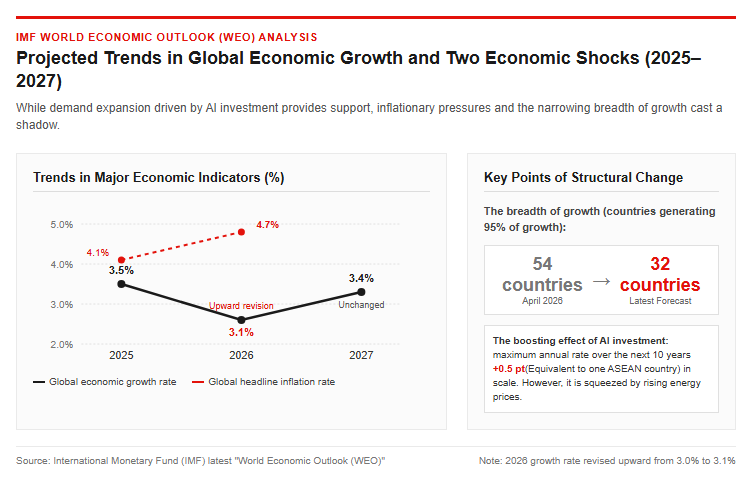
The disparity in growth is widening further between tech companies and countries integrated into the semiconductor supply chain that directly benefit from AI investment, and energy-importing countries that are directly hit by soaring energy prices.
Key Risk Factors and Structural Changes Shaking the Global Economy
Prolonged Geopolitical Risks and Trends in Middle Eastern Crude Oil and Energy Markets
One of the biggest downside risks in the global economic outlook toward 2027 is the prolonged military conflict in the Middle East and its impact on energy markets. Tensions around the Strait of Hormuz and disruptions in maritime transport have become major factors pushing up crude oil prices and logistics costs.
In the IMF’s baseline scenario, oil prices (such as Brent crude) are projected to average $96 per barrel in 2026—a year-on-year increase of about 41%—and settle at around $87 in 2027. Furthermore, regarding navigation restrictions in the Strait of Hormuz, the assumption is that passage will begin to resume in March 2027, heading toward general normalization by October of the same year.
However, if crude oil prices reach $130 per barrel by the first quarter of 2027 due to a further escalation of military conflict, severe negative impacts will be inevitable. According to IMF estimates, the following impacts are projected to occur.
- Pushes down global growth in 2026 by 0.2 points
- Global growth in 2027 dragged down by 0.5 percentage points
- Global inflation rate jumps to 5.2% in 2027, accelerating price hikes
In particular, the impact of the Middle East situation is extremely uneven across regions. Asian countries with a high dependence on Middle Eastern crude oil and natural gas, as well as Middle Eastern countries directly affected by the conflicts (such as Saudi Arabia, whose 2026 forecast is projected to plunge to -3.3%), are being forced into severe contractions in economic activity. Defensive measures by various nations, such as the release of national reserves, are also reaching their limits, and vigilance against an energy shock persists.
The Surge in Public Debt and the Limits of Fiscal Space Across Nations
A major source of uncertainty, alongside the energy shock, is the ballooning public debt and fiscal deficit issues worldwide. According to IMF estimates, the global public debt-to-GDP ratio is nearing 94% in 2025, and if the current pace continues, it is projected to reach 100% of GDP between 2029 and 2030. This is a historical high not seen since immediately after World War II.
With the end of the prolonged ultra-low interest rate environment, government bond yields, particularly in major developed economies, are rising to levels not seen in decades. As government debt is refinanced, interest payments are surging, placing a heavy burden on national budgets. For example, in the U.S. federal budget, net interest payments for fiscal year 2026 are projected to reach approximately $1 trillion, significantly reducing the fiscal space available for discretionary policy initiatives.
The challenges and impacts resulting from the expansion of public debt are as follows.
- Energy shocks and a reduced capacity to respond during recessions due to the depletion of fiscal space
- Upward pressure on long-term interest rates accompanying the increase in government bond issuance
- The risk of pressure on central banks to cut interest rates and demands for fiscal financing
Managing Director Georgieva has told advanced-economy governments with high debt that it is impossible to reduce debt ratios by relying solely on economic growth, and is strongly urging them to formulate credible medium-term fiscal consolidation plans.
Trends and Future Outlook in Major Countries and Regions
The Widening Polarization Between Developed and Emerging Countries
In the global economic growth process leading toward 2027, “polarization (fragmentation)” between regions and countries is becoming even more pronounced. Differences in technology utilization capabilities, energy self-sufficiency rates, and policy support are serving as a litmus test dividing the economic performance of nations.
The trends in growth forecasts for major countries and regions in 2026–2027 are as follows.
- US: Maintaining solid growth at 2.3% in both 2026 and 2027. While robust personal consumption, tax cuts, and AI investment provide support, high import dependence acts as an offsetting factor.
- Eurozone: 2026 growth rate revised upward to 1.1%. Increased defense spending and participation in the AI value chain contributed.
- India: Projected 7.0% growth for both 2026 and 2027. Maintaining one of the highest growth rates among major economies, driven by strong domestic demand, the services sector, and AI-related investments.
- China: Revised downward to 4.5% for 2026 and 4.0% for 2027. Hit by sluggish domestic demand due to the real estate slump and high crude oil prices.
- Japan: Following a resilient, domestic demand-led recovery path, backed by improvements in real income driven by regular pay rises and high-level wage increases, as well as comprehensive economic measures.
Please refer to the following figure for data visualizations showing a comparison of growth rates and economic trends in major countries.
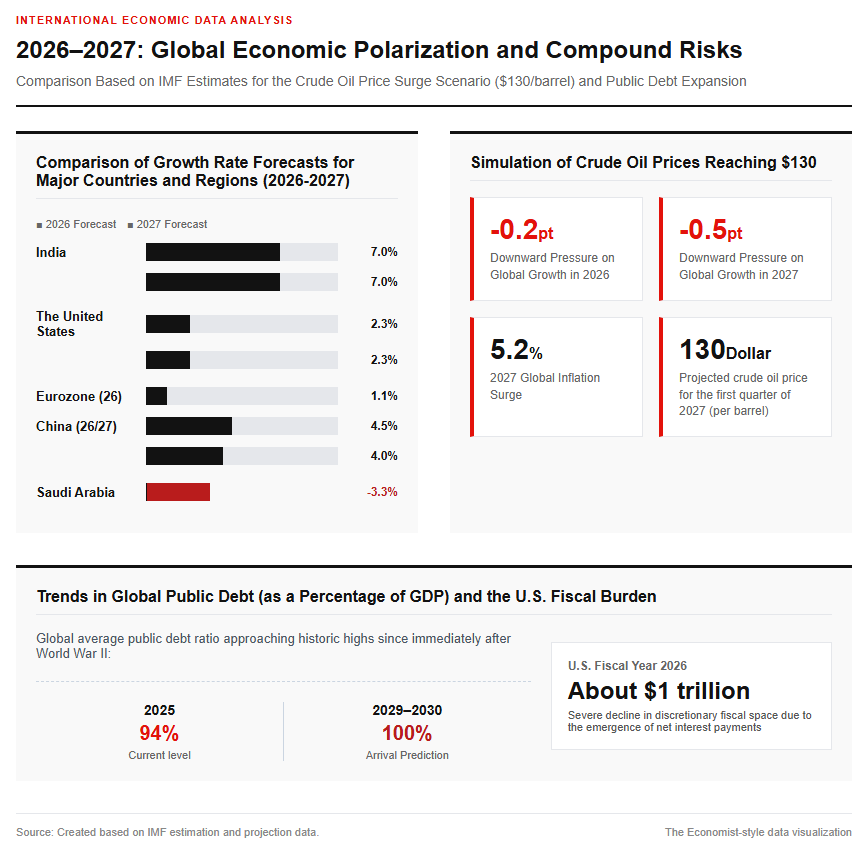
In this way, while countries deeply integrated into the AI value chain and possessing energy supply capabilities are accelerating their growth, nations left behind by the AI economy and hit hard by high energy prices are forced into stagnation.
Future Outlook and Key Points: Structural Reforms and Monetary Policy to Prevent an Economic Slowdown
Whether the global economy can maintain a stable growth trajectory of 3.4% toward 2027 hinges on the stabilization of energy supply chains, the effectiveness of AI investments, and sound policymaking across nations. The key points that market participants and policymakers should closely monitor going forward can be summarized into the following three areas.
First, it is the maintenance of a “cautious hawkish stance” in monetary policy and the achievement of price stability. Central banks are required to avoid premature rate cuts in response to inflationary pressures stemming from the AI construction boom and energy supply shocks, while maintaining their independence and keeping price stability as their utmost priority.
Second is the verification of market expectations versus actual profitability in AI investments. As major tech companies continue their massive capital expenditures, if general enterprises and individuals are slow to monetize AI services, there is a risk that a rapid stock price correction shock could spread across the entire stock market and financial system.
Third, avoiding geoeconomic fragmentation and fiscal consolidation. The fragmentation of international trade, capital, and technology flows reduces the potential growth rate of the global economy. While promoting crisis management and growth investments, it is essential for governments to rebuild fiscal buffers and achieve sustainable public debt management.
Reference page
- [Japan Research Institute: 2026-2027 World Economic Outlook] https://www.jri.co.jp
【#IMF #WorldEconomicOutlook #EconomicGrowthRate #AIInvestment #GeopoliticalRisk #PublicDebt】


コメント