The Ministry of Economy, Trade and Industry has decided to provide about 10 billion yen in support for the development of AI robot “hands” by companies like Honda. Behind this is the “AI Robotics Strategy” formulated in March 2026, marking the full-scale launch of a national industrial policy aimed at regaining dominance in the global market.
- Honda and RIKEN take on the challenge of developing a world-class ‘robot hand’
- The 20 trillion yen future envisioned by the “AI Robotics Strategy” announced in March 2026
- Over 1.2 trillion yen in AI and semiconductor budget, with a focus on physical AI
- Japan’s winning strategy against America’s “intelligence” and China’s “mass production power”
- The massive barrier of a shortage of 3.26 million people and the urgent need for reskilling
- Focus on the 2027 Domestic Infrastructure Model Release and Social Implementation
Honda and RIKEN take on the challenge of developing a world-class ‘robot hand’
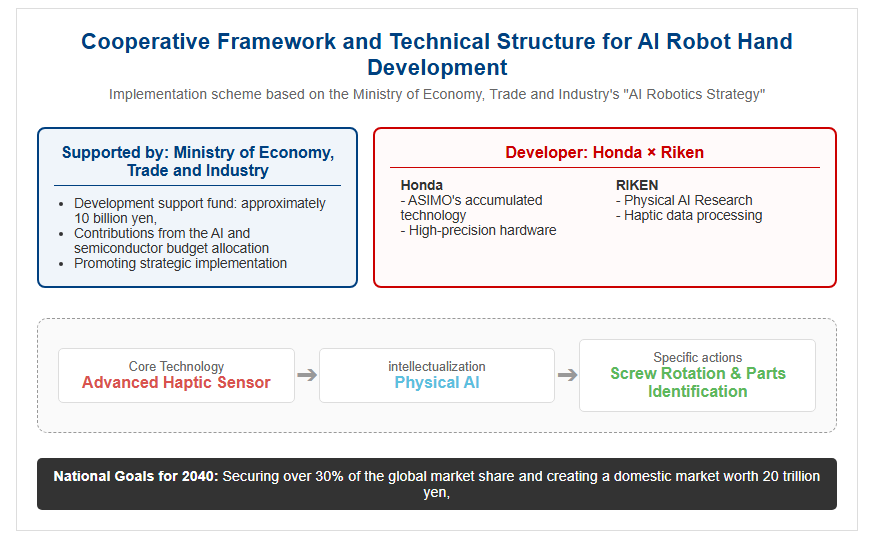
The core of the Ministry of Economy, Trade and Industry’s decision to provide approximately 10 billion yen in support is the development of the AI robot “hand,” which Honda is advancing by applying technology cultivated in its bipedal robot “Asimo.” In robot development, the “hand,” which combines delicate movements with strong force, is considered the most challenging part, and even leading companies in the US and China struggle with development. Honda’s robotic hands can handle complex tasks such as turning small screws and grasping parts of a wide variety of shapes, and the company prides itself on “technology that overseas competitors cannot quickly catch up.”
This project focuses not only on hardware development but also on AI and sensors capable of instantly processing tactile data when touching objects. Therefore, Honda has established a system to jointly promote research and development of this “Physical AI” with RIKEN. By supporting this advanced technology, the Ministry aims to establish a decisive advantage in precise movement domains such as the hands over the United States and China, which are ahead of the United States and China, in lower body walking techniques. Please refer to the diagram below.
The 20 trillion yen future envisioned by the “AI Robotics Strategy” announced in March 2026
This support is positioned as a concrete part of the “AI Robotics Strategy” compiled on March 26, 2026. This strategy goes beyond the traditional framework of “robot introduction support,” redefining robots as “physical intelligent systems” that integrate AI models, data, computing resources, control, and safety certification, representing a large-scale industrial policy.
The Japanese government has set extremely high quantitative targets, aiming to secure over 30% market share of the global multipurpose robot market by 2040 and to create a domestic market worth 20 trillion yen. The strategy specifies 16 priority areas including manufacturing, logistics, construction, care, and defense, and in the short term, prioritizes the implementation of the “eight common tasks” such as inspections, transportation, and cleaning. High-difficulty tasks like Honda’s “finger work” are expected to be sources of medium- to long-term competitiveness, and this 10 billion yen support can be seen as a stepping stone for that purpose.
Massive budget investments and intensifying hegemonic rivalry between the US and China
Over 1.2 trillion yen in AI and semiconductor budget, with a focus on physical AI
The Japanese government is not making AI robotics a standalone initiative, but is incorporating it into the broader framework of the national ‘AI and semiconductor industry infrastructure enhancement.’ In the Ministry of Economy, Trade and Industry’s budget proposal for fiscal year 2026 (Reiwa 8), a total of 1.239 trillion yen is allocated for cutting-edge semiconductors and AI-related fields, an extraordinary scale of 3.7 times the initial budget of the previous year. Of this massive budget, 387.3 billion yen is planned to be allocated to the “physical AI” field, where AI controls robots and machines, the development of foundational models for domestic AI, and data infrastructure infrastructure.
Additionally, a massive fiscal framework has been proposed to attract over 10 trillion yen in public support by fiscal year 2030, inducing over 50 trillion yen in combined public and private investment. This 10 billion yen support for Honda is part of this vast budget portfolio and is especially noted as a “project with a strong dedicated theme.” Within the government, there is strong support for advancing everything from demand generation to social implementation in an integrated manner, but there is also a shared sense of urgency that an “overwhelming speed of execution” is needed to keep pace with the US and China.
Japan’s winning strategy against America’s “intelligence” and China’s “mass production power”
As of 2026, Japan’s robotics industry faces fierce competition from powerful rivals in the global market. In the United States, companies like Google, NVIDIA, and Tesla maintain overwhelming leadership in “embodied AI,” which applies large language models to robots, as well as in simulation learning environments. Meanwhile, China, backed by strong national support such as “Made in China 2025,” is dominating the service robot market for food delivery, cleaning, and logistics with overwhelmingly low prices and rapid mass production.
In contrast, the key for Japan is how to integrate the “traditional strengths” of precision hardware and on-site implementation know-how held by companies like FANUC, Yaskawa Electric, and Kawasaki Heavy Industries with AI. In our strategy, rather than directly confronting the US and China with generic AI models, we place “integration and operational capabilities” in the physical world as the core of our competitiveness. Honda’s development of a high-precision robotic hand is a symbolic effort to maintain its advantage at this “physical contact point.”
Facing the 2040 Talent Crisis and a Roadmap for Social Implementation
The massive barrier of a shortage of 3.26 million people and the urgent need for reskilling
The biggest concern for the expansion of the AI robotics industry is the severe talent shortage. According to future projections published by the Ministry of Economy, Trade and Industry, there is a possibility that by 2040, there will be a shortage of 3.26 million AI and robot utilization personnel in Japan. While demand is expected to be about 4.98 million people, the current supply trend forecasts it will remain at 1.72 million. In particular, there is a shortage of 2.81 million skilled workers who operate robots on-site, not only for professionals such as data scientists and robot operation engineers.
To bridge this talent gap, the government is proposing multifaceted policies such as strengthening AI education at high schools and technical colleges, and providing public support for reskilling working adults. On the other hand, advances in AI and automation are expected to create a surplus of 2.14 million clerical workers, making smooth labor mobility and retraining a social challenge. If this “skills mismatch” cannot be resolved, warnings warn that the market target of 20 trillion yen will also “become unattainable.”
Focus on the 2027 Domestic Infrastructure Model Release and Social Implementation
As a notable milestone going forward, the open-source release of the “Domestic Robot Base Model (Beta)” is planned, aiming for around June 2027. This is an attempt to secure a domestic foundation for AI that can learn from various tasks in general, rather than programming individual robots individually. Additionally, through businesses such as NEDO, we are advancing the construction of large-scale datasets for robot training.
However, there are also numerous challenges beyond technology when it comes to social implementation. At the 3rd AI Robotics Strategy Review Meeting, there were repeated criticisms that the division of responsibility in the event of accidents (such as responsibility under the PL Act), the insurance system, and the establishment of safety certification systems are unclear. From companies considering implementation, concerns about “safety and accident liability” remain strong, not just about cost. How much we can create successful cases in the ‘eight common tasks’ such as inspection and transport by 2030 will be the turning point for whether Japan can maintain its position as a robot powerhouse.
[#AIロボティクス #経済産業省 #ホンダ #ロボット開発 #フィジカルAI #経済ニュース #2040年問題]


コメント