
In the latest World Economic Outlook released by the International Monetary Fund (IMF), it has been revealed that Japan’s nominal Gross Domestic Product (GDP) is projected to drop to 6th place globally, being overtaken by India and the UK between 2026 and 2027. Behind this, in addition to the shrinking of dollar-denominated values due to the historic depreciation of the yen, lie structural challenges such as the long-term stagnation of potential growth rates and population decline.
- Key Points of the Event: Timeline and Data on the Drop to 6th Place Globally
- Qualitative Differences in the Overtaking by India and the UK
- The “Scale Effect” Caused by the Weak Yen and Dollar-Denominated Compression
- Low Potential Growth Rate and the Deep-Seated Nature of Deflationary Mindset
- The Substantial Impact on Corporate Finance and Overseas Investment
- Future Outlook and Points to Watch: Supply-Side Reforms and Challenges for Re-growth
Key Points of the Event: Timeline and Data on the Drop to 6th Place Globally
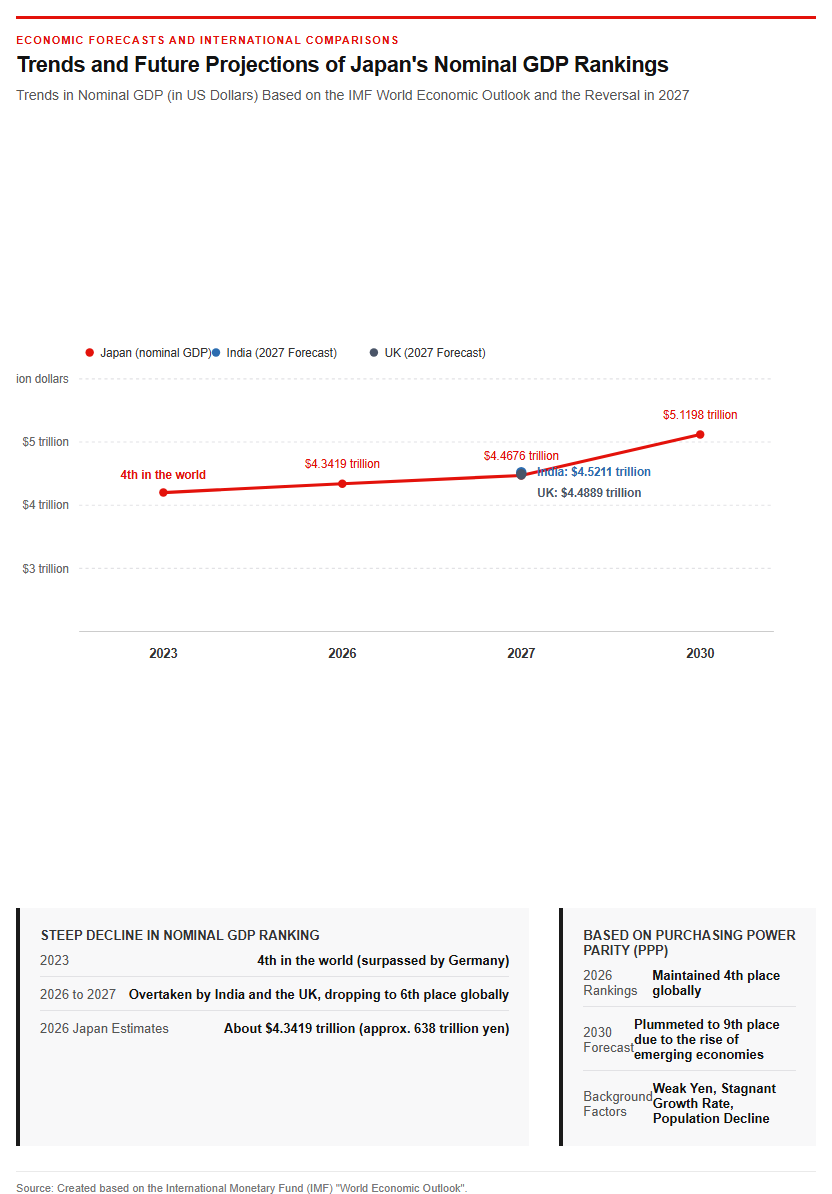
According to the World Economic Outlook released by the International Monetary Fund (IMF), following Japan’s nominal GDP in US dollars being surpassed by Germany in 2023 to fall to 4th place globally, the country will face a major turning point between 2026 and 2027. Japan’s nominal GDP for 2026 is estimated at approximately $4.3419 trillion (approx. 638 trillion yen), but it is expected to reach only around $4.4676 trillion in 2027. Meanwhile, India, maintaining high growth, is projected to surpass Japan by expanding to about $4.5211 trillion in 2027, and with the UK also reaching about $4.4889 trillion, Japan’s ranking is predicted to drop to 6th place globally. The Japanese economy, which for many years maintained the world’s 2nd place position second only to the US, will thus see consecutive declines from 4th to 6th place in just a few years. Furthermore, IMF projections for 2030 indicate that Japan’s nominal GDP will remain at approximately $5.1198 trillion (approx. 775 trillion yen), widening the gap with the top nations. Although GDP based on purchasing power parity (PPP) will maintain the 4th global ranking as of 2026, it is expected to plunge to 9th place by 2030 due to the rise of emerging economies. Please refer to the chart below for data regarding GDP ranking fluctuations and trends across countries.
Qualitative Differences in the Overtaking by India and the UK
India and the UK are both set to surpass Japan, but the economic mechanisms behind these shifts are entirely different. India’s overtaking of Japan is driven by genuine scale expansion fueled by overwhelming economic expansion, with an annual real GDP growth rate of around 7.0%. Backed by a massive population of over 1.4 billion, robust private consumption, and active capital investment, India is on a high-growth trajectory that will widen the gap with Japan to 7.5% by 2028, and even surpass Germany to emerge as the world’s third-largest economy by 2029. In contrast, the UK’s overtaking of Japan leans heavily toward a short-term, superficial reversal largely dependent on currency values and price trends. The UK’s real economic growth rate is around 1.2% per year, a difference of just 0.5 percentage points from Japan’s projected 0.7%. However, the UK’s nominal GDP in dollar terms is being propped up by population growth driven by an influx of immigrants (approximately 69 million), relative inflation, and a strong pound. The gap with the UK is an extremely narrow margin of less than 0.5%, a close enough distance that even a slight shift toward a stronger yen in the exchange rate could reverse the rankings once again. It is essential to understand this dual structure: India’s fierce pursuit driven by substantive growth potential, and the competition with the UK, which fluctuates based on exchange rates and price movements.
Analysis of the Two Major Factors Behind the Sharp GDP Drop
The “Scale Effect” Caused by the Weak Yen and Dollar-Denominated Compression
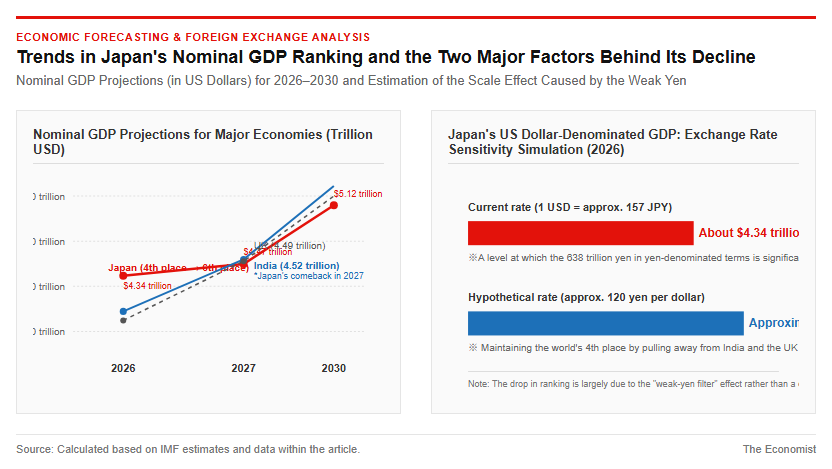
When discussing the sharp decline in nominal GDP ranking, the most direct impact comes from the record-breaking depreciation of the yen and appreciation of the dollar in the foreign exchange market. Because dollar-denominated GDP used for international comparisons is calculated by converting GDP in local currency using the exchange rate at that time, when the yen depreciates, the dollar-converted value is significantly compressed even if the real economy is growing. In fact, Japan’s yen-denominated nominal GDP itself is steadily expanding to about 638 trillion yen against the backdrop of rising prices and wage increases. However, when converted to US dollars at an exchange rate of around 157 yen to the dollar, it is held down to about 4.06 trillion to 4.34 trillion dollars. If the exchange rate had been around 120 yen to the dollar, Japan’s dollar-denominated GDP would have reached approximately 5.32 trillion dollars, and simulations show it would have easily maintained its position as the world’s 4th largest economy, well ahead of India and the UK. In other words, this drop in GDP ranking strongly reflects a “numerical contraction through the exchange rate filter of a weak yen” rather than a “rapid loss of production capacity within Japan.” Please refer to the following image for the exchange rate sensitivity analysis and dollar-denominated GDP fluctuations by scenario.
Low Potential Growth Rate and the Deep-Seated Nature of Deflationary Mindset
We cannot simply dismiss the decline in ranking as merely the result of currency fluctuations. At its root lies a serious structural challenge: Japan’s sluggish potential growth rate, which has sunk to the lowest level among major economies. Comparing the average annual real GDP growth rate over the past decade, Japan has remained at an extremely low level of around +0.5%. Furthermore, a vicious cycle persists in which private companies tend to hold back on domestic capital and innovation investments due to labor shortages driven by the declining birthrate and aging population, alongside concerns over a shrinking domestic market. Looking at nominal GDP per capita in US dollars—an indicator of individual economic prosperity—Japan has slumped to 38th in the world as of 2025. Projections for 2027 show an even wider gap, with Japan at approximately $36,620 compared to the UK at around $64,030, a difference of more than 1.7 times. It has also been pointed out that near-term price increases are largely driven by high crude oil prices and imported inflation, meaning this is not inflation accompanied by fundamental economic expansion, and that the break from a deflationary mindset remains incomplete. Unless essential growth strategies to boost productivity are implemented, it will be difficult to avoid a medium- to long-term decline in standing, regardless of exchange rate fluctuations.
Impact on the Japanese Economy and Corporate Financials, and Future Outlook
The Substantial Impact on Corporate Finance and Overseas Investment
The decline in GDP ranking and the prolonged depreciation of the yen are having a significant impact not only on the macroeconomy, but also on the financial strategies and investment decisions of private companies. Due to the decline in the purchasing power of yen-denominated funds caused by the weak yen, the costs of overseas M&A and overseas capital expenditures by Japanese companies have jumped significantly. Specifically, when acquiring $100 million in overseas assets, funds that would have sufficed at 12 billion yen when the exchange rate was 120 yen to the dollar now require 15.7 billion yen at 157 yen to the dollar, meaning that purchasing power effectively drops by about 23%. On the other hand, the accumulation of government bond issuance, rising fiscal risks, and interest rate hikes accompanying the Bank of Japan’s monetary policy changes are factors that drive up companies’ weighted average cost of capital (WACC). Due to the rise in risk-free rates and fluctuations in the equity risk premium, the risk that investments will no longer be financially viable under conventional hurdle rates is increasing. When making overseas or capital investments, companies are required to thoroughly implement Financial Planning and Analysis (FP&A) that strictly conducts sensitivity analyses based on multiple exchange rate scenarios and WACC stress testing, rather than relying on a single exchange rate.
Future Outlook and Points to Watch: Supply-Side Reforms and Challenges for Re-growth
For the Japanese economy to break free from the negative loop of a “shrinking Japan” and maintain its international voice and economic foundation, future policy shifts and drastic reforms of the industrial structure will be major points of focus. The top priority is considered to be the thorough enhancement of “productivity per capita” to generate added value even amid a declining population. Through the promotion of digital transformation (DX) and the practical implementation of AI and robotics, it is essential to overcome the severe labor shortage and raise the potential growth rate. Furthermore, discussions are underway to shift away from an expansionary fiscal policy that relies on government-led demand creation toward a private sector-led supply-side growth strategy that boosts the growth expectations of private companies and draws in investment. Accelerating structural reforms such as labor market reforms, measures against the declining birthrate, the utilization of foreign human resources, and startup support will lead to the recovery of medium- to long-term trust. Rather than simply being swayed by numerical GDP rankings, the ultimate focus for the future Japanese economy is whether it can enhance the affluence of each and every citizen as well as its intellectual property and innovation capabilities while maintaining the scale of its economy.
Reference page
- [Nomura Research Institute] Japan to Be Overtaken by India in GDP by 2026, Dropping to 5th Globally: Aggressive Fiscal Policy Cannot Solve Problems
2026年に日本はGDPでインドに抜かれ世界第5位に:積極財政政策は問題解決につながらないwww.nri.com


[#JapaneseEconomy #GDP #IMF #WorldEconomicOutlook #WeakYen #PotentialGrowth #CorporateFinances]


コメント