An expert panel at the Ministry of Land, Infrastructure, Transport and Tourism has indicated a policy to strongly promote the “transition to a monthly salary system” aimed at improving the working conditions of construction workers and securing young talent. Behind this are the long-standing practice of daily wage systems and fluctuations in workload throughout the year, with the reality that unstable incomes hinder young people from entering the industry and the adoption of a two-day weekend system.
- Holding of the Second Committee Meeting and Proposal to Transition to a Monthly Salary System
- The Current State of Daily Wage Practices and the Barrier of Seasonal Fluctuations Hindering the Transition to Monthly Salaries
- A Multifaceted Approach for Construction Companies and Project Owners to Take
- Labor Management Support and the Creation of an Environment for Diverse and Flexible Work Styles
- Boost from the implementation of the third set of workforce-related laws and labor cost standards
- Future Roadmap and Transformations Required in the Construction Industry
Holding of the Second Committee Meeting and Proposal to Transition to a Monthly Salary System
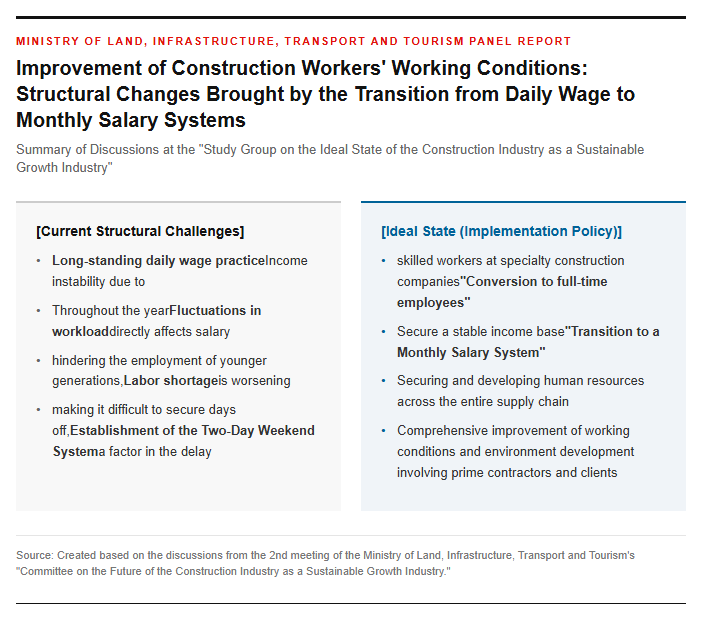
On October 13, 2026, the Ministry of Land, Infrastructure, Transport and Tourism held the second meeting of the “Study Group on the Future of the Construction Industry as a Sustainable Growth Industry.” This study group is an expert panel established to formulate a new policy vision looking 10 years ahead for the construction industry. At the opening of the meeting, Akio Sudo, Director-General of the Real Estate and Construction Economy Bureau, emphasized that for the construction industry to become an industry chosen by job seekers and the younger generation, it is essential to further improve compensation and working conditions, develop systems and environments where everyone can thrive, and strengthen human resource development.
At the meeting held on the same day, “human-centric industries” was raised as a major theme, and discussion points were presented aimed at improving the treatment of skilled workers who support the frontline and realizing flexible working styles. Amidst this, the Ministry of Land, Infrastructure, Transport and Tourism emphasized the importance of securing and nurturing human resources across the entire supply chain, setting forth a policy that the conversion of skilled workers into regular employees and the “transition to a monthly salary system” at specialized construction companies should be strongly promoted. In addition, discussions were held regarding the involvement of primary contractors in the development of skilled workers, as well as the necessity for clients—who are the project owners themselves—to take an interest in the development of skilled workers.
The Current State of Daily Wage Practices and the Barrier of Seasonal Fluctuations Hindering the Transition to Monthly Salaries
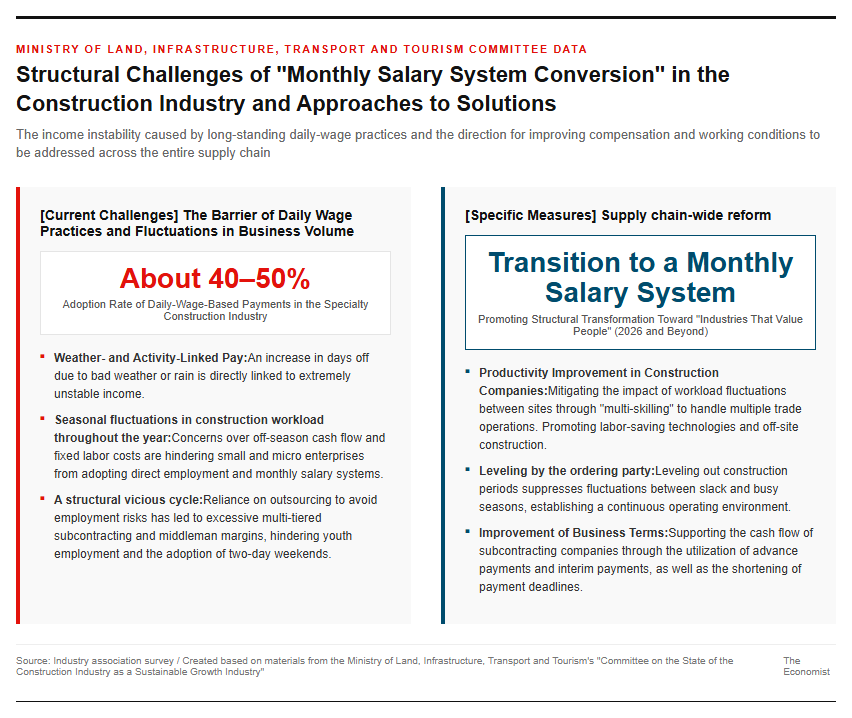
In the construction industry, particularly in the specialized contracting sector responsible for on-site construction work, the business practices of a “daily wage system” or a “daily-rate monthly salary system,” where pay fluctuates according to the weather and the number of days worked, remain deeply ingrained. According to surveys by industry organizations, daily-rate payments are adopted by approximately 40% to nearly half of specialized construction businesses. Because the daily wage system directly leads to a decrease in craft workers’ income due to work stoppages caused by inclement weather and an increase in days off during bad weather, it has also been pointed out as a factor hindering the establishment of the two-day weekend system being promoted across the industry.
The fundamental cause making the transition to a monthly salary system difficult is the fluctuation in the volume of construction work throughout the year. Construction work is prone to imbalances in on-site workloads depending on the season and the timing of orders, and small and medium-sized specialized construction companies, concerned about cash flow and the fixed nature of labor costs during off-peak seasons, find it difficult to take the plunge into directly employing technicians or adopting fixed salaries. As a result, it is analyzed that this strengthens the tendency to rely on subcontracting to avoid employment risks during off-peak periods, becoming a factor in the creation of an excessively multi-layered subcontracting structure and unnecessary intermediate margins (so-called skimming).
Specific Measures for Improving Treatment and Enhancing Productivity
A Multifaceted Approach for Construction Companies and Project Owners to Take
To transition skilled workers to a monthly salary system and stabilize their income, multifaceted efforts are required not only from individual construction companies, but also across the entire supply chain, including project owners. The draft policy guidelines presented by the Ministry of Land, Infrastructure, Transport and Tourism strongly urge construction companies to improve on-site productivity. Specifically, the guidelines propose mitigating the impact of busy and slack periods between construction sites by promoting “multi-skilling,” where a single worker handles multiple types of construction work, as well as introducing labor-saving technologies, “off-site manufacturing” involving pre-processing and pre-assembly of components, and the promotion of component standardization and normalization.
Meanwhile, ordering parties are being urged to thoroughly implement the “leveling of construction periods” to equalize work timing throughout the year. If the fluctuations of slack and busy seasons can be curbed in both public and private construction projects, contractors will find it easier to keep skilled workers continuously engaged. Furthermore, improving payment terms for construction work is also essential, with a strong emphasis on establishing an environment that supports contractors’ cash flow through the active utilization of advance and interim payments, as well as shortening payment deadlines between ordering and receiving parties.
Labor Management Support and the Creation of an Environment for Diverse and Flexible Work Styles
When introducing a monthly salary system, small and medium-sized and micro construction companies that have traditionally operated mainly on a daily wage system face labor management challenges, such as revising employment regulations and establishing personnel evaluation systems. To address this, the Ministry of Land, Infrastructure, Transport and Tourism is proposing the establishment of a support system by experts during the initial stage of introducing the monthly salary system and the transition period. By supporting the design of new personnel evaluations and incentives to replace the daily wage system, the aim is to facilitate a smooth transition to the new system for companies while enhancing the work motivation of skilled workers.
At the same time, the diversification of working styles and environmental improvements at construction sites became important subjects of discussion. To encourage the entry of a diverse workforce—including youth, women, and seniors—the promotion of flexible working arrangements was set forth, such as flexible start and end times, the allowance of reduced-hour shifts, and the utilization of flexible working hour systems on-site. As measures against the extreme heat associated with recent climate change, the creation of environments to reduce physical burdens was outlined, such as setting work schedules to avoid the scorching sun and establishing satellite hubs. Furthermore, the thorough utilization of the “Construction Career Up System (CCUS),” which evaluates the backgrounds and skills of technicians, is also included.
Legal Foundation and Future Outlook
Boost from the implementation of the third set of workforce-related laws and labor cost standards
The measures to improve the treatment of skilled workers being discussed in this study group are deeply intertwined with structural reforms already in motion as a legal framework. Based on the “third set of three laws concerning construction workers” enacted in 2024 (the Amended Construction Business Act, the Act on Ensuring Quality of Public Works, and the Act on Proper Tendering and Contracting for Public Works), the Amended Construction Business Act came into full effect on December 12, 2025. As a result, securing appropriate labor costs in construction contracts has been made mandatory, prohibiting the submission of estimates that fall significantly below the “standards regarding labor costs” established by the Central Construction Business Council, as well as the conclusion of below-cost contracts.
With the establishment of a system ensuring that appropriate labor costs (the source of wages) flow from contractors to subcontractors, and ultimately to on-site skilled workers, a transition is underway from conventional low-price competition to “healthy competition based on securing better treatment for skilled workers and their construction capabilities.” The Ministry of Land, Infrastructure, Transport and Tourism has set target values for skilled workers’ annual incomes by skill level utilizing CCUS, fostering an environment where appropriate wages are paid regardless of whether projects are public or private. The current discussions regarding the transition to a monthly salary system can be seen as an initiative to further enhance the effectiveness of these statutory rules and complete an employment foundation where skilled workers can work with peace of mind for the future.
Future Roadmap and Transformations Required in the Construction Industry
The “Study Group on the Ideal State of the Construction Industry as a Sustainable Growth Industry” plans to deepen discussions through its fourth meeting on themes such as “an industry that values people,” “an industry with true management capabilities,” and “an industry that continues into the future.” The Ministry of Land, Infrastructure, Transport and Tourism aims to compile these discussions by the summer of 2027, report them to the Central Council for Construction Industry, and formulate them as the basic guidelines for construction industry policy over the next 10 years.
Going forward, promotion of labor mobility measures in cooperation with the Ministry of Health, Labour and Welfare (such as revisions to the employment opportunity securing business for construction workers) and the consideration of mechanisms (such as revisions to the comprehensive construction business evaluation) to ensure that companies adopting monthly salary systems are fairly evaluated and more easily gain order opportunities in public works bidding and private orders are expected to proceed. The major focus moving forward will be whether the construction industry as a whole can break away from the “traditional business custom of using wages as a source of price cuts” and transform into a sustainable industrial structure that balances the shift of technicians to permanent employees with fixed salaries and the improvement of productivity.
Reference Page
- 【Committee on the Future of the Construction Industry as a Sustainable Growth Industry – Ministry of Land, Infrastructure, Transport and Tourism】https://www.mlit.go.jp/tochi_fudousan_kensetsugyo/const/tochi_fudousan_kensetsugyo_const_tk1_000001_00068.html
[#MinistryOfLandInfrastructureTransportAndTourism #ConstructionIndustry #SkilledWorkers #MonthlySalarySystem #TreatmentImprovement #ConstructionCareerUpSystem #WorkStyleReform #WorkingEnvironment]

コメント