As the government sets forth a policy to expand the scope of the discretionary labor system, bereaved families of those who died from overwork and lawyers held a rally in Tokyo to strongly urge that the eradication of death by overwork (karoshi) and work-related accidents be thoroughly ensured before any deregulation takes place. In the background lies a profound concern that if the system is introduced while the decision-making authority over workloads remains in the hands of employers, it will lead to the recurrence of boundless, long working hours and deaths from overwork.
- About 270 bereaved families, lawyers, and others gathered at a rally in Tokyo in October.
- The Gap Between “Choice of Working Hours” and “Overwork”
- The 2026 “Basic Policies” and Developments in the Ministry of Health, Labour and Welfare Councils
- The Health Impacts of “Presence or Absence of Discretion” as Shown by Government Statistics and University Research
- The “Freelancing of White-Collar Workers” Amid Concerns Over the Widespread Adoption of the Discretionary Labor System
- Outlook Toward Achieving Zero Work-Related Accidents and the Early Introduction of Work-Interval Regulations
About 270 bereaved families, lawyers, and others gathered at a rally in Tokyo in October.
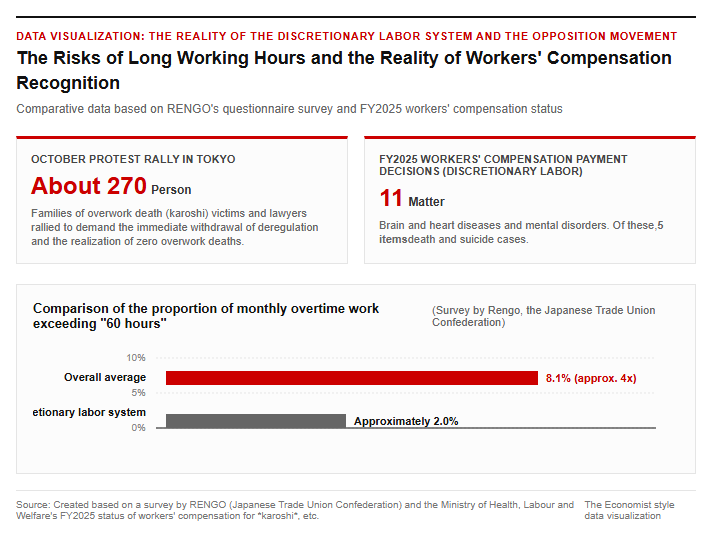
On October 9, 2026, an emergency rally hosted by the Japan Lawyers’ Council for Workers was held in Tokyo to oppose the expansion of job categories eligible for the discretionary labor system, drawing approximately 270 participants, including bereaved families of karoshi (death from overwork) and labor organization representatives. At the rally, attorneys and supporters who have worked on karoshi issues for many years took the stage, calling for stricter working hour regulations to protect the lives and health of workers. According to a survey released by the Japanese trade union confederation Rengo, while the proportion of workers with monthly overtime exceeding 60 hours stands at only about 2% on the overall average, it reaches 8.1% among those under the discretionary labor system and similar arrangements, revealing the reality that those subject to the system are exposed to prominent long working hours. Following the rally, participants staged a protest march against the casual expansion policy of the discretionary labor system and toward the eradication of karoshi. Even in the fiscal 2025 statistics on workers’ compensation for karoshi and related conditions, 11 cases of workers’ compensation benefit approvals for brain and heart diseases or mental disorders among workers under the discretionary labor system (including 5 deaths and suicides) were confirmed, underscoring the reality that the legal duty of care for workplace safety is not being adequately fulfilled.
The Gap Between “Choice of Working Hours” and “Overwork”
Eri Koike, a bereaved family member of a karoshi victim (Osaka Association of Families of Karoshi Victims), spoke at a gathering about the harrowing experience of her husband, who died of overwork at the age of 49 in October 2010. Koike’s husband served as the administrative manager at a nursing care facility operated by a social welfare corporation. While shouldering overnight shifts once or twice a week, he was forced to work overtime until late every night due to heavy workloads caused by staff shortages. Plagued by chronic sleep deprivation, he continually took short naps in his personal car during lunch breaks, and ultimately suffered a subarachnoid hemorrhage while working overtime, which led to his death. The Labour Standards Inspection Office recognized the death as a work-related accident, and the Wakayama District Court also issued a ruling acknowledging the corporation’s breach of its duty of care for employee safety. Regarding the government’s policy platform that “workers choose their working hours of their own free will,” Koike pointed out that as long as a structure exists in which employers unilaterally dictate the amount of work itself, workers have no real discretion whatsoever. The harsh realities on the ground—where employees are unable to refuse tasks due to understaffing and consideration for coworkers, ultimately driving them into grueling overwork—were strongly denounced.
Government Relaxation Policy and Labor-Management Conflict/Actual Data
The 2026 “Basic Policies” and Developments in the Ministry of Health, Labour and Welfare Councils
Since taking office, Prime Minister Takaichi has ordered a review into relaxing working hours regulations as part of her growth strategy, and the “Basic Policies” approved by the Cabinet in July 2026 also included a review of how the scope of the discretionary labor system should be defined. In response to this, the Labour Policy Council of the Ministry of Health, Labour and Welfare has been proceeding with full-scale discussions to organize key issues at a pace of two to three times a month since September 2026, and a bill is also expected to be submitted to the ordinary Diet session in 2027. The business community (Keidanren) is strongly requesting that problem-solving proposal work and shared service operations be added to the scope of the discretionary labor system, citing improved productivity and the promotion of autonomous working styles. Meanwhile, labor circles and legal defense teams point out that illegal operations and cases of abuse where application requirements are not met are already sporadically seen even under the current system, and have expressed their adamant opposition to a review that would hollow out working hours regulations, which are a fundamental principle of the Labor Standards Act. Factual surveys and research results from the Ministry of Health, Labour and Welfare also clearly reflect these risks in numerical terms. Please refer to the chart below.
The Health Impacts of “Presence or Absence of Discretion” as Shown by Government Statistics and University Research
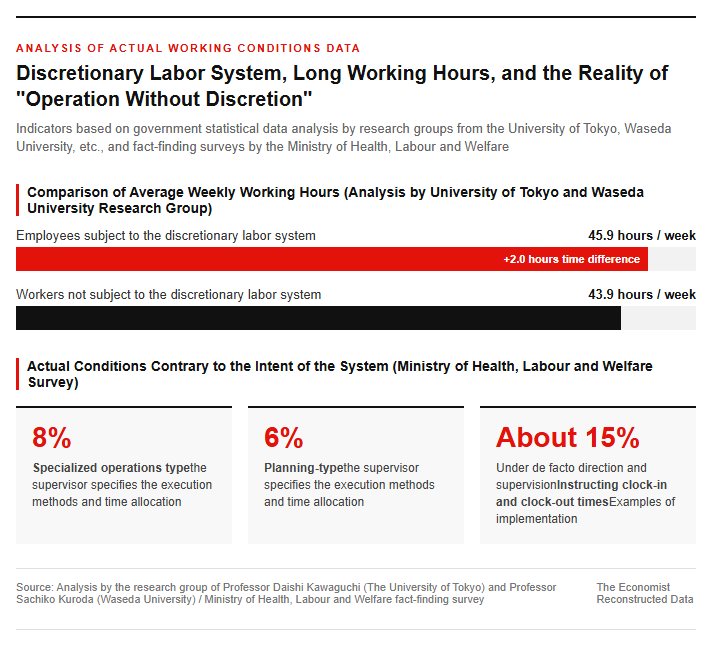
According to a research group including Professor Daiji Kawaguchi of the University of Tokyo and Professor Sachiko Kuroda of Waseda University, who analyzed government statistical data, it has been found that workers under the discretionary labor system work an average of 2 hours longer per week than those not under the system (45.9 hours per week for covered workers vs. 43.9 hours per week for non-covered workers). This study measured workers’ actual degree of discretion from five aspects, such as setting work goals and allocating time. While workers with substantial discretion showed no deterioration in health, it was scientifically proven that for “discretionless discretionary workers”—those to whom the system is applied while having low freedom in executing their tasks—long working hours cause significant health deterioration and a drop in job satisfaction. Furthermore, the Ministry of Health, Labour and Welfare’s 2022 fact-finding survey revealed that operations under actual direction and command that run counter to the intent of the system have become normalized; for instance, supervisors specify execution methods and time allocation for 8% of professional-type and 6% of planning-type discretionary workers, and give instructions on arrival and departure times for approximately 15%.
Organizational Impact and the Focus of Future Labor Policy
The “Freelancing of White-Collar Workers” Amid Concerns Over the Widespread Adoption of the Discretionary Labor System
According to an analysis by Mayo Morita of Mizuho Research Institute (Mizuho Bank), if the scope of the discretionary labor system is carelessly expanded to cover white-collar workers in general, there is a risk that it will bring about profound transformations in corporate organizations. When the means of executing work are left to individual discretion and evaluations lean heavily toward results, the in-group membership and sense of community traditionally held by Japanese companies will fade, and a transactional relationship of equals between workers and companies—the so-called “freelancing of white-collar workers”—will advance. Combined with the clarification of job scopes (job-based human resources), this change risks reducing mutual support among employees, leading to organizational siloization, the loss of serendipitous talent development opportunities, and excessive individualism. If companies introduce the system for the purpose of cutting overtime pay and management costs without taking appropriate job design and health-securing measures, it could simultaneously trigger the disintegration of the organization and the destruction of workers’ health. From the perspective of organizational management as well, challenges have been pointed out regarding the uncritical expansion of the discretionary labor system’s application. Please refer to the figure below.
Outlook Toward Achieving Zero Work-Related Accidents and the Early Introduction of Work-Interval Regulations
The central focus of future labor policy should not be prioritizing deregulation in the name of economic growth, but rather ensuring the thorough establishment of an environment that guarantees workers’ lives and health. Taking seriously the reality that workers’ compensation claims for mental disorders have surged to 4,958 per year—more than three times the figure from a decade ago—the Japan Association for Prevention of Karoshi and the National Defense Counsel for Victims of Karoshi argue that efforts to eliminate karoshi and reduce recognized workers’ compensation cases to zero must be the utmost priority. Specifically, given that only 6.9% of companies have introduced the “inter-shift interval system” (which secures a set rest period between the end of one shift and the start of the next), there is a growing consensus that making this regulation mandatory and strictly enforcing compliance with upper limits should take precedence over merely expanding the system. As parliamentary debates kick into gear from the fall of 2026 through the spring of 2027, the challenge extends beyond simply introducing flexibility in working hours; it demands effective health protection measures and the strict guarantee of workers’ autonomy.
Reference page
- [The University of Tokyo FOCUS] https://www.u-tokyo.ac.jp/focus/ja/articles/z0116_00229.html
- [Japan Labour Lawyers Association] https://roudou-bengodan.com/proposal/
- 【Japan Society for the Prevention of Overwork Deaths】https://www.jskr.net/
[#DiscretionaryLaborSystem #OverworkDeath #WorkStyleReform #WorkingEnvironment #WorkersAccidentRecognition #MinistryOfHealthLabourAndWelfare]


コメント