On September 25, 2026, Kyushu Railway Company and the SBI Group announced a basic agreement toward the introduction of a financial super app provisionally named “JQ BANK” exclusively for JR Kyushu Web members. By integrating lifestyle services such as railways and real estate with financial technology, they aim to launch the service during fiscal year 2027.
- Key Points of the Strategic Business Alliance and the “JQ BANK” Initiative Announced in September 2026
- Multifaceted Features of a Financial Super App Combining BaaS and FPaaS
- A unique railway economic zone leveraging a 5-million-strong customer base and “JR Qupo”
- Strengthening Non-Railway Operations and Enhancing Customer Lifetime Value in the Medium-Term Management Plan 2025-2027
- JR Kyushu’s Differentiation Strategy as Seen in Comparison with JR East and JR West
- The Regional Bank Landscape in Kyushu and Future Prospects Envisioned by Financial Super Apps
Key Points of the Strategic Business Alliance and the “JQ BANK” Initiative Announced in September 2026
Five companies—Kyushu Railway Company (JR Kyushu), SBI Holdings, SBI SECURITIES, SBI Shinsei Bank, and SBI Neo Financial Platform—announced on September 25, 2026, that they have entered into a basic agreement for a strategic business alliance. Under this partnership, JR Kyushu will leverage the financial technology provided by the SBI Group to begin concrete considerations for the introduction of “JQ BANK” (tentative name), a financial super-app exclusively for JR Kyushu Web members. The launch of the service is targeted for sometime in fiscal year 2027, with the precondition that JR Kyushu obtains a license for banking agency services with SBI Shinsei Bank as its affiliated bank.
Under this initiative, services that were previously deployed individually will be integrated. As shown in the conceptual diagram below, the plan is to unify various services within the application.
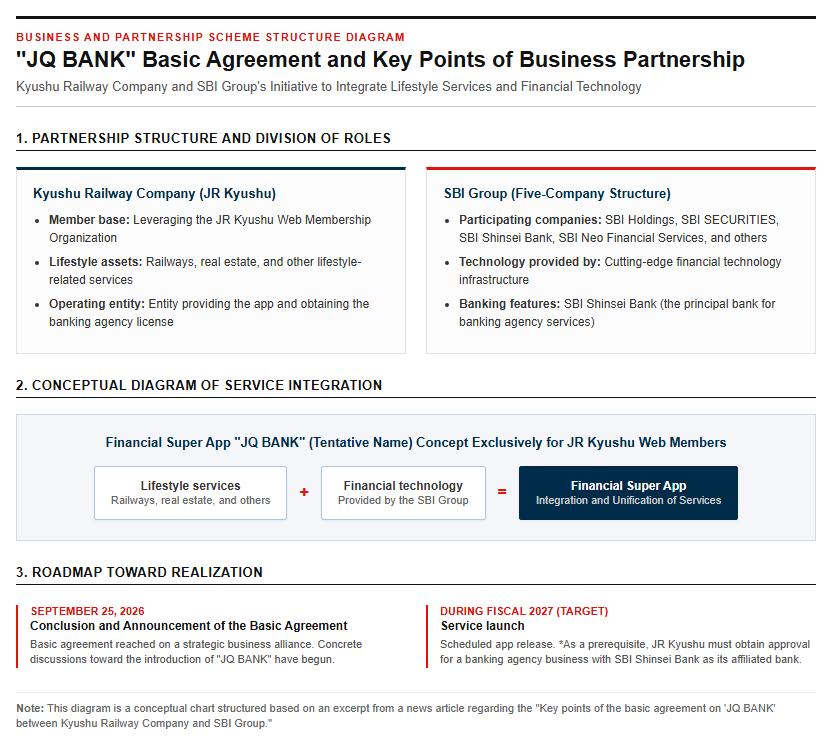
JR Kyushu has long offered the “SUGOCA” transportation IC card, the “JQ CARD” credit card, and the “JR Kyupo” points service. By linking these with the cutting-edge financial platform possessed by the SBI Group, the vision is to provide a new digital financial experience that seamlessly connects everyday financial services such as deposits and payments with asset building.
Multifaceted Features of a Financial Super App Combining BaaS and FPaaS
The most defining feature of JQ BANK lies in its diverse service functions as a “financial super app” that goes beyond mere banking services. Based on the comprehensive financial platform (FPaaS) developed by SBI Neo Financial Platform, the plan is to integrate SBI Shinsei Bank’s BaaS (Banking as a Service) functions, SBI SECURITIES’ brokerage services, as well as insurance, crypto assets, FX, stablecoin payments, and AI agent functions within a single app.
Specifically, as part of the collaboration with SBI Shinsei Bank, consideration is being given to awarding JR Kyupo points based on deposit balances and setting a certain number of free convenience store ATM withdrawals and free transfers to other banks. Additionally, the plans include offering the “SBI Hyper Deposit” yen deposit service—which is automatically reflected in SBI SECURITIES’ purchasing power—and applying special mortgage interest rates for JR Kyushu users. Furthermore, through collaboration with SBI SECURITIES, plans are underway to introduce a credit card-based mutual fund accumulation service using the “JQ CARD,” as well as a system allowing users to invest accumulated JR Kyupo points into domestic stocks—including JR Kyushu shares—and investment trusts.
The Background and Management Strategy Behind JR Kyushu’s Full-Scale Entry into the Financial Business
A unique railway economic zone leveraging a 5-million-strong customer base and “JR Qupo”
The greatest strength behind JR Kyushu’s full-scale entry into the financial services business lies in the massive customer touchpoints and strong membership base the company has cultivated. The scale of JR Kyushu’s app and point program members has reached the 5-million mark, forming a robust, lifestyle-integrated network across the entire Kyushu region. The company launched the membership rank service “JR Qupo Waku Waku Program” in April 2026, operating a system where benefits change depending on the number of services used and the registration status of JQ CARD and SUGOCA.
The JQ BANK initiative is designed to make this member base, along with the “JR Kyushu Web Member ID” and “JR Qupo,” function as a hub. It directly connects financial services with various businesses such as railways, station buildings, real estate, hotels, and retail and dining, building a mutual rewards cycle in which railway discount services and JR Qupo points are granted according to the usage history of financial transactions. As shown in the diagram below, the concept envisions expanding everyday customer touchpoints into finance.
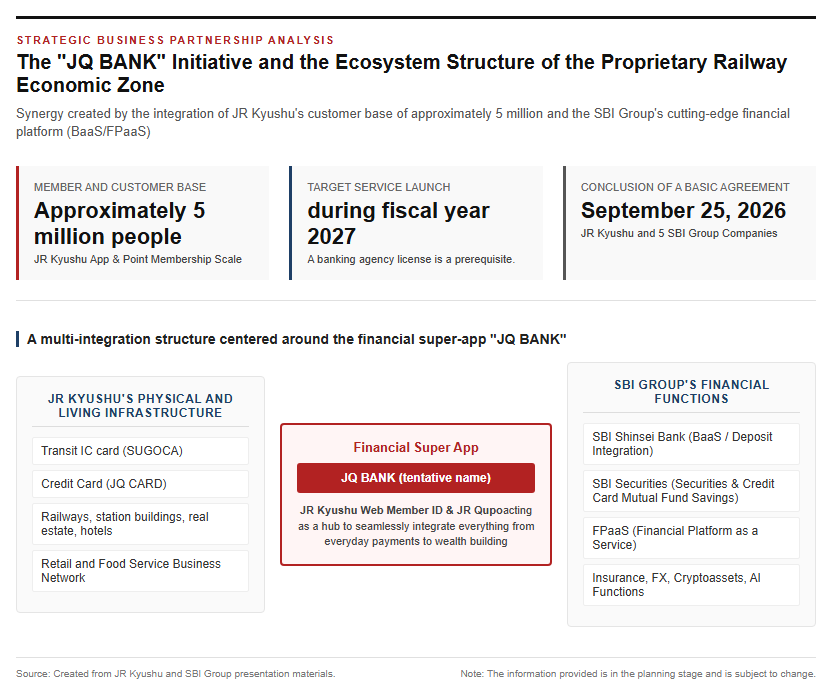
It aims to establish a unique railway economic sphere where users earn points by riding trains, use those points for savings and investments, and then enjoy travel and shopping once again with the increased points.
Strengthening Non-Railway Operations and Enhancing Customer Lifetime Value in the Medium-Term Management Plan 2025-2027
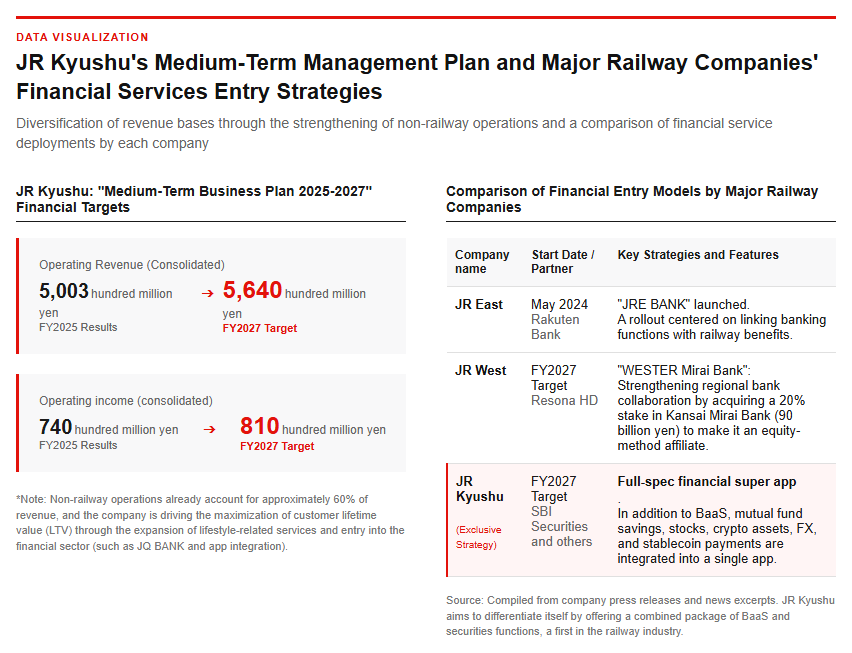
A look at JR Kyushu’s business structure shows that non-railway operations account for approximately 60% of its sales, and the company has advanced diversified business operations that do not depend on the traditional railway business. While the company recorded operating revenues of 500.3 billion yen and operating profit of 74 billion yen in fiscal 2025, its “Medium-Term Business Plan 2025–2027” sets a target of achieving operating revenues of 564 billion yen and operating profit of 81 billion yen by fiscal 2027. As it faces changes in mobility demand accompanying population decline and digitalization, further expanding lifestyle-related services has become essential for achieving sustainable revenue growth.
In this mid-term management plan, JR Kyushu has positioned “the evolution of the customer experience and the creation of new domains” as a key initiative, with its entry into the financial sector serving as a core policy. The aim is to enhance CRM initiatives that comprehensively analyze customer behavior and purchasing data, thereby accelerating cross-promotional customer referrals across the group’s various businesses. By combining financial data—such as deposits and asset management—with lifestyle data, the company aims to maximize customer lifetime value (LTV) and has outlined a strategy to cultivate the financial business as a “third revenue pillar” following railways and real estate.
The Financial Entry Trend in the Railway Industry and Its Spillover Effects on the Regional Economy
JR Kyushu’s Differentiation Strategy as Seen in Comparison with JR East and JR West
The entry of major railway companies into the financial sector has expanded rapidly in recent years. Starting with JR East launching “JRE BANK” in collaboration with Rakuten Bank in May 2024, companies are successively moving to financialize their own economic spheres, such as JR West partnering with Resona Holdings with the aim of launching “WESTER Mirai Bank” in fiscal 2027. JR West is adopting a strategy that goes as far as investing in financial institutions, such as acquiring a 20% stake in Kansai Mirai Bank for 90 billion yen to make it an equity-method affiliate.
Compared to these preceding examples, JR Kyushu’s differentiation strategy lies in its aiming for a “full-spec financial super app” from the very beginning. While JR East focuses on linking banking functions with railway benefits and JR West strengthens collaboration with regional financial institutions, JR Kyushu has outlined a policy to integrate not only BaaS-enabled banking functions, but also mutual fund accumulation and stock investment through a partnership with SBI Securities, cryptocurrencies, foreign exchange (FX), and even stablecoin payments into a single app. Through the railway industry’s first combined offering of BaaS and securities functions, it aims to deliver a comprehensive service that integrates mobility and wealth creation.
The Regional Bank Landscape in Kyushu and Future Prospects Envisioned by Financial Super Apps
The birth of JQ BANK could also have a significant impact on the future outlook of the financial markets and regional economy in Kyushu. The Kyushu region is home to numerous influential and deeply rooted regional banks, such as the Bank of Fukuoka, Nishi-Nippon City Bank, Higo Bank, Kagoshima Bank, Minami-Nippon Bank, and Oita Bank. JR Kyushu has a history of collaborating with regional financial institutions through initiatives like issuing various credit cards, and its entry into the financial sector is seen not as a simple structure of confrontation with regional banks, but as creating a new relationship of coexistence and competition in the digital realm.
Moving forward, the focus will be on the progress of development toward the service launch in fiscal 2027 and the high quality of the user experience. As shown in the system integration concept diagram below, every touchpoint of community life is expected to be consolidated into the app.
By combining JR Kyushu—which possesses a railway network spanning the entire Kyushu region and physical touchpoints for daily life such as station buildings and hotels—with the SBI Group’s online financial technology, the broad “Kyushu economic zone” covering all seven prefectures of Kyushu will be strengthened. If an environment is established where users can seamlessly handle travel, shopping, deposits, and investments through a single app, it is expected to widely take root as a new lifestyle infrastructure in regional cities.
Reference page
- 【JR Kyushu and SBI Group: Basic Agreement Toward Strategic Business Partnership (Press Release)】https://prtimes.jp/main/html/rd/p/000001379.000037933.html
- [Kyushu Railway Company News Release] https://www.jrkyushu.co.jp/common/inc/news/newtopics/__icsFiles/afieldfile/2026/09/24/20260925_Basic_agreement_for_a_strategic_business_partnership.pdf
- [SBI Holdings, Inc. News Release] https://www.sbigroup.co.jp/news/2026/0925_16607.html
【#JQBANK #JRKyushu #SBIHoldings #FinancialSuperApp #RailwayEconomicSphere #SBIShinseiBank】

コメント