It has been revealed that the Bank of Japan is highly likely to keep its policy interest rate unchanged at the monetary policy meeting at the end of this month. This is because, while the economy and prices have moved as expected following the rate hike in September 2026, upward risks to prices are not high enough to necessitate immediate consecutive rate hikes, and there is a need to carefully assess uncertainties in overseas developments.
- Economic and Price Trends and the Current State of Monetary Policy After the September Rate Hike
- The Shift to Positive Real Wages and Uncertainty in Global Conditions
- The Nikkei Stock Average Rebound and the Dollar-Yen Exchange Rate Tug-of-War
- Scenarios for the Banking, Real Estate, and High-Tech Sectors
- Expectations for Additional Rate Hikes in December 2026 and the Impact of the U.S. CPI
- Long-term impact on personal financial products and household budgets
Economic and Price Trends and the Current State of Monetary Policy After the September Rate Hike
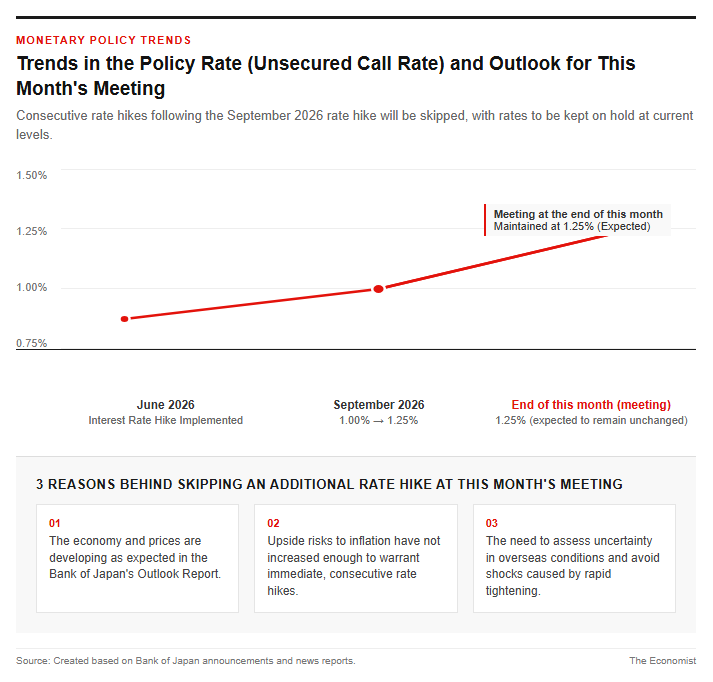
At its monetary policy meeting in September 2026, the Bank of Japan (BOJ) decided to raise the policy interest rate (the uncollateralized overnight call rate) from 1.00% to 1.25%. This followed another rate hike in June of the same year, and because the increase came after a short interval of just three months, caution had spread in the market that the pace of monetary normalization would accelerate. However, it has become clear that at the monetary policy meeting to be held at the end of this month, the BOJ is likely to leave the policy interest rate unchanged at 1.25%. Since the September rate hike, Japan’s economic and price trends have generally moved in line with the outlook presented in the BOJ’s Outlook Report. Nevertheless, it is judged that upside risks to prices have not increased to the extent that additional rate hikes must be implemented at two consecutive meetings. Within the BOJ, there is a strong intention to assess whether the virtuous cycle between prices and wages will become more robust, while avoiding the shock that rapid monetary tightening could inflict on the domestic economy. For market participants as well, the expectation of a hold at this month’s meeting comes as no surprise, and is being welcomed as a mitigating factor that alleviates concerns over an overly rapid pace of rate hikes. As shown in the figure below, stability in monetary policy brings a sense of security to the market.
The Shift to Positive Real Wages and Uncertainty in Global Conditions
One of the primary reasons behind holding off on additional rate hikes is the trend in real wages, which serve as an indicator of household purchasing power. Although high wage increases have been achieved in the Shunto spring labor negotiations since 2025, real wages have yet to secure a stable footing in positive territory as the Consumer Price Index (core CPI) continues to hover around 2.5% year-on-year. BOJ leadership, including Governor Ueda, wants to confirm that sustainable wage growth capable of outpacing inflation has firmly taken root across a wide range of industries, including manufacturing and small and medium-sized enterprises (SMEs). Furthermore, uncertainty in the external environment is reinforcing the cautious stance on rate hikes. In the United States, global crude oil prices remain stubbornly high due to the impact of the Trump administration’s tariff policies and escalating tensions in the Middle East, heightening concerns over downside risks to the global economy. In addition, a mountain of overseas-originating disruptive factors is piling up, including the trajectory of the U.S. Federal Reserve’s (FRB) monetary policy and delays in various economic data releases stemming from concerns over a potential U.S. government shutdown. By deliberately adopting a reactive approach, the BOJ is avoiding the risk that premature rate hikes could snuff out the nascent virtuous cycle of inflation, and this cautious stance is strongly reflected in its decision at the October policy meeting.
The Nikkei Stock Average Rebound and the Dollar-Yen Exchange Rate Tug-of-War
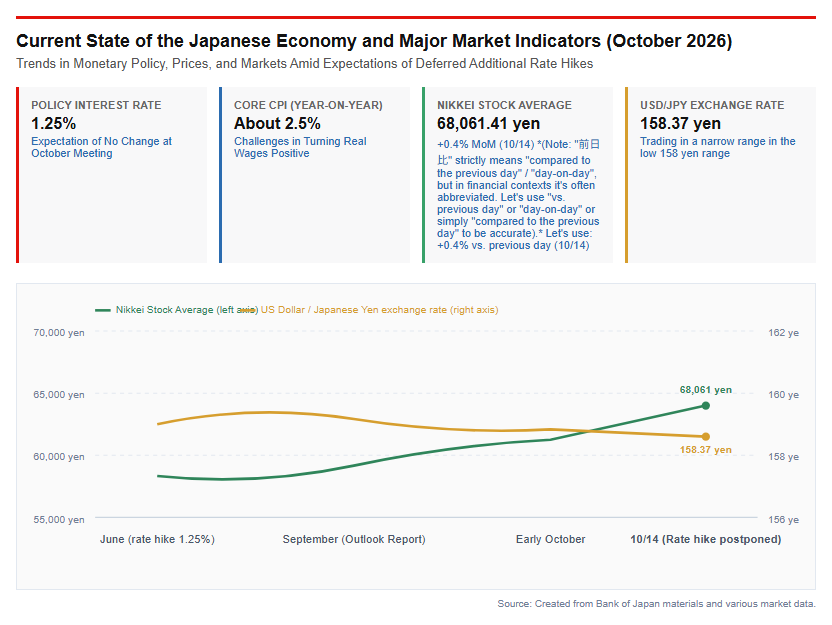
Following reports that the Bank of Japan will forgo a rate hike at this month’s meeting, a sense of relief has spread across financial markets. On the Tokyo stock market on October 14, 2026, the Nikkei Stock Average rebounded as concerns over premature monetary tightening eased, at one point rising 0.4% from the previous day to 68,061.41 yen. Buying was led particularly by AI and semiconductor-related stocks such as Kioxia Holdings and Taiyo Yuden, with solid expectations for corporate earnings supporting the market. Meanwhile, in the foreign exchange market, the dollar-yen exchange rate continued to trade in a narrow range in the lower half of the 158 yen zone. Immediately following the reports of the skipped rate hike, there were moments when it rose to 158.37 yen on temporary yen-selling and dollar-buying, but follow-through movement was limited. Markets remain heavily cautious ahead of the release of the US September Consumer Price Index (CPI) scheduled for the night of October 14, leading to a directionless trend driven by a desire to assess the results. In addition, as the weak-yen phase approaches the 159 yen level, caution grows regarding potential currency intervention by the Japanese government and the Bank of Japan, keeping the upside heavy ahead of the 160 yen psychological milestone. As the following graph shows, a complex correlation can be seen between foreign exchange and stock prices.
Scenarios for the Banking, Real Estate, and High-Tech Sectors
Changes in interest rate trends are having varying impacts across different sectors of the stock market. The decision to forgo rate hikes has created short-term selling pressure on financial sectors such as bank stocks. The Tokyo Stock Price Index (TOPIX) dipped into negative territory partly because the decline in bank stocks—driven by receding expectations for margin expansion—acted as a heavy weight. However, in the banking sector, this is merely a “postponement of the timing for additional rate hikes” rather than the “end of rate hikes,” meaning that the structural earnings improvement narrative aimed at correcting PBRs below 1x remains intact. On the other hand, for the real estate sector and J-REITs, which carry high levels of interest-bearing debt, avoiding the risk of soaring interest rates provides a sense of relief in the short term. Nevertheless, concerns over rising funding costs persist in an environment where long-term interest rates remain high at around 1.0%. As for high-tech and growth stocks, valuation adjustment pressures from rising interest rates are easing, while the expansion of demand for generative AI in the U.S. is serving as a catalyst for rising share prices. In this way, depending on the “pace” and “level” of interest rates, selective investment stances across TSE sectors are intensifying further.
Outlook for Future Monetary Normalization and Key Events to Watch
Expectations for Additional Rate Hikes in December 2026 and the Impact of the U.S. CPI
Following the Bank of Japan’s decision to hold off on a rate hike, market focus has shifted from “this month” to the “December 2026 or January 2027 meeting.” This does not mean that the fundamental course of rate hikes has been retracted, and the probability of an additional rate hike at the December meeting remains heavily priced in by the market at around 80%. The single biggest key for future decision-making will be the U.S. September Consumer Price Index (CPI), to be released on October 14, as well as future trends in energy prices. If U.S. core CPI exceeds the 2.5% forecast, expectations for continued rate hikes by the Fed will grow, potentially accelerating dollar appreciation and yen depreciation due to the Japan-U.S. interest rate differential. If import inflation pressure caused by the weaker yen re-emerges, the BOJ will have no choice but to implement an additional rate hike at the December meeting. Conversely, if U.S. inflation slows and the pricing-in of a December rate hike unwinds, there is also the risk of yen appreciation driven by market position adjustments. The BOJ will time its actions while carefully assessing the trial-and-error state of U.S. monetary policy—led by Fed Chair Jerome Powell and others—and remaining vigilant against a sudden spike in market volatility associated with simultaneous policy pivots in Japan and the U.S.
Long-term impact on personal financial products and household budgets
Keeping monetary policy unchanged also provides a temporary reprieve for individuals’ asset management and loan repayments. In the mortgage market, concerns over an increased repayment burden for households have eased, as rapid hikes in floating interest rates linked to the policy rate were avoided. However, turning to the government bond market, the newly issued 10-year government bond yield remains at a high level of around 3.015%, staying in the 3% range, and the upward trend in long-term interest rates—reflecting inflation and concerns over future fiscal deterioration—continues. Influenced by this, the interest rates for retail government bonds offered in October 2026 have all recorded their highest levels since the start of the Reiwa era: 2.07% for the 3-year fixed-rate, 2.39% for the 5-year fixed-rate, and 2.05% for the 10-year variable-rate bonds. Along with a full-scale return to a world with interest rates, households are expected not to rely solely on deposits, but rather to diversify their purchases of government bonds with different maturities and shift toward assets that perform well in a rising interest rate environment. Rather than simply viewing the “postponement of rate hikes” with optimism, it is crucial to formulate financial plans with a clear view of the irreversible, medium-to-long-term trend of rising interest rates.
Reference Page
- [Bank of Japan Monetary Policy Meeting] https://www.boj.or.jp/
- [National Diet Library “The Bank of Japan’s Monetary Policy Heading Toward Normalization”] https://dl.ndl.go.jp/
[#BankOfJapan #MonetaryPolicy #RateHikeHold #NikkeiAverage #USDJPY #JapaneseEconomy #AssetManagement]


コメント