Fueled by a massive surge in semiconductor exports, South Korea’s annual export volume is on track to surpass the historic \$1 trillion milestone for the first time. This unprecedented growth is primarily driven by explosive global demand for advanced memory chips, sparked by the rapid expansion of artificial intelligence markets.
- The Core News: Heading Toward an Unprecedented $1 Trillion, Reaching ~98% of Last Year’s Total in Just 8 Months
- Surpassing Japan for the First Time: South Korea Outperforms Japan and Taiwan in H1 Exports
- The AI Semiconductor Supercycle: Capitalizing on Global Investment Surges
- Severe Concentration in Large Conglomerates: The Deepening “K-Shaped” Polarization
- The Disconnect Between the Real Economy and Financial Markets: Record Exports Meet a Depreciating Won
- Future Trajectory and Key Milestones: Entering the Global Top 4 and Navigating External Risks
The Core News: Heading Toward an Unprecedented $1 Trillion, Reaching ~98% of Last Year’s Total in Just 8 Months
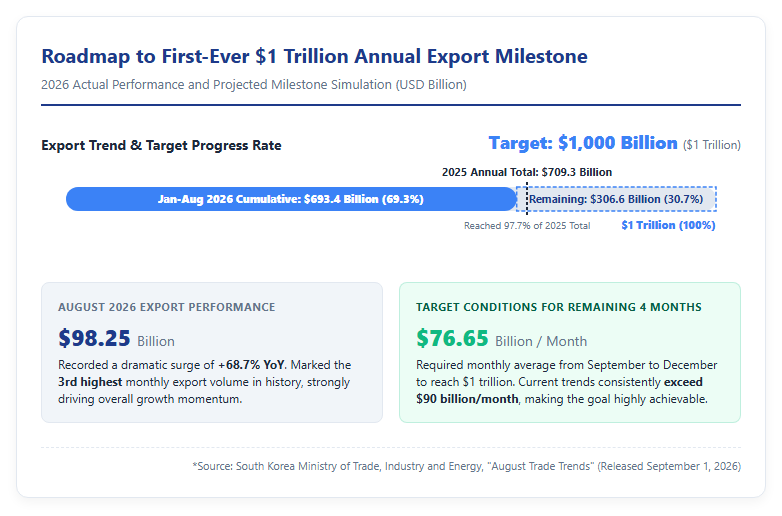
South Korea is on the verge of breaking the historic \$1 trillion mark in annual export value for the first time. According to the August Trade Trends report released by the Ministry of Trade, Industry and Energy on September 1, 2026, the country’s exports for August reached \$98.25 billion, representing a dramatic 68.7% increase compared to the same month last year. This remarkable figure marks the third-highest monthly export volume in South Korean history. From January to August 2026, cumulative exports reached \$693.4 billion, which already accounts for 97.7% of the \$709.3 billion total recorded for the entire year of 2025. Achieving this level in just eight months makes the \$1 trillion target highly feasible. To hit this milestone over the remaining four months, South Korea needs approximately \$306.6 billion in total exports, or a monthly average of about \$76.65 billion. Given that monthly exports have consistently exceeded the \$90 billion mark recently, this target is statistically well within reach. The rapid acceleration of export volume is illustrated in the following trend chart.
Surpassing Japan for the First Time: South Korea Outperforms Japan and Taiwan in H1 Exports
A symbolic milestone of South Korea’s economic momentum in 2026 is its displacement of Japan in export volume for the first time in history. A joint analysis of national trade statistics by the Nikkei and Mitsubishi UFJ Research and Consulting revealed that South Korea’s exports in the first half of 2026 (January–June) reached \$496.3 billion. In contrast, Japan’s exports stood at \$384.4 billion and Taiwan’s at \$416.6 billion, marking a historic shift where South Korea outpaced both competitors. While Japan’s export growth was sluggish at under 10% compared to the first half of last year, both South Korea and Taiwan recorded blistering growth rates of nearly 50%. This gap was decisively widened by the explosive demand for semiconductors driven by the expanding AI sector. In the first half of 2026 alone, South Korea’s integrated circuit exports reached \$149 billion, surpassing its full-year total for 2025. Semiconductors accounted for approximately 30% of total exports in both South Korea and Taiwan, compared to a mere 5% in Japan, demonstrating how capacity in high-value-added final products translates directly into trade performance.
AI Semiconductors Driving Structural Trade Transformation
The AI Semiconductor Supercycle: Capitalizing on Global Investment Surges
The primary engine behind South Korea’s explosive export growth is the arrival of a semiconductor supercycle driven by the global artificial intelligence boom. Capital expenditure on data centers by hyperscale cloud service providers and AI developers has reached fever pitch, fueling massive demand for high-value-added memory chips. At the forefront of this trend are high-bandwidth memory (HBM) and the latest DDR5 DRAM chips, which are critical components for AI servers. During the first four months of 2026, South Korea’s semiconductor exports surged approximately 2.5 times to reach \$110.40209 billion, representing over a third of the nation’s total exports in a single product category. South Korean memory giants like Samsung Electronics and SK Hynix have secured a dominant position in the global AI supply chain, capturing the lion’s share of this burgeoning demand. This fundamental strength in the production of high-value components gives South Korea a powerful competitive advantage in the race for value-added capture.
Severe Concentration in Large Conglomerates: The Deepening “K-Shaped” Polarization
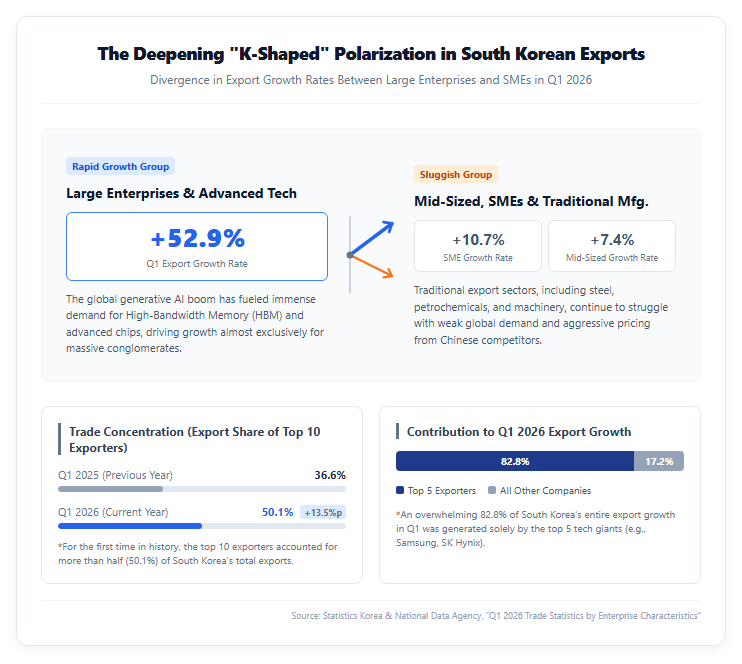
Behind the glittering headlines of record-breaking export figures lies a widening and structural disparity between large conglomerates and small-to-medium enterprises, as well as between high-tech and traditional manufacturing. According to the Q1 2026 Trade Statistics by Enterprise Characteristics report published by Statistics Korea and the National Data Agency, the trade concentration of the top ten exporters reached 50.1%, surpassing the 50% threshold for the first time in history. This represents a steep rise of 13.5 percentage points from the 36.6% recorded in the same quarter of the previous year. Furthermore, the top five companies, centered around Samsung Electronics and SK Hynix, alone accounted for 43.5% (\$95.7 billion) of total exports. Strikingly, 82.8% of South Korea’s entire export growth in the first quarter was generated by these five companies. This concentration indicates that the fruits of the current boom are concentrated in a tiny group of tech giants. Meanwhile, traditional backbones of the export economy, such as steel, petrochemicals, and general machinery, continue to struggle under the weight of weak global demand and aggressive pricing from Chinese manufacturers, entrenching a K-shaped recovery. The structural divergence in export growth between large enterprises and SMEs is illustrated in the diagram below.
Divergence of Economic Indicators and Future Outlook
The Disconnect Between the Real Economy and Financial Markets: Record Exports Meet a Depreciating Won
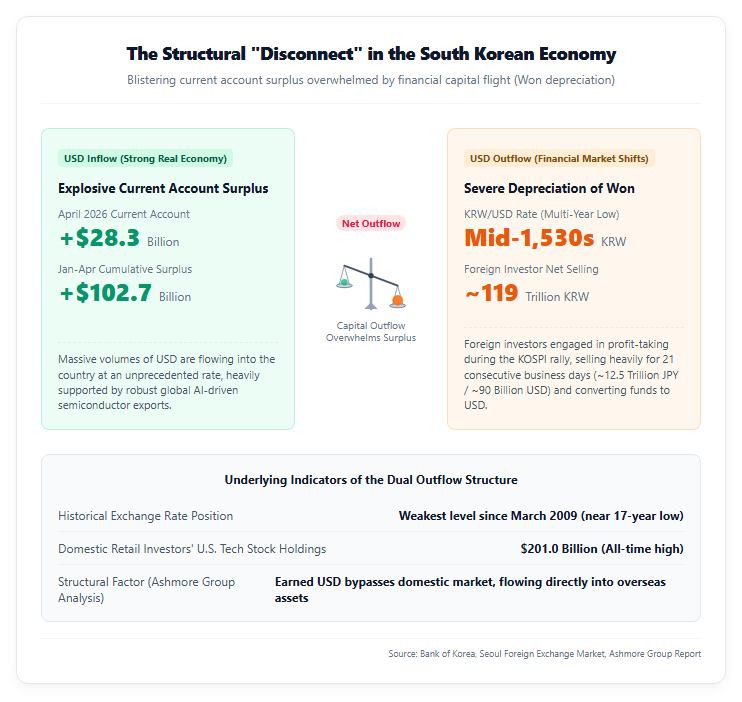
The South Korean economy is currently navigating a highly unusual disconnect: a massive current account surplus running parallel to a sharply depreciating Korean Won. According to the Bank of Korea, the country registered a current account surplus of \$28.3 billion in April 2026, pushing the cumulative surplus for the first four months of the year to an astonishing \$102.7 billion. Normally, such a vast influx of foreign currency would drive up the value of the Won. However, the local currency has instead plummeted in the Seoul foreign exchange market, temporarily sinking into the mid-1,530s per US dollar. This represents the weakest level for the Won since March 2009, a near 17-year low. This divergence is driven by substantial capital flight from South Korea’s financial markets. Following a sharp run-up in the domestic stock market, foreign investors engaged in heavy profit-taking, net-selling for 21 consecutive business days and pulling out approximately 119 trillion Won (about 12.5 trillion Yen) to convert into US dollars. Additionally, domestic retail investors have accumulated a record \$201 billion in US tech stock holdings, creating a double outflow structure where earned dollars bypass the domestic market and flow directly abroad, exerting heavy downward pressure on the Won. This paradox of a booming export sector and a weak currency is shown in the exchange rate chart below.
Future Trajectory and Key Milestones: Entering the Global Top 4 and Navigating External Risks
Should South Korea successfully break the \$1 trillion annual export threshold, it will significantly elevate its position in global trade architecture. By surpassing the Netherlands, which historically averages around \$900 billion in annual exports, South Korea is poised to secure a spot among the top four global exporters. However, the medium-term outlook contains significant hurdles. South Korea’s heavy reliance on a single sector and a small hand of giant conglomerates leaves the macroeconomy highly vulnerable to any downturn in the global tech cycle, potential cooldowns in AI capital expenditure, or cyclical drops in chip prices. Furthermore, external uncertainties loom large, including shifts in US tariff policies, the protracted war between Russia and Ukraine, and escalating geopolitical tensions in the Middle East that could trigger oil price shocks. As South Korea depends on crude oil and natural gas for 55% of its primary energy, and sources the vast majority of it from the Middle East, high energy prices remain a significant drag on domestic growth. To ensure this historic boom translates into long-term, sustainable economic strength, South Korea’s key priorities must be bolstering the export competitiveness of its SMEs and diversifying its industrial portfolio away from extreme tech concentration.
Reference Page
- [JETRO South Korea Trade & Investment Report] https://www.jetro.go.jp/world/asia/kr/gtir.html
【#SouthKoreaEconomy #SemiconductorExports #AIBoom #TradeBalance #WeakWon #BusinessEconomy #KoreaDiscount #KShapedRecovery】


コメント