- Ballooning Deficit-Covering Debt and the 150 Trillion Yen Threshold by 2030
- The Impending Breach of the 60% GDP Debt Threshold and Downgrade Risks
- Unprecedented Fiscal Expansion and the Era of the 1,000 Trillion Won Budget
- Vulnerabilities Stemming from Extreme Reliance on a Single Industry
- Expanding Welfare Commitments and the Hardening of the National Budget
- Approaching Depletion of Public Insurances and the Direction for Structural Reform
Ballooning Deficit-Covering Debt and the 150 Trillion Yen Threshold by 2030
Concerns over the sustainability of South Korea’s public finances are mounting rapidly. According to the fiscal year 2025 national audit, the country’s national debt reached 1,304.5 trillion won, representing a sharp year-on-year increase of 129.4 trillion won—the largest annual spike since the 1997 Asian financial crisis. Government projections indicate that national debt will rise from 1,519.8 trillion won next year to 1,734.1 trillion won (approximately 202.3 trillion yen) by 2030. Within this total, deficit-covering debt—which lacks corresponding backing assets and must eventually be repaid using taxpayer money—is expanding at an alarming rate, with estimates showing it will exceed 150 trillion yen by 2030. Although net new bond issuance to curb further borrowing is projected to decline to 96.3 trillion won (approximately 11.2 trillion yen), refinancing demands to pay off existing debt are surging; bond issuance for maturity redemption is set to jump by 20.2 trillion won to 110.7 trillion won (about 12.9 trillion yen) next year. Furthermore, skyrocketing government bond yields are placing a heavy burden on public finances, with the 3-year treasury yield closing at 3.878%—a sharp 0.925 percentage point rise from 2.953% at the end of last year. These compounding factors are rapidly undermining South Korea’s fiscal health.
The Impending Breach of the 60% GDP Debt Threshold and Downgrade Risks
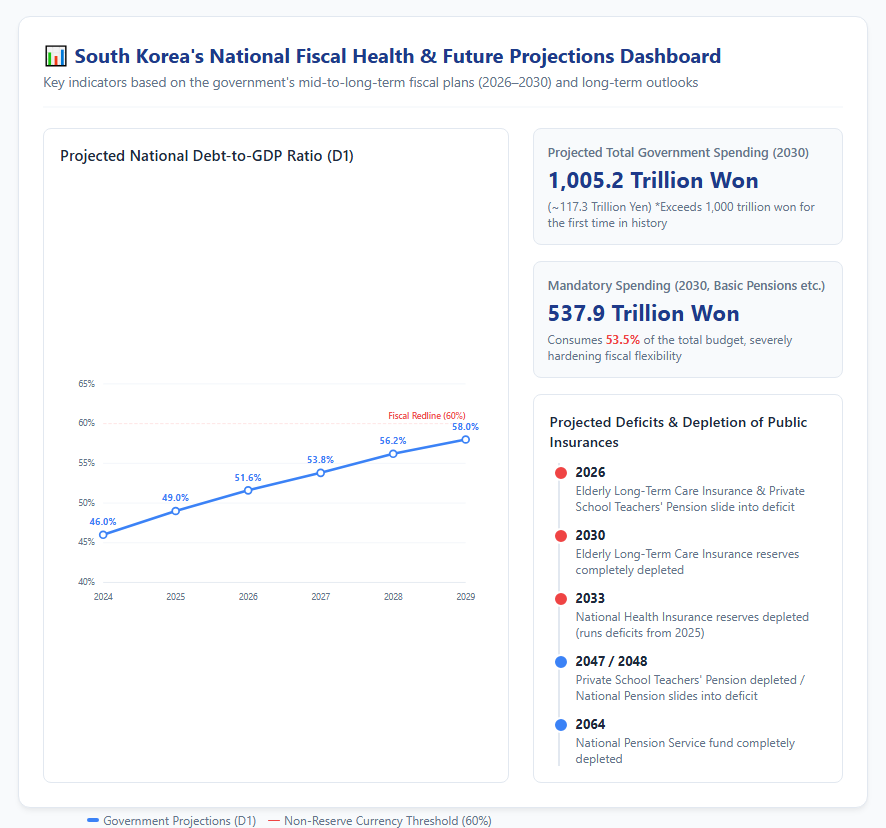
As South Korea’s debt continues to accumulate, its national debt-to-GDP ratio (D1) is deteriorating rapidly. The ratio climbed from 46.0% in 2024 to 49.0% in 2025, marking the sharpest single-year increase since the COVID-19 pandemic in 2020. Government plans project the ratio to climb further to 51.6% in 2026, 53.8% in 2027, 56.2% in 2028, and 58.0% in 2029, making a breach of the critical 60% fiscal threshold highly likely by 2030. For non-reserve currency nations, a 60% debt-to-GDP ratio is widely considered a psychological redline for maintaining international economic stability. The International Monetary Fund (IMF) paints an even bleaker picture, revising its projection for South Korea’s general government debt-to-GDP ratio (D2) up by more than 5 percentage points to 64.3% by 2030. Data from the Bank for International Settlements (BIS) reveals that South Korea’s central and local government debt-to-GDP ratio surged fivefold from 9% to 45.3% over the 24 years between September 2000 and September 2024. This rate of debt accumulation is more than twice as fast as that of the United States, which saw its debt ratio double from 51.1% to 107.4% over the same period before experiencing sovereign credit downgrades. Consequently, worries are intensifying that global rating agencies such as S&P, Fitch, and Moody’s may soon downgrade South Korea’s sovereign credit rating. Please refer to the diagram below.
The 1,000 Trillion Won Budget and the Pitfalls of the “Semiconductor Illusion”
Unprecedented Fiscal Expansion and the Era of the 1,000 Trillion Won Budget
The South Korean government has formalized an era of massive spending, with the national budget projected to surpass 1,000 trillion won (approximately 116.6 trillion yen) for the first time in history by 2030. According to the mid-term fiscal management plan (2026–2030) released by the Ministry of Planning and Budget, total government expenditures will reach 1,005.2 trillion won (approximately 117.3 trillion yen) by 2030. Under the five-year term of the Lee Jae-myung administration, cumulative spending is expected to increase by approximately 332 trillion won (about 38.7 trillion yen)—an expansion nearly equivalent to the combined spending increases of the three previous administrations (Park Geun-hye, Moon Jae-in, and Yoon Suk-yeol), which totaled 348 trillion won. However, this aggressive expansion relies heavily on optimistic revenue forecasts tied to the current semiconductor boom. The government expects national tax revenue to increase at an average annual rate of 13.4%, reaching 644.8 trillion won (about 75.2 trillion yen) by 2030. Meanwhile, the managed fiscal balance—the ultimate indicator of the government’s actual financial position—will see its deficit temporarily narrow to 3.1 trillion won next year, only to balloon back to 100.8 trillion won (about 11.8 trillion yen) by 2030. This would push the deficit-to-GDP ratio to 2.9%, dangerously close to the government’s mid-term target ceiling of 3%. Economists warn that assuming this peak semiconductor boom will persist indefinitely is highly reckless.
Vulnerabilities Stemming from Extreme Reliance on a Single Industry
The Organisation for Economic Co-operation and Development (OECD) has cautioned that South Korea’s current export-driven boom is a “semiconductor illusion” that masks deep structural weaknesses. In May of this year, semiconductors accounted for a staggering 42.3% of South Korea’s total exports—an extreme level of concentration compared to the roughly 10% seen in the 1990s. Excluding semiconductors and computer-related products, the export growth rate of other industries is a sluggish 9.5%. This imbalance is equally stark in capital markets, where the two semiconductor giants, Samsung Electronics and SK Hynix, make up half of the stock market’s total capitalization. Although the KOSPI index recently surged from the 3,000-point level to 8,800 points, this rally was overwhelmingly driven by these two stocks. This vulnerability recalls the painful lessons of 1996, when a 51% drop in DRAM prices decimated trade balances and paved the way for the 1997 IMF crisis. The OECD warns that if the current semiconductor boom cannot be converted into broader corporate investment and productivity growth, South Korea’s potential economic growth rate could fall below an all-time low of 1.5% next year. If the DRAM cycle turns downward, capital flight sparked by fears over South Korean assets could trigger severe instability in both the KOSPI and the foreign exchange market.
Aging Demographics, Surging Mandatory Spending, and the Path to Reform
Expanding Welfare Commitments and the Hardening of the National Budget
The most significant structural driver behind South Korea’s growing debt is the world’s fastest-aging population and the subsequent explosion in social welfare demands. Mandatory spending dictated by law—such as basic pensions—is projected to grow at an average annual rate of 8.5%, reaching 537.9 trillion won (approximately 62.7 trillion yen) by 2030. This will swallow 53.5% of the total national budget, effectively turning more than half of the government’s annual expenditures into fixed, unalterable costs. While discretionary spending—the funds the government can actively allocate—is also projected to rise at an annual rate of 8.3% to fund high-tech industries and birthrate initiatives, the surge in mandatory spending severely limits the state’s fiscal flexibility. Should external shocks like energy price hikes from geopolitical risks in the Middle East or a broader global economic slowdown occur, the fiscal deficit could easily breach the government’s target of 3% of GDP, potentially causing the state to lose control over its fiscal trajectory.
Approaching Depletion of Public Insurances and the Direction for Structural Reform
To prevent a medium-to-long-term fiscal collapse, proactive measures must be taken to address the rapid depletion of South Korea’s public social insurance systems. According to the Ministry of Economy and Finance’s third long-term fiscal outlook (2025–2065), the National Health Insurance system will slip into a deficit next year, with its reserves completely depleted by 2033. The long-term care insurance for the elderly is projected to enter a deficit in 2026 and run out of reserves by 2030. Meanwhile, the private school teachers’ pension fund is expected to deplete by 2047, followed by the National Pension Service fund in 2064. The insolvencies of these major public programs will ultimately translate into deficit-covering debt borne directly by the public. As the debt-to-GDP ratio rises, the risk of sovereign rating downgrades escalates, which experts warn will trigger mandatory, painful fiscal stabilization measures. Moving forward, the critical focal points for securing South Korea’s fiscal future lie not only in pension reforms but also in executing comprehensive tax reforms to expand the revenue base and fostering new growth industries to break the country’s over-reliance on semiconductors.
Reference Pages
- 【OECD: Korea’s Unborn Future (March 2025)】https://www.oecd.org/en/publications/korea-s-unborn-future_75aa749c-en.html
- 【IMF: Republic of Korea (2024)】https://www.imf.org/
【#SouthKoreaEconomy #NationalDebt #DeficitDebt #SemiconductorDependence #AgingSociety #FiscalDeficit #SovereignDowngrade #SocialSecurityReform】

コメント