
It has been decided that Bank of Japan Governor Kazuo Ueda will visit Bangkok, Thailand, starting October 13, 2026, to attend events including the G20 Meeting of Finance Ministers and Central Bank Governors. This decision is driven by the growing importance of direct dialogue concerning monetary policy and foreign exchange market trends across countries, amid intensifying uncertainties surrounding global interest rate hikes and the situation in the Middle East.
- Key Points of the Event: Overview of the Thailand Business Trip and G20 Meeting
- Meeting with the U.S. Treasury Secretary and Speculation on Monetary Policy
- The Decision to Raise Interest Rates at the September 2026 Meeting and the Composition of the Policy Board
- Arguments for Fiscal Expansion, Inflationary Pressures, and Risks of Rising Interest Rates
- The Simultaneous Rise of Higher Stocks, a Weaker Yen, and Higher Interest Rates, and Market Forecasts
- Future Outlook and Key Points: Scenarios Toward the End of 2026
Key Points of the Event: Overview of the Thailand Business Trip and G20 Meeting
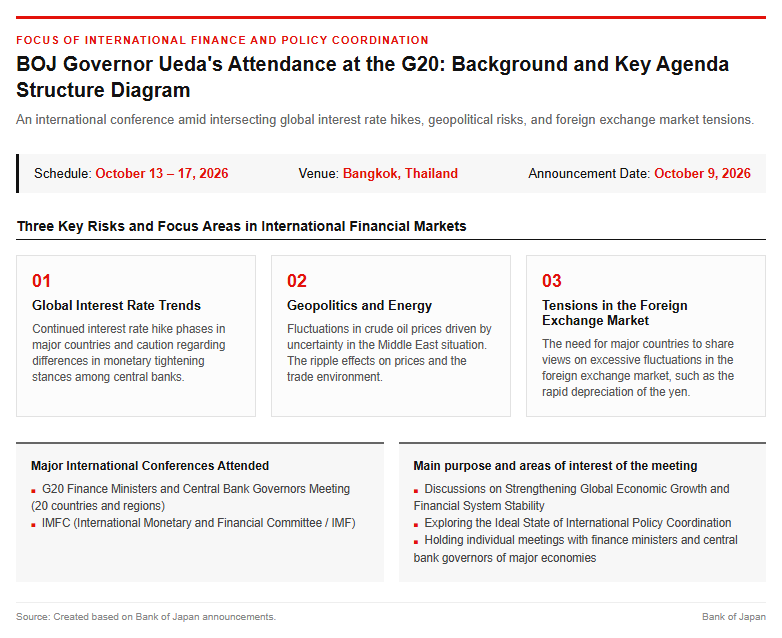
On October 9, 2026, the Bank of Japan announced that Governor Kazuo Ueda will visit Bangkok, Thailand, from the 13th to the 17th of the same month. During his visit, the G20 Finance Ministers and Central Bank Governors Meeting and the International Monetary Fund’s (IMF) International Monetary and Financial Committee (IMFC) will be held, where policymakers from major countries will discuss strengthening global economic growth and the stability of the financial system.
This business trip is taking place amidst ongoing tensions in international financial markets, such as fluctuations in crude oil prices and the rapid depreciation of the yen in the foreign exchange market. In particular, concerns are growing regarding the impact of soaring energy prices and geopolitical risks on the price levels and trade environments of various countries, and the approach to international policy coordination is expected to be a major focal point.
In between the meetings, bilateral talks with the finance ministers and central bank governors of major nations are also being arranged. There is strong market interest in how various central banks’ stances amid the global phase of interest rate hikes, as well as their views on excessive fluctuations in the foreign exchange market, will be shared.
Please refer to the figure below.
For the Japanese economy as well, discussions at international conferences serve as a crucial basis for gauging the future direction of monetary policy.
Meeting with the U.S. Treasury Secretary and Speculation on Monetary Policy
Of particular note at international conferences are points of contact with overseas officials, such as US Treasury Secretary Bessent. In a meeting held in September 2026, US Treasury Secretary Bessent made remarks calling for a review of Japan’s reflationary policies, which lean toward monetary easing and aggressive fiscal expansion, and pointed out that the weak yen is creating inflationary pressures within Japan.
Although both the Japanese and U.S. governments have expressed a cooperative stance against excessive exchange rate fluctuations, the exchange rate continues to hover at a weak-yen level of around 160 yen to the dollar. Markets are mindful of the possibility that discussions surrounding the interest rate differential between Japan and the U.S. and trade policies may reignite.
These calls from overseas to raise interest rates and moves to curb the weak yen are also having a significant impact on the Bank of Japan’s policy decisions. Governor Ueda has emphasized careful dialogue with the market while demonstrating a stance of assessing economic and price conditions at each Monetary Policy Meeting to make decisions.
Through discussions with overseas authorities, the focus will be on how they evaluate the outlook for the underlying inflation rate to sustainably reach the 2% target, as well as countermeasures against rising import prices caused by the rapid depreciation of the yen.
Bank of Japan Monetary Policy and the Current State of the Domestic Economy
The Decision to Raise Interest Rates at the September 2026 Meeting and the Composition of the Policy Board
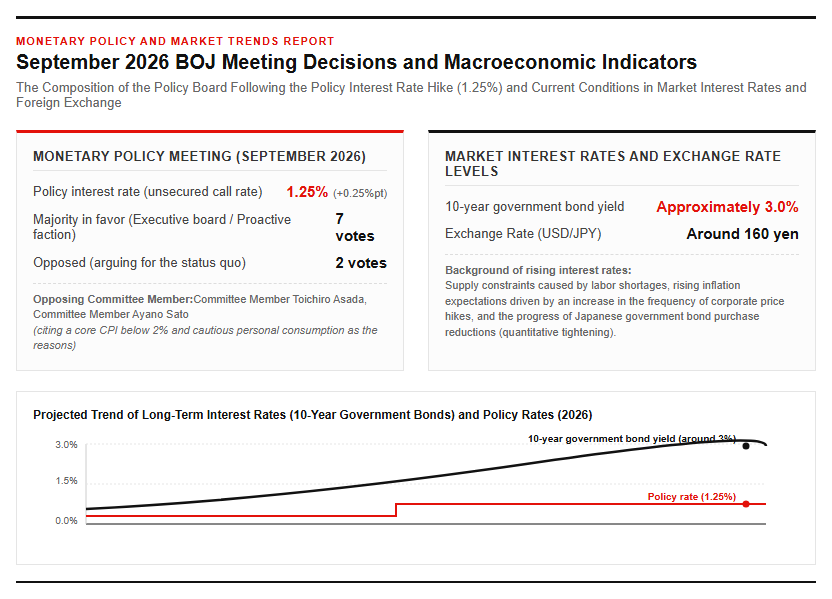
Turning to domestic monetary policy developments, the Bank of Japan (BOJ) decided at its Monetary Policy Meeting on September 17 and 18, 2026, to raise the target for the policy interest rate—the uncollateralized overnight call rate—by 0.25 percentage points to around 1.25%. This decision was made by a majority vote of 7 to 2.
The two members who voted against the measure were board members Toichiro Asada and Ayano Sato, who argued for maintaining the status quo, citing the fact that consumer prices excluding fresh food remain below 2% and the recent cautiousness in private consumption. Meanwhile, the majority, including board member Hajime Takada, voted in favor of the rate hike, emphasizing that the underlying inflation rate is approaching the 2% target and that financial conditions remain accommodative.
Looking at the stances of the nine policy board members, the following trends can be observed.
– Executive leadership and the majority (7 members): Policy to continue gradual interest rate hikes in line with the economic and price outlook
– Dovish members (2): Argued for maintaining the status quo to carefully assess the trends in domestic demand and personal consumption.
Amid such discussions among policy board members, the BOJ positions the situation as having entered a new policy phase to stabilize the inflation rate at around 2%.
Arguments for Fiscal Expansion, Inflationary Pressures, and Risks of Rising Interest Rates
While the normalization of monetary policy progresses, the balance between domestic fiscal policy and inflation risks has become a focal point for the market. Although the government’s growth strategies and various fiscal support measures play a role in preventing an economic downturn, expanding expenditures is raising concerns about medium- to long-term fiscal deterioration, acting as a factor that pushes up long-term interest rates through rising risk premiums.
Japan’s 10-year government bond yield has seen an accelerating upward trend in 2026, temporarily reaching levels close to 3%. This rise in yields is driven by rising inflation expectations—stemming from supply constraints caused by labor shortages and an increased frequency of corporate price hikes—alongside the ongoing reduction in Japanese government bond purchases (quantitative tightening) by the Bank of Japan.
Please refer to the image below.
Amid the conflicting directions of fiscal stimulus and monetary tightening, concerns also linger over the risk of falling “behind the curve,” where a prolonged period of low real interest rates could lead to a delayed response to inflation. The Bank of Japan is required to navigate a difficult course: carefully examining fiscal trends and market functionality while normalizing interest rate formation and avoiding a sudden surge in rates.
Impact on the Market and Future Challenges
The Simultaneous Rise of Higher Stocks, a Weaker Yen, and Higher Interest Rates, and Market Forecasts
The current Japanese market is in a unique “triple-high” state—characterized by rising stocks, a weak yen, and rising interest rates—where the equity market remains resilient despite climbing interest rates. Normally, rising interest rates increase corporate financing costs and weigh on stock prices, but currently, expanding corporate earnings are outstripping that pressure and supporting stock prices.
Global capital expenditure demand, particularly centered around AI and semiconductor-related fields, alongside the profit-boosting effect on exporters from the weak yen, is contributing to strong financial performance. Bullish forecasts are also emerging from market analysts, suggesting the possibility that the US dollar-yen exchange rate will settle in the 160-yen range toward the end of 2026 and that the Nikkei Stock Average will aim for the major milestone of surpassing 80,000 yen.
However, among market participants, the following factors are attracting attention.
– Whether corporate earnings growth can continue to absorb rising interest rate costs
– Will the rising import costs resulting from the ongoing depreciation of the yen dampen consumption by households and small and medium-sized enterprises?
The sustainability of a scenario in which interest rates and stock prices rise simultaneously holds significant keys in future corporate earnings growth and trends in real wages.
Future Outlook and Key Points: Scenarios Toward the End of 2026
What will attract the most attention in future developments is the next Monetary Policy Meeting scheduled for October 29 and 30, 2026, and the analysis results of the Regional Economic Report (Sakura Report) released on October 8. While the Sakura Report judged economic conditions in all nine regions to be “recovering” or “picking up,” the assessment for private consumption was left unchanged across all regions, and polarized consumer trends will influence future assessments.
Looking ahead, the terms of Policy Board members Hajime Takata and Naoki Tamura—both viewed as staunch hawks and hawks—are set to expire in July 2027. Additionally, the terms of the Governor and Deputy Governors will end in the spring of 2028. These personnel changes could bring about significant shifts in the balance of power and policy direction within the BOJ.
The key points in assessing future market trends are as follows.
– The timing and pace of additional rate hikes at policy board meetings from October 2026 onward
– the degree to which the inflation rate—reflecting crude oil prices and overseas situations—is firmly established at 2%
– Whether or not foreign exchange intervention is implemented by the Ministry of Finance and the monetary policy gap between Japan and the United States
Along with the achievements of international diplomacy—including Governor Ueda’s visit to Thailand—careful policy management based on a thorough assessment of domestic economic data will remain crucial going forward.
Reference page
- [Summary of the Joint Press Conference by Minister of Finance and Minister of State for Special Missions Katayama and Bank of Japan Governor Ueda][suspicious link removed]
- 【(BOJ Review) Impact of the Bank of Japan’s Reduction in Government Bond Purchases on the Government Bond Market】[suspicious link removed]
【#BankOfJapan #KazuoUeda #G20 #MonetaryPolicy #RateHike #ForexIntervention #JapaneseEconomy】


コメント