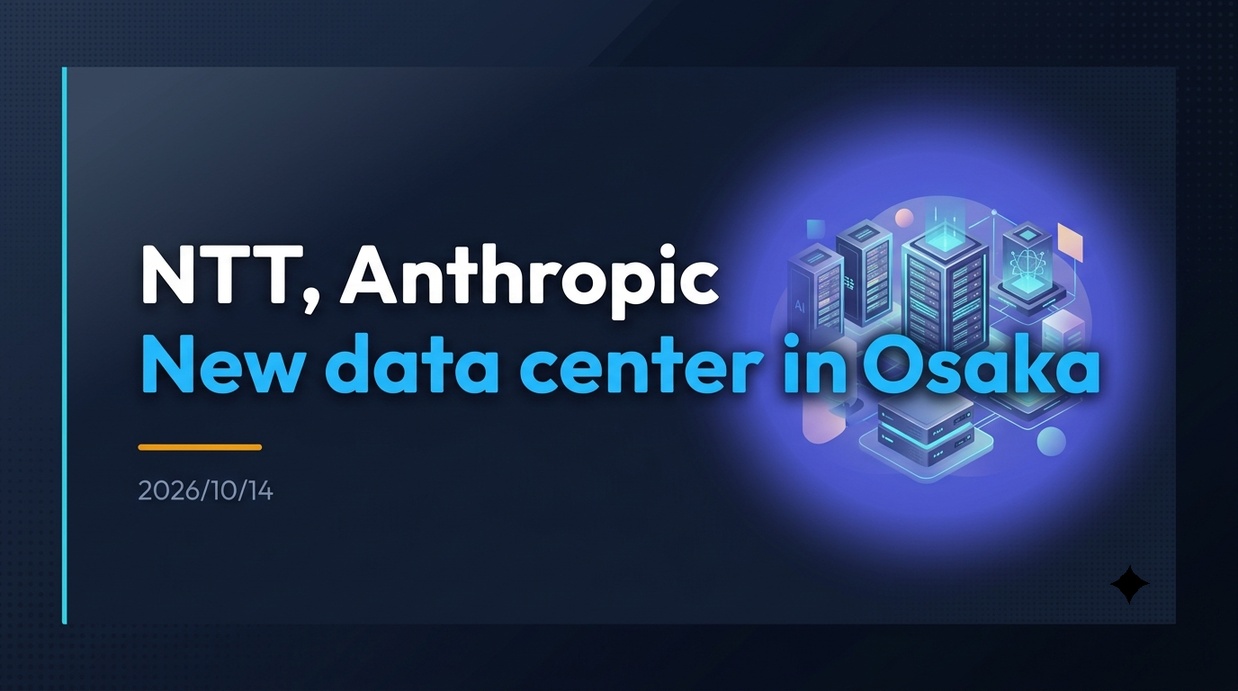
NTT Data Group has entered final coordination to build a new AI data center on a scale of up to 1 trillion yen in Osaka Prefecture for US-based Anthropic. Behind this move are the rapid global expansion of generative AI demand, the decentralization of infrastructure from the Tokyo metropolitan area, and the necessity of securing power.
- Key Points of the Major Japan-US Collaboration and Up-to-500-Megawatt Power Reception Plan
- US-based Anthropic’s Focus on the Japanese Market and the Strategic Significance of Its Dedicated Hub
- Mitigating the Risk of Concentration in the Tokyo Metropolitan Area and Osaka’s Strengths as an IX Hub
- Electricity Supply and Demand and Siting Challenges in Coastal and Inland Areas of the Kansai Region
- 1 GW Expansion Goal and Differentiation through IOWN and Liquid Cooling Technology
- Economic ripple effects on domestic industries and future developments/points of focus
Key Points of the Major Japan-US Collaboration and Up-to-500-Megawatt Power Reception Plan
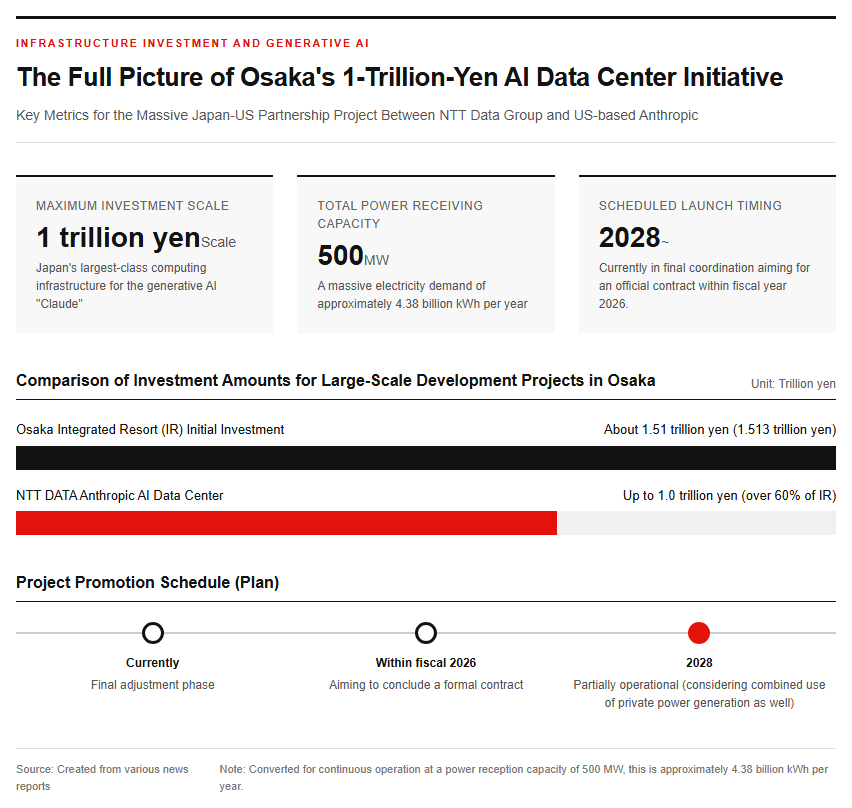
On October 13, 2026, it was revealed that NTT Data Group has entered final arrangements to build a large-scale, AI-dedicated data center in Osaka Prefecture for US-based Anthropic, the developer of the generative AI “Claude”. Construction costs are expected to reach up to 1 trillion yen, and with a total receiving capacity of up to 500 megawatts (500MW), it is projected to become one of the largest computing infrastructures in Japan. The two companies aim to officially sign the contract within fiscal 2026 (by the end of March 2027), with plans to begin partial operations as early as 2028.
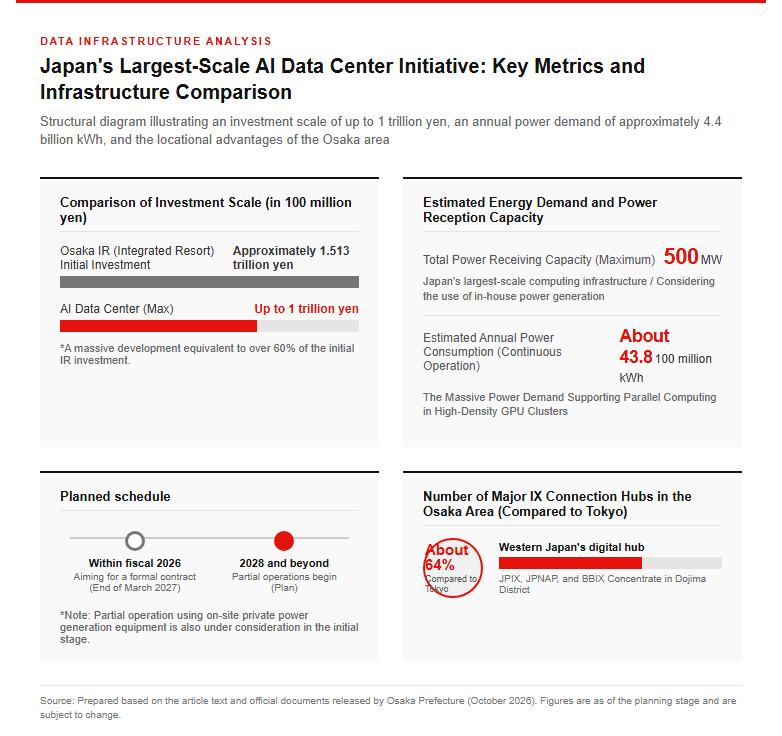
The investment scale of up to 1 trillion yen in this initiative is a massive development equivalent to over 60% of the approximately 1.513 trillion yen initial investment for the Integrated Resort (IR) project also underway in Osaka. Additionally, assuming continuous operation of 500 megawatts of power throughout the year, the estimated electricity consumption reaches approximately 4.38 billion kilowatt-hours (kWh) annually, generating energy demand to support vast computational resources. In the initial stages of the plan, taking into account the connection period to the power grid, consideration is also being given to installing on-site private power generation facilities such as fuel cells to begin partial operations. For the overall structure and installation concept of the facility, please refer to the layout and schematic diagrams below.
If this project is realized, it will be the first case in Japan of a dedicated domestic hub for a leading overseas AI company.
US-based Anthropic’s Focus on the Japanese Market and the Strategic Significance of Its Dedicated Hub
US-based Anthropic is a world-class AI development company known for its large language model “Claude” and software development assistance tool “Claude Code”. The company opened its Tokyo office in October 2025 and announced a strategic partnership with NEC in April 2026, driving the development of solutions tailored for major Japanese corporations and local governments. The Japanese market features numerous enterprise customers—spanning manufacturing, finance, healthcare, and other sectors—that integrate advanced AI processing into their daily operations, making the securement of continuous and stable infrastructure an urgent priority.
While traditional data centers were primarily used for data storage and cloud infrastructure construction, AI data centers require parallel computing via high-density GPU clusters, along with massive power and cooling capacities. Anthropic’s establishment of its first dedicated facility (data center) in Japan will meet the data governance demands of domestic corporations seeking high confidentiality, while also giving it the competitive advantage of delivering its proprietary models with ultra-low latency. While still relying on overseas platforms, the strategy of bringing the infrastructure facilities and operational bases themselves onshore holds critical significance for enhancing the autonomy of Japan’s digital infrastructure foundation.
Why Osaka?—The Rationale Behind Site Selection and Infrastructure
Mitigating the Risk of Concentration in the Tokyo Metropolitan Area and Osaka’s Strengths as an IX Hub
In site selection for data centers, Japanese infrastructure investment has historically been heavily concentrated in the Kanto region. However, from the perspective of Business Continuity Planning (BCP) risks associated with large-scale disasters such as a direct earthquake beneath the capital, the need for geographical diversification is rapidly increasing. Osaka is the core hub of Western Japan, and with major IXs (Internet Exchanges) such as JPIX, JPNAP, and BBIX densely concentrated around the central Dojima district, it possesses a significant advantage in providing high-quality telecommunications interconnection.
According to data released by Osaka Prefecture in October 2026, the number of major IX connection sites in the Osaka area has reached approximately 64% of that in the Tokyo area, boasting a sufficient infrastructure foundation as Japan’s second-largest digital hub. Furthermore, in April 2026, Osaka Prefecture established the “Osaka Digital Infrastructure Council” with the policy of integrally promoting the development of data centers, international submarine cables, and urban operating systems. For the network configuration connecting the high-speed communication network in the city center with large-scale hubs in the coastal area via optical fiber, please refer to the infrastructure configuration diagram below.
The development of such policy and technological environments is helping to attract global AI companies.
Electricity Supply and Demand and Siting Challenges in Coastal and Inland Areas of the Kansai Region
The biggest bottleneck in operating AI data centers is securing stable and affordable electricity. Looking at the Japan Electric Power Exchange (JEPX) spot market prices for June 2026, compared to 20.01 yen per kWh in the Tokyo area, the Kansai area trended at 13.88 yen, about 6.13 yen lower. In the Kansai region, the restart of nuclear power plants and other measures are progressing, and this relative cost advantage in electricity has become a strong incentive for companies operating large-scale data centers.
On the other hand, challenges also exist at actual site locations. According to a survey by Osaka Prefecture, while the Osaka Bay coastal area, which features vast former factory sites, is advantageous for securing land, the current power grid capacity has little spare capacity, and grid reinforcement is estimated to take approximately eight years. In contrast, while inland areas in southern Osaka such as Senshu and Minamikawachi have power-receiving surplus on the scale of several hundred megawatts, regulatory challenges concerning communication networks and urbanization control areas remain. Toward partial operation slated for 2028, how to realize the combined use of on-site power generation and rapid grid reinforcement will be the key moving forward.
NTT’s Next-Generation AI Strategy and Its Ripple Effects on the Japanese Economy
1 GW Expansion Goal and Differentiation through IOWN and Liquid Cooling Technology
NTT Group is advancing a long-term plan to rapidly expand the power reception capacity of its data center business in Japan from the current 300 megawatts to a 1-gigawatt (1,000 MW) system—more than triple—by fiscal 2033. In addition to developing an urban liquid-cooled data center scheduled to open in Shinagawa Ward in 2029 and a submarine cable-directly connected hub in Fukuoka City, this latest 500-megawatt initiative in Osaka is positioned as a core project toward realizing the 1-gigawatt system.
The biggest technological differentiators are the next-generation optical communication infrastructure “IOWN” (Innovative Optical and Wireless Network), which NTT is currently developing, and the introduction of advanced cooling technologies. Because conventional air-cooling methods struggle to cool high-heat-generating advanced GPU servers, the implementation of “liquid cooling” or “water-cooling” systems—which circulate cooling liquid directly—has become essential. By combining IOWN’s ultra-low-latency, high-capacity optical network with high-efficiency liquid cooling technology, they are aiming to achieve overwhelming differentiation in energy efficiency and processing performance compared to competing telecommunications carriers and foreign hyperscalers.
Economic ripple effects on domestic industries and future developments/points of focus
This mega-investment on a scale of up to 1 trillion yen will bring significant economic ripple effects to the Kansai region and the entire Japanese economy through construction work, power facilities, power receiving and transforming equipment, and the construction of communication infrastructure. Furthermore, even after operations commence, it will generate continuous business demand in facility maintenance, security, and energy supply, leading to the creation of jobs for specialized personnel equipped with advanced skills. In addition, the utilization of advanced computing infrastructure by manufacturing industries, universities, and research institutions concentrated in the Keihanshin region is expected to accelerate the creation of new industries and collaborative research.
The biggest points of focus for future developments are the signing of the formal contract scheduled within fiscal 2026 and the concretization of power-receiving infrastructure development. The success or failure of the schedule will be determined by coordination with power transmission and distribution operators for grid connection of up to 500 megawatts, as well as progress in deregulation and location support by local governments. As the demand for AI model training and inference continues to expand on a global scale, whether this project can be launched as planned will be a critical turning point for Japan to establish its position as a cutting-edge digital hub in the Asia-Pacific region.
Reference page
- 【Ministry of Internal Affairs and Communications】2024 Information and Communications White Paper: https://www.soumu.go.jp/johotsusintokei/whitepaper/ja/r06/html/nd219100.html
- [NTT DATA Group] Regarding the Construction of a New Data Center in Osaka Prefecture: https://www.nttdata.com/global/ja/news/topics/2025/052700/
【#NTTData #Anthropic #AIDataCenter #Osaka #GenerativeAI #IOWN #DataCenter】

コメント