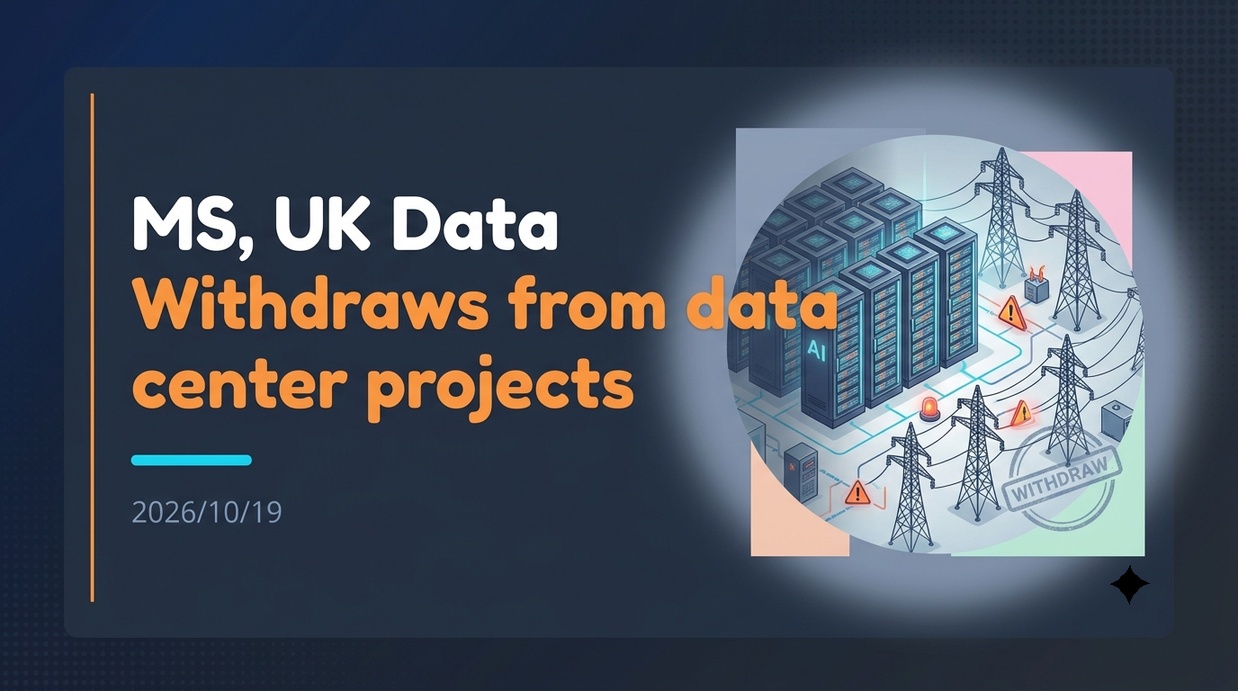
It was revealed in October 2026 that Microsoft has withdrawn from a large-scale AI data center project planned in Loughton, Essex, UK. The backdrop to this is a severe transmission infrastructure bottleneck, as UK power grid connections face delays of up to 10 years, preventing sufficient power supply from being secured until the 2030s.
- Key Points for Withdrawing from Massive AI Data Center Projects
- Long-Term Power Supply Delays and Infrastructure Bottlenecks
- A blow to Nscale ahead of a billion IPO
- Heavy Debt of AI Infrastructure Companies and Market Cooling
- The Surge in Electricity Demand and the Barriers to Grid Connection Reform
- Future Developments in AI Infrastructure Development and Key Points to Watch
Key Points for Withdrawing from Massive AI Data Center Projects
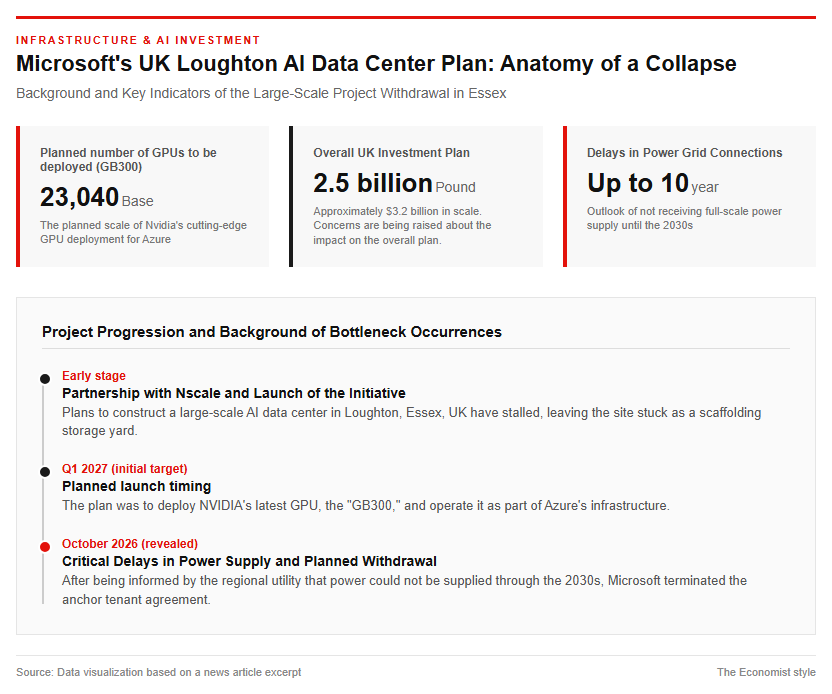
It has been revealed that U.S. tech giant Microsoft has withdrawn from a data center project in Loughton, Essex, which it was advancing in partnership with British cloud provider Nscale. This facility was scheduled to deploy 23,040 of NVIDIA’s state-of-the-art GB300 GPUs for Microsoft’s cloud service, Azure, and begin operations in the first quarter of 2027. However, construction on the project stalled from the early stages, with the site remaining stagnant as a storage yard for scaffolding. Furthermore, after receiving a notification from the regional power grid operator that full-scale power supply to the facility would not be realized until the 2030s—serving as the final blow—Microsoft decided to terminate its contract as the anchor tenant. This withdrawal also casts a shadow over the company’s overall £2.5 billion (approximately $3.2 billion) data center investment plan in the UK. The following figure shows a conceptual layout of data centers in AI infrastructure development.
Long-Term Power Supply Delays and Infrastructure Bottlenecks
At the root of this withdrawal drama lies the worsening issue of grid connection delays across the entire UK. While compute demand required for AI training and inference is surging, the enhancement of aging power infrastructure is completely failing to keep pace. Hyperscale companies, including Microsoft, point out that wait times of 8 to 10 years are occurring just to connect new data centers to the power grid. Projects around Leeds, Newport, and London that initially aimed for completion between 2027 and 2029 have also been forced to alter their plans. To avoid waiting in line for power grid connections, some data center operators have temporarily changed their renewable energy usage policies, developing into a situation where they are exploring direct connections to fossil-fuel-based natural gas power generation. The physical limitation of the infrastructure—being unable to secure electricity—has become the biggest deterrent to tech companies’ investments and AI development.
Emerging Cloud Company Nscale and the Crisis in AI Infrastructure Investment
A blow to Nscale ahead of a billion IPO
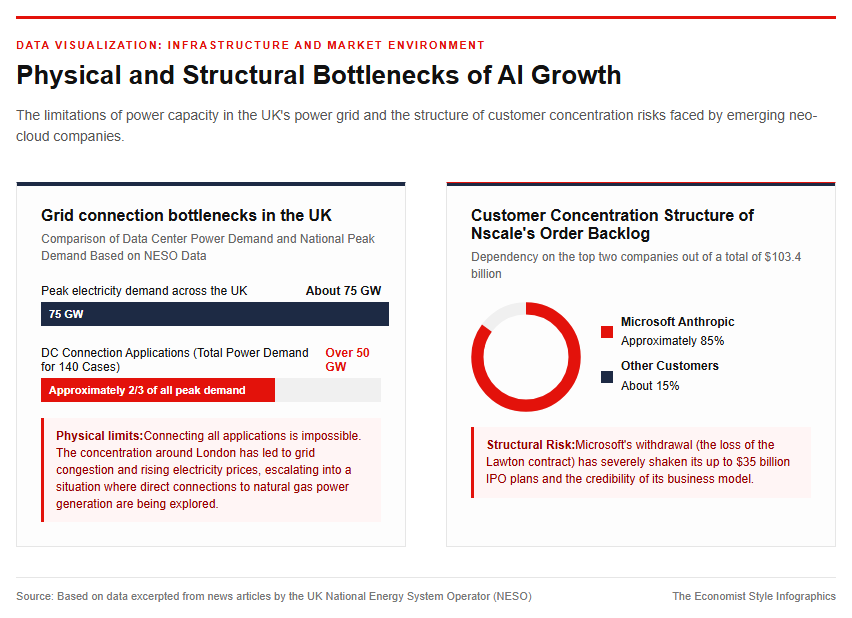
Microsoft’s withdrawal dealt a fatal blow to Nscale, a British AI cloud startup. The company has filed to list on the New York Stock Exchange and was preparing for an initial public offering (IPO) aiming for a valuation of up to $35 billion. Of the company’s reported $103.4 billion order backlog, Microsoft and Anthropic together accounted for about 85 percent, so the departure of a major customer has severely undermined the credibility of its business model. Microsoft alone had signed statements of work worth up to $43.8 billion through December 2033, but the loss of the Lawton project has cast strong uncertainty over the achievement of its listing plans. Although Nscale has emphasized that there is no impact on other contracts and has shown an intention to explore alternative power sources and alternative expansion sites in the UK, the structural risk of excessive dependence on a single customer has been brought to light.
Heavy Debt of AI Infrastructure Companies and Market Cooling
The stock market is taking a harsher view of infrastructure-lending companies known as “neo-clouds,” which have grown rapidly on the tailwinds of AI demand. Their business model—purchasing massive amounts of expensive Nvidia chips and leasing them to customers—relies heavily on huge amounts of debt. Australian AI firm Firmus was also forced to abruptly cancel its planned $5 billion IPO scheduled for October 2026 due to concerns over its plan to accumulate $30 billion in debt by 2028, which amounts to six times its operating profit. According to forecasts by market analysis firms, 80 percent of neo-cloud operators that lack differentiated technology and rely on debt and a few major customers will not be able to maintain independent management by 2030. As investors demand early monetization and clear governance for massive infrastructure investments, a realistic sense of caution regarding the AI bubble is spreading rapidly.
Structural Challenges of the UK Power Grid and Future Prospects
The Surge in Electricity Demand and the Barriers to Grid Connection Reform
According to data from the UK’s National Energy System Operator (NESO), data center projects applying for connection to the power grid have reached 140, with their combined power demand exceeding 50 gigawatts. This is an extraordinary scale, equivalent to two-thirds of the UK’s total peak electricity demand of approximately 75 gigawatts, and it is physically impossible to connect all the applied projects. NESO Chief Executive Fintan Slye has warned that an inappropriate concentration of data centers around London—which lacks surplus power capacity—would cause transmission congestion, resulting in higher electricity bills for the public and an unstable power supply. While the UK government is designating large-scale data centers as “Nationally Significant Infrastructure Projects (NSIPs)” to expedite reviews and is promoting “AI Growth Zones (AIGZs)” to designate regions where power capacity can be secured, it will still take a considerable amount of time to achieve effective infrastructure enhancement. The following figure shows the connection structure between the power grid and data centers.
Future Developments in AI Infrastructure Development and Key Points to Watch
In future AI data center development, a shift from simply expanding computing resources to a strategy that prioritizes securing power and feasibility will be essential. The construction of hyperscale AI training campuses, which has been concentrated in metropolitan areas such as London, is reaching saturation, and inference data centers—which can be deployed on a smaller, phased scale in regions closer to users—are expected to become increasingly important. Furthermore, developers will be required to demonstrate the reduction of environmental and social impacts, such as building consensus with local communities and promoting a circular economy that repurposes waste heat emitted from servers for local heating networks. On the policy front, the reorganization of connection queues is underway to narrow down priority grid connection rights from speculative applicants to genuinely viable operators. The speed at which the AI revolution progresses depends not only on the evolution of algorithms, but also on how rapidly the physical infrastructure of the power grid can be rebuilt.
Reference page
- [UK Government Policy Paper: Delivering AI Growth Zones] https://www.gov.uk/government/publications/delivering-ai-growth-zones/delivering-ai-growth-zones
- 【UK Department for Energy Security and Net Zero (DESNZ) Consultation on Accelerating Electricity Network Connections for Strategic Demand】https://www.gov.uk/government/consultations/accelerating-electricity-network-connections-for-strategic-demand/accelerating-electricity-network-connections-for-strategic-demand-accessible-webpage
- [Ofgem (UK Office of Gas and Electricity Markets) Call for Input on Demand Connections Reform] https://www.ofgem.gov.uk/call-for-input/demand-connections-reform
[#Microsoft #Datacenter #AIInfrastructure #PowerGrid #BrokeEconomy #RenewableEnergy #NeoCloud]

コメント