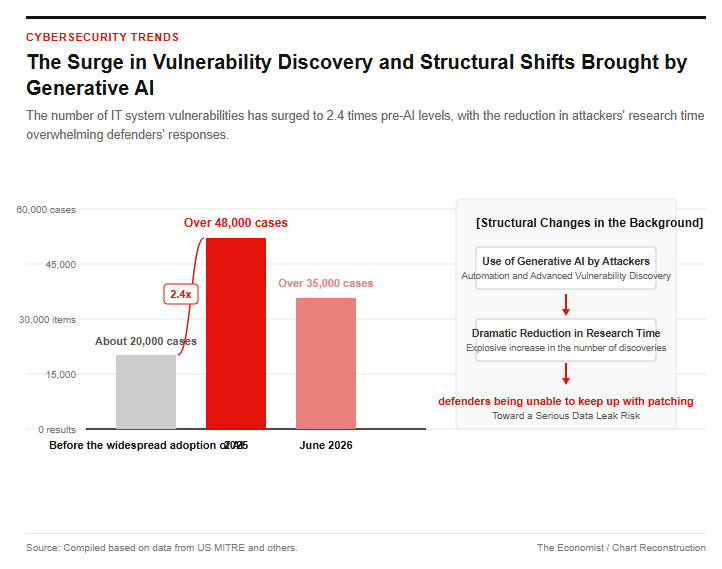
The number of discovered IT system vulnerabilities worldwide exceeded 48,000 in 2025, surging to 2.4 times the level seen before the widespread adoption of AI. Driving this trend is a structural shift in which attackers use generative AI to probe for vulnerabilities, drastically cutting down research time. This has created a serious situation where defenders cannot keep pace with patching and remediation efforts.
- The Current State of Vulnerability Discoveries That Have Surged 2.4-Fold Worldwide
- Dramatic shift in attack profitability and automation of investigation work
- The Asymmetry of Months to Fix and Hours to Exploit
- The Proliferation of Vulnerabilities in AI-Generated Code in Development Environments
- Automated Defense and Diagnostic Innovation Utilizing AI Agents
- Future Outlook and Key Points in Human-AI Collaboration
The Current State of Vulnerability Discoveries That Have Surged 2.4-Fold Worldwide
According to data compiled by the U.S. non-profit organization MITRE and revealed on October 17, 2026, the number of IT system vulnerabilities discovered worldwide exceeded 48,000 in 2025, ballooning to 2.4 times the 2021 level. Even in 2026, the count had already surpassed 35,000 as of June, showing momentum to break the all-time record. Such global trends are also having a significant impact on the domestic security environment.
The number of information leak incidents affecting companies and organizations in Japan has already exceeded 500 in 2026, reaching an extremely serious level comparable to the total of the past two years. The damage has caused a major shock to society, with Park24, which operates Times Car, suffering a leak of approximately 6.6 million account information records, and major restaurant operator Monogatari Corporation announcing concerns over a potential data leak on the scale of 10.79 million records at Yakiniku King. There is a growing trend of indiscriminate targeting regardless of company size, going beyond traditional detour attacks via vulnerabilities in the supply chain. The following figure illustrates the structure of vulnerability risks that are rapidly increasing on a global scale.
Dramatic shift in attack profitability and automation of investigation work
The biggest reason for the rapid surge in vulnerability discoveries is the “dramatic reduction in research costs” on the cyber attacker’s side. Until now, for a highly skilled attacker to analyze a target company’s system configuration and communication procedures and find program weaknesses, it typically required two to three weeks of work and massive labor costs.
However, this situation has changed completely as generative AI and LLMs have come to be misused as attack tools. By having AI autonomously take over tasks such as specialized code analysis and vulnerability exploration, a mechanism has been established where finding weaknesses that previously took several weeks can now be completed in just a few hours. This automation and acceleration of the attack process has dramatically improved the cost-effectiveness of hacking. As a result, even mid-sized and small businesses—which previously could not have been targets of attacks—are now subjected to comprehensive automated scanning, and the risk that even the slightest vulnerability in a system will be instantly identified and exploited has increased explosively.
The Growing Disadvantage of Defenders and Blind Spots in AI-Generated Code
The Asymmetry of Months to Fix and Hours to Exploit
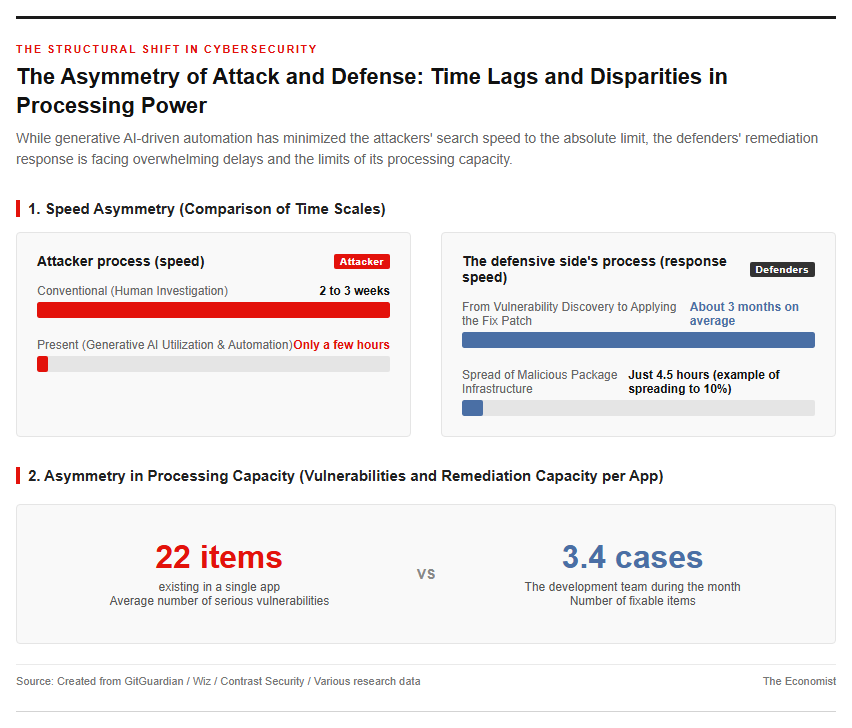
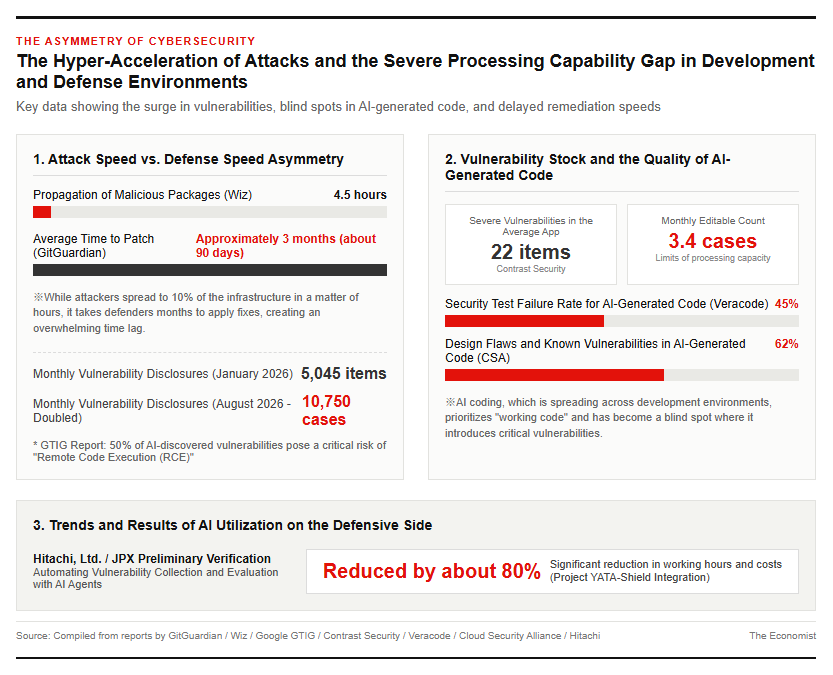
The “asymmetry” in which defensive response speeds fail to keep up with accelerating attacks is rapidly widening. According to a study by security firm GitGuardian, it takes an average of about three months from the discovery of a system vulnerability to the application of a patch. In contrast, a report by security vendor Wiz confirmed a case where a malicious package distributed via unauthorized access spread to 10% of the monitored infrastructure in just 4.5 hours.
Furthermore, according to an August 2026 report by Google’s Threat Intelligence Group (GTIG), between January and August 2026, the monthly number of vulnerability disclosures doubled from 5,045 to 10,740, and indeed 50% of the vulnerabilities discovered by AI were critical issues leading to “Remote Code Execution (RCE).” Meanwhile, according to a study by Contrast Security, despite an average of 22 severe vulnerabilities existing in a single application, development teams are only able to fix 3.4 of them per month. Below is a diagram illustrating the time lag and processing capacity gap between the attacker and defender sides.
The Proliferation of Vulnerabilities in AI-Generated Code in Development Environments
Not only on the offensive side, but also in software development environments, the adoption of AI coding assistants such as Claude Code and GitHub Copilot is rapidly advancing. However, a new blind spot has emerged in the fact that the code automatically generated by AI itself contains numerous vulnerabilities.
According to a 2025 security report conducted by Veracode, 45% of AI-generated code failed security tests, revealing the inclusion of critical web security vulnerabilities. Additionally, a study by the Cloud Security Alliance reported that 62% of AI-generated code contains design flaws or known vulnerabilities. The causes include Large Language Models (LLMs) learning even vulnerable code from public repositories as part of their training data, as well as prioritizing the output of “working code” without understanding the system-wide access control structure. Adopting code without explicitly instructing security requirements results in embedding vulnerabilities oneself.
Implementation of Defensive AI and Future Security Strategies
Automated Defense and Diagnostic Innovation Utilizing AI Agents
To counter the surging wave of vulnerabilities, defenders are also adopting new operational approaches incorporating advanced AI technology. Hitachi, Ltd. launched an AI agent service in September 2026 that collects the latest vulnerability information and security patches 24/7, cross-references them with customer system configuration information, and analyzes the degree of impact. Pre-deployment verification at Japan Exchange Group (JPX) confirmed that this service can reduce the time required to collect and evaluate vulnerability information by approximately 80%.
Additionally, the startup supa Inc. has released a penetration testing service in which AI executes automated intrusion scenarios within its proprietary local GPU environment, achieving a dramatic reduction in assessment time and costs. Furthermore, in May 2026, the Japanese government compiled “Project YATA-Shield,” strongly urging critical infrastructure operators and software vendors to actively leverage frontier AI on the defensive side as well to implement automated patching and multi-layered defenses. Below is a schematic diagram illustrating the latest AI-powered automated defense model.
Future Outlook and Key Points in Human-AI Collaboration
In future cybersecurity strategies, the biggest focus will be on establishing a governance framework that integrates high-speed detection by AI with high-precision decision-making by human experts. Verification results from Contrast Security show that when three different AI scanners analyzed the same code, the consistency rate of their results was a mere 5%, indicating that placing excessive, blind trust solely in AI-driven vulnerability assessment tools is extremely dangerous.
Therefore, it is essential to establish a “division of roles between humans and AI,” where AI agents are entrusted with primary investigations and log screening to automate massive processing, while humans are responsible for final risk assessments and judgments of business impact. Corporate management is strongly urged to redefine security measures not as mere costs, but as a top-priority investment target that supports business continuity and growth, while actively promoting the development of in-house talent and improving system resolution.
Reference Page
- 【Security Vulnerabilities in AI-Generated Code – arXiv】https://arxiv.org/abs/2510.26103
- [2025 GenAI Code Security Report – Veracode] https://www.veracode.com/resources/analyst-reports/2025-genai-code-security-report/
- 【Understanding Security Risks in AI-Generated Code – CSA】https://cloudsecurityalliance.org/blog/2025/07/09/understanding-security-risks-in-ai-generated-code
- 【AI risk and resilience – Google Cloud】https://cloud.google.com/security/resources/ai-risk-and-resilience-2026
- [Information Security White Paper 2026 – IPA][suspicious link removed]
【#Cybersecurity #Vulnerability #GenerativeAI #ITGovernance #InformationSecurity】

コメント