
Minister of State for Economic and Fiscal Policy Minoru Kiuchi avoided giving a clear answer regarding a potential revision of the government-BOJ joint statement following the Bank of Japan’s achievement of the 2% price stability target, stating that he “does not answer hypothetical questions.” Behind this lies a cautious stance toward deciding to declare an end to deflation and an aim to curb excessive market speculation about the future direction of monetary policy.
- Economic and Fiscal Policy Minister Kiuchi avoids mentioning revision of joint statement
- Criteria for Declaring the End of Deflation and a Cautious Stance
- The Framework of the January 2013 Joint Statement and the Background of Policy Coordination
- The Prolongation of Unprecedented Monetary Easing and the Rise of Calls for a Review
- Market Reaction and Concerns Amid Speculation Over Statement Revision
- Monetary Policy Meetings and Challenges in Government-BOJ Cooperation
Economic and Fiscal Policy Minister Kiuchi avoids mentioning revision of joint statement
Minister of State for Economic and Fiscal Policy Minoru Kiuchi, at a post-Cabinet press conference on October 23, 2026, avoided making a definitive statement regarding the possibility of revising the joint statement between the government and the Bank of Japan if the BOJ determines at an upcoming Monetary Policy Meeting that the 2% price target has been achieved, stating, “I will not answer hypothetical questions.” Furthermore, during the Q&A session on the same day, he stated, “I will refrain from answering as it is a hypothetical question,” holding back from mentioning any specific direction for revising the statement. With that, Minister Kiuchi emphasized his longstanding view that he continues to expect the Bank of Japan to conduct appropriate policy management toward the sustainable and stable achievement of the 2% price stability target.
This press conference was held amidst growing speculation among market participants that the Bank of Japan is expected to formally determine that the inflation rate has reached its target level of 2%. The joint statement agreed upon by the government and the Bank of Japan in January 2013 has served as a strong basis for promoting large-scale monetary easing. Therefore, whether or not to revise the joint statement as the achievement of the price target comes into view has attracted strong interest from financial markets as a touchstone that will influence the future pace of monetary policy normalization. However, by clearly distancing itself from speculations regarding an early revision of the statement, the government side has highlighted its stance of maintaining the current cooperative framework for the time being.
Criteria for Declaring the End of Deflation and a Cautious Stance
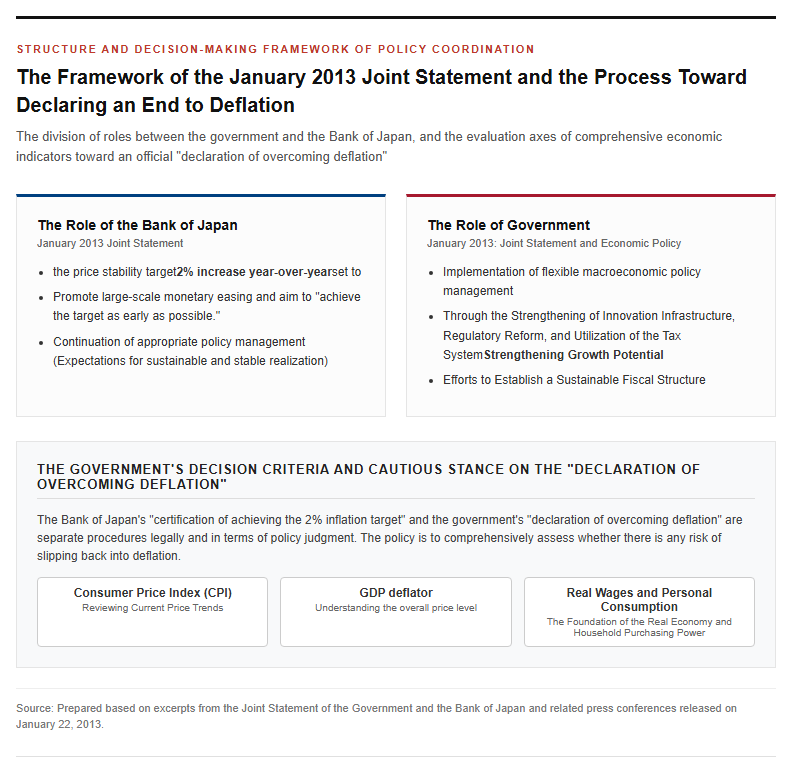
State Minister Kiuchi also maintained a cautious stance on whether the government would issue an official “declaration of overcoming deflation” in tandem with the Bank of Japan’s policy decisions. When asked at a press conference about the prospect of issuing the declaration, State Minister Kiuchi explicitly stated, “We need to make a careful judgment.” As specific economic indicators for making this judgment, he listed current figures such as the Consumer Price Index (CPI) and the Gross Domestic Product (GDP) deflator, and reiterated the government’s basic view that it will comprehensively assess these indicators while also determining whether there is any possibility of the Japanese economy slipping back into deflation.
What the government emphasizes as a prerequisite for declaring an end to deflation is whether the risk of slipping back into a phase of sustained price declines can be reliably avoided. The Bank of Japan’s recognition of achieving the 2% price stability target and the government’s official declaration of exiting deflation are treated as separate procedures under legal and policy frameworks. Even if the central bank determines that the target has been achieved, it does not mean the government will immediately issue a declaration; therefore, the alignment of views between the two and the form of their policy coordination remain major points of focus. The process of carefully assessing whether the foundation of the real economy—such as trends in real wages, domestic private consumption, and household purchasing power—can sustain continuous price increases is ongoing.
Historical Background of the Joint Statement and the Evolution of the 2% Target
The Framework of the January 2013 Joint Statement and the Background of Policy Coordination
The joint statement by the government and the Bank of Japan, titled “Policy Coordination between the Government and the Bank of Japan for Overcoming Deflation and Achieving Sustainable Economic Growth,” was agreed upon and released on January 22, 2013, by three parties: the Cabinet Office, the Ministry of Finance, and the Bank of Japan. The core of the statement is that, toward achieving an early exit from deflation and sustainable economic growth under price stability, the government and the BOJ will strengthen policy coordination and work in tandem. The Bank of Japan set its price stability target at a 2 percent year-on-year rate of increase in the Consumer Price Index and explicitly stated that it would promote monetary easing with the aim of achieving this “at the earliest possible time.”
Meanwhile, the government played a role in striving for flexible macroeconomic policy management, while also mobilizing measures—such as strengthening the foundation for innovation, regulatory reform, and the utilization of the tax system under the Headquarters for Japan’s Economic Revitalization—to promote initiatives aimed at strengthening the competitiveness and growth potential of the Japanese economy. It was also included to steadily advance efforts to establish a sustainable fiscal structure. This framework served as the foundation for the large-scale monetary easing under Abenomics, and played a role in imposing a strong policy commitment on the Bank of Japan.
Please refer to the diagram below for the basic structure of policy coordination.
In light of this joint statement, “Quantitative and Qualitative Monetary Easing” was introduced in April 2013 under Governor Haruhiko Kuroda.
The Prolongation of Unprecedented Monetary Easing and the Rise of Calls for a Review
Under the quantitative and qualitative monetary easing introduced in April 2013, the aim was to achieve the 2% price stability target at the earliest possible time, with an initial time horizon of about two years. However, factors such as declining crude oil prices, sluggish demand following the consumption tax hike, and the persistent deflationary mindset among the public acted as downward pressures, leading to the repeated postponement of the target’s achievement timeline. The Bank of Japan introduced negative interest rates in January 2016, and in September of the same year, it was forced to reorganize its framework into “Quantitative and Qualitative Monetary Easing with Yield Curve Control,” centered on yield curve control (YCC).
Since 2023, a decade after the issuance of the joint statement, the price environment of the Japanese economy has changed significantly, with the growth rate of the consumer price index reaching 4% against the backdrop of rising resource prices and a weaker yen. Along with this, discussions on whether the joint statement should be revised have emerged among market participants and economists. Criticisms have been raised that the joint statement’s stipulation of achieving the target “as early as possible” has deprived monetary policy of its flexibility and caused the accumulation of side effects—such as the rapid depreciation of the yen driven by the entrenchment of ultra-low interest rates, the deterioration of government bond market functioning, and pressure on the profitability of financial institutions including regional banks.
Impact on the Market and the Outlook for Monetary Policy
Market Reaction and Concerns Amid Speculation Over Statement Revision
Discussions regarding the revision or review of the joint statement inherently tend to be directly linked to speculation about policy adjustments in the financial markets. Among the main changes that have attracted market attention are revising the wording that the 2% target should be achieved “at the earliest possible time” to reposition it as a medium- to long-term goal, as well as proposals to change the target level to a target range, such as “around 2%” or “1% to 3%”. There are expectations that if these revisions are implemented, the Bank of Japan will be freed from excessive easing obligations, allowing for more flexible policy conduct.
However, if work begins on revising the joint statement, market expectations that the Bank of Japan will move toward an early additional rate hike or a scaling back of large-scale asset purchases would surge all at once. This, it has been pointed out, risks triggering a rapid appreciation of the yen and a fall in stock prices, thereby throwing cold water on the domestic economy. Because hasty revisions would instead increase market uncertainty, there are persistent calls for a cautious approach.
Please refer to the following figure for the transmission pathways of observations in financial markets.
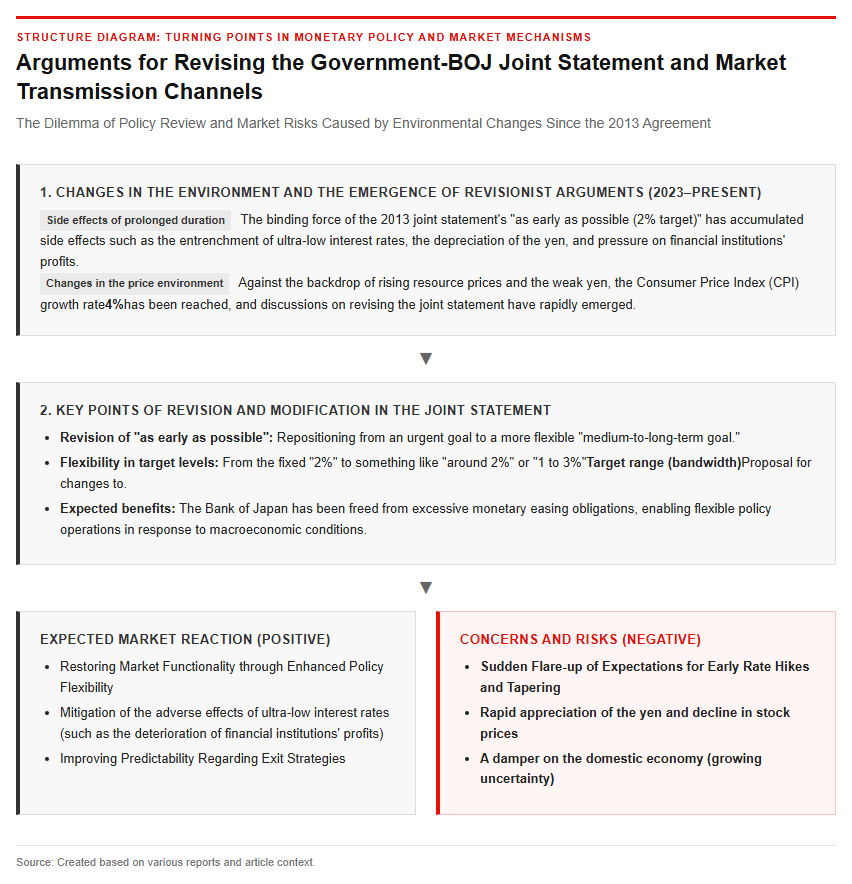
To ensure policy flexibility while maintaining market stability, utmost care is required regarding the timing and wording of statement revisions.
Monetary Policy Meetings and Challenges in Government-BOJ Cooperation
At the Bank of Japan’s Monetary Policy Meeting, while discussions regarding policy rate hikes and monetary normalization are underway, strong attention is also focused on the intentions and stance of the government representatives in attendance. In the “Summary of Opinions” from the September 2026 Monetary Policy Meeting, an attendee representing the Cabinet Office expressed opinions urging the Bank of Japan to fulfill its accountability, carefully examine the cumulative effects of past rate hikes, and cautiously check the level of the neutral interest rate. This remark was interpreted by the market as suggesting that a cautious stance toward rapid rate hikes remains deeply rooted within the government.
The “Japan Growth Strategy Headquarters” established under the Takaichi administration aims for economic expansion through growth investment, and concerns exist that rapid monetary tightening could derail the economic recovery. Minister in charge Kiuchi’s avoidance of a definitive stance on revising the joint statement by stating he “will not answer hypothetical questions” can be seen as reflecting the government’s intention to carefully monitor the pace of interest rate hikes and market trends while avoiding unnecessary political speculation and market turmoil regarding policy. To balance sustainable economic growth with price stability, disciplined dialogue between the government and the Bank of Japan remains crucial.
Reference Page
- 【Whether Joint Statement Will Be Revised Upon BOJ Achieving Price Target: “Will Not Answer Hypothetical Questions” — Economic and Fiscal Policy Minister Kiuchi】https://finance.yahoo.co.jp/news/detail/87f762ee79850a31c1dfc3dac7adade334e8db73
【#MonetaryPolicy #BankOfJapan #JointStatement #OvercomingDeflation #PriceTarget #MinoruKiuchi】


コメント