LINE Yahoo Corporation, in collaboration with U.S. investment fund Bain Capital, has officially proposed the acquisition of Kakaku Com, Inc., which operates a purchasing support site. They have offered acquisition prices that exceed the proposals from the leading European fund EQT, and the battle for leading companies in Japan’s internet industry is now in its final stage.
- LINE Yahoo’s official announcement of a ‘side-step acquisition’
- Soaring acquisition prices and fierce money games
- The True Nature of Crisis: The Zero-Click Problem and the Inevitability of AI Investment
- LINE Yahoo’s strategy for regrowth through data integration
- Digital Garage’s Reinvestment Strategy and Oasis Trends
- Deadline July 2, 2026 and Future Scenarios for Enactment
LINE Yahoo’s official announcement of a ‘side-step acquisition’
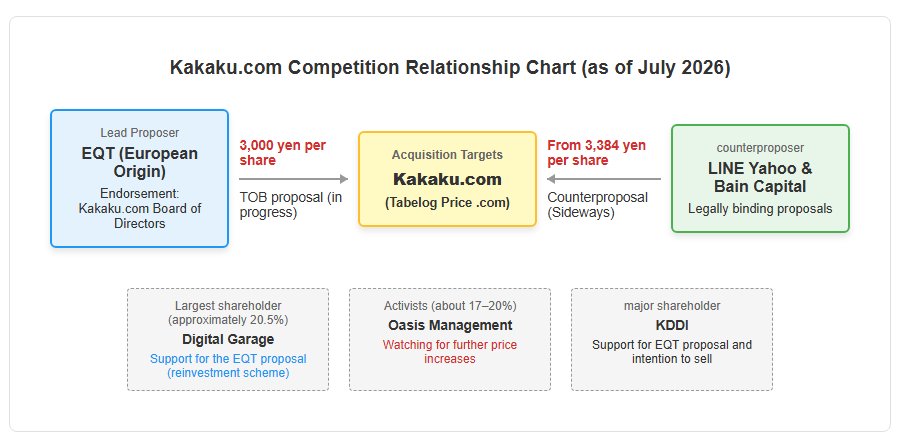
On July 1, 2026, LINE Yahoo announced that it had officially proposed acquiring Kakakucom, which operates “Tabelog” and “Price .com” together with Bain Capital. The company had submitted an initial proposal on May 7, 2026, but this time it has updated the content and is submitting it as a legally binding proposal. This proposal took the form of a so-called “sideways takeover” to counter the tender offer (TOB) that Sweden’s investment fund EQT had been leading the way. The LINE Yahoo group has established a joint venture with Bain Capital, aiming to acquire all shares of Kakaku.com through this company and take it private. Kakaku.com acknowledged receipt of the proposal and issued a statement to begin reviewing its content. The following chart illustrates the correlation of this acquisition.
Soaring acquisition prices and fierce money games
The biggest focus in this bidding war is the acquisition price per share. The proposed price by the leading EQT was 3,000 yen per share, but LINE Yahoo re-proposed 3,232 yen on May 14, 2026, and further raised the condition to 3,384 yen per share (up to 3,500 yen depending on conditions) in this official proposal. This far exceeds the initial EQT proposal and demonstrates Kakakucom’s high valuation of its potential corporate value. Driven by expectations of this acquisition battle, the stock price surged sharply, at one point hitting the daily limit and up 17% from the previous day, reaching 3,425 yen. Independent analysts also predict that, considering the possibility of a counterproposal from EQT, the final acquisition price could be revised upward from around 3,600 to 3,800 yen.
Management and Strategy Background: Sense of crisis in the era of generative AI and pursuit of synergy
The True Nature of Crisis: The Zero-Click Problem and the Inevitability of AI Investment
The reason Kakaku.com, which has maintained strong performance, chose to delist due to going private is a structural sense of crisis caused by the rise of generative AI. The company’s business model has relied on traffic from search engines like Google, but due to the “zero-click problem” where AI completes answers on the search results screen, there is a risk of losing site traffic in the future. Research firm Gartner predicts that usage of traditional search engines will shrink by 25% by the end of 2026. By going private, the company aims to create a management environment capable of implementing “AI investments without sanctuaries” worth tens of billions of yen, freeing it from market pressure for short-term quarterly earnings profit growth.
LINE Yahoo’s strategy for regrowth through data integration
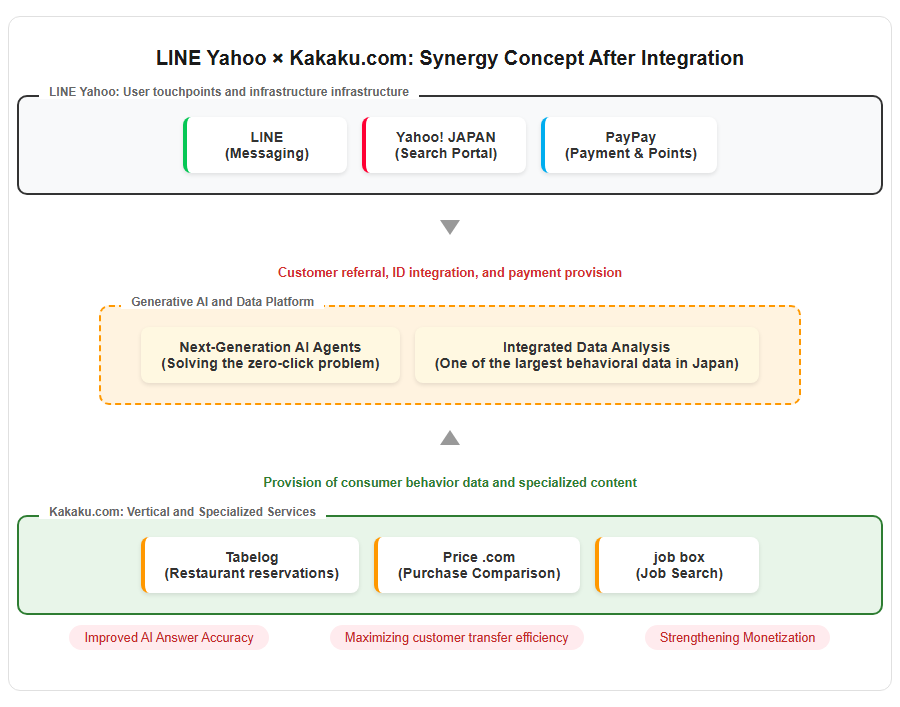
The reason LINE Yahoo strongly desires Kakakucom lies in the overwhelming consumer behavior data it possesses. Kakaku.com’s largest domestic purchase comparison data (price .com) and restaurant reservation data (Tabelog) are available on LINE and Yahoo! If integrated with JAPAN’s user base, it will be possible to build a unique AI service platform in the Japanese-speaking world. LINE Yahoo explains that by linking its payment platform and products with Kakaku.com’s services, it can create effective synergies such as improved customer flow efficiency and enhanced monetization. However, it has also been pointed out that, from the perspective of market dominance, this integration may be subject to strict antitrust scrutiny by the Fair Trade Commission. The diagram below illustrates the concept of service integration after integration.
Future developments and key points: Major shareholders’ trends and the timing of settlements
Digital Garage’s Reinvestment Strategy and Oasis Trends
The key to the success or failure of the acquisition lies in the hands of Kakakucom’s major shareholders. Digital Garage, the largest shareholder (holding about 20.5%), has expressed its support for the “20% reinvestment scheme” included in the EQT proposal over the high acquisition price of LINE Yahoo. This scheme is designed so that shareholders remain even after going private, reaping the benefits of future corporate value enhancement. On the other hand, the trend of oasis management, where activists (talking shareholders) hold about 17.2% to 20% of the shares, cannot be ignored. Oasis is likely to take a position seeking a higher purchase price, and a strategy is possible to use LINE Yahoo’s high offer as leverage for negotiations to raise prices (bump) to EQT.
Deadline July 2, 2026 and Future Scenarios for Enactment
The deadline for EQT’s TOB is set for July 2, 2026, with very limited time to finalize. As a realistic scenario going forward, first, Kakaku.com might judge LINE Yahoo’s proposal as “reasonable” and request EQT to raise the TOB price. Second, LINE Yahoo may be unable to persuade major shareholders such as Digital Garage and withdraw to avoid the risk of proceeding to a legally binding formal TOB. If the stock price continues to significantly exceed the TOB price, it could result in a “failure” situation where any acquisition by any group fails, potentially causing Kakakucom’s AI shift strategy to be delayed.
[#LINEヤフー #カカクコム #TOB #買収 #生成AI #食べログ #価格com #デジタルガレージ]
コメント