On May 20, 2025, Google announced Gemma 3n, a lightweight AI model that enables advanced processing on mobile devices. This is driven by the globally growing demand for on-device AI that balances privacy protection with communication lag.
- Overview of the Lightweight Model Gemma 3n
- Why On-Device AI Matters Right Now
- PLE technology drastically reduces memory usage
- MatFormer Architecture and Dynamic Scaling
- The shock of LMArena surpassing 1300
- Advanced multimodal features and Japanese support
- The Privacy Revolution and the Democratization of AI
- Expanding Ecosystem and Future Outlook
Overview of the Lightweight Model Gemma 3n
On May 20, 2025, Google announced a preview version of Gemma 3n, an OpenAI model specialized for running on mobile devices such as smartphones and laptops. This model incorporates the latest technology developed by Google DeepMind and is available to developers through Google AI Studio and Google AI Edge. During development, close cooperation was established with major mobile chipset manufacturers such as Qualcomm in the US, MediaTek in Taiwan, and Samsung System LSI in South Korea.
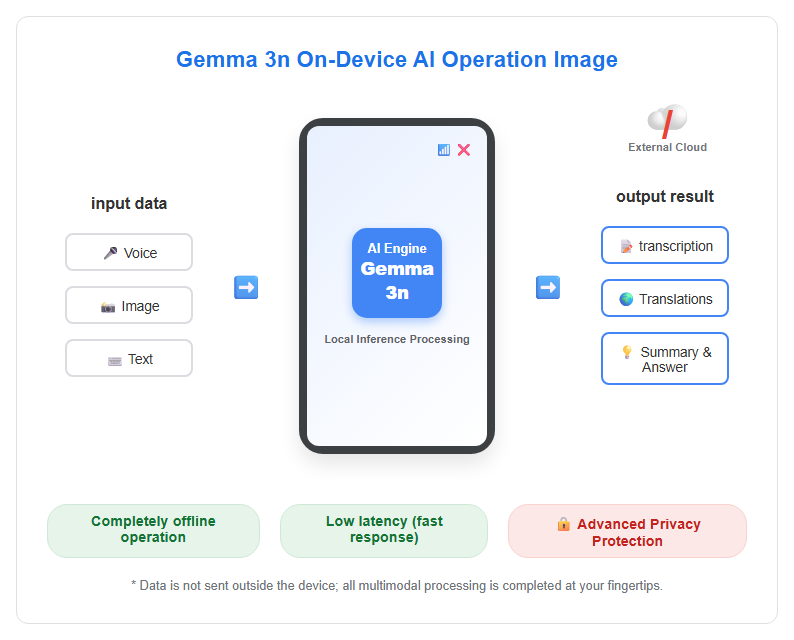
The biggest feature of Gemma 3n is that it is an on-device AI that operates directly on the device. This allows users to access personal and private AI features even in environments without internet access. Until now, large language models (LLMs) required enormous computing resources and were typically processed in the cloud, but Gemma 3n achieves processing completed on the device at hand through its proprietary compression technology, which will be discussed later.
The models offered are based on parameter sizes of 5B (5 billion) and 8B (8 billion). They feature multimodal capabilities that can process text, images, audio, and video simultaneously, enabling advanced tasks such as automatic speech recognition, real-time transcription, and translating speech into text within mobile environments. The diagram below shows an image of how it works on a mobile device.
Why On-Device AI Matters Right Now
The main reason on-device AI like Gemma 3n is gaining attention is user privacy protection. In cloud AI, input data is sent to external servers, which carries risks in handling confidential and personal information. In contrast, on-device AI handles all processing within its own device, so data never leaves the premises. As of 2026, this autonomy is highly valued in applications with strict security requirements, such as handling medical data and summarizing internal information.
Another major advantage is that they are not affected by the convenience of the cloud service side. Cloud AI is affected by fluctuations in usage fees, service outages, or communication lag, but on-device AI can operate stably even in offline environments like mountain huts late at night, as long as the power is on. As services like GitHub Copilot transition to token-based pay-as-you-go in 2026, the importance of local environments that can operate solely on fixed costs (device purchases and electricity bills) is increasing.
Furthermore, improved processing power at edge devices also contributes to improved energy efficiency. By suppressing massive power consumption in data centers and leveraging optimized chips on the device side, sustainable AI utilization becomes possible. Gemma 3n is positioned not merely as a technical demonstration but as next-generation infrastructure combining practicality and sustainability.
Technological innovations driving remarkable memory efficiency
PLE technology drastically reduces memory usage
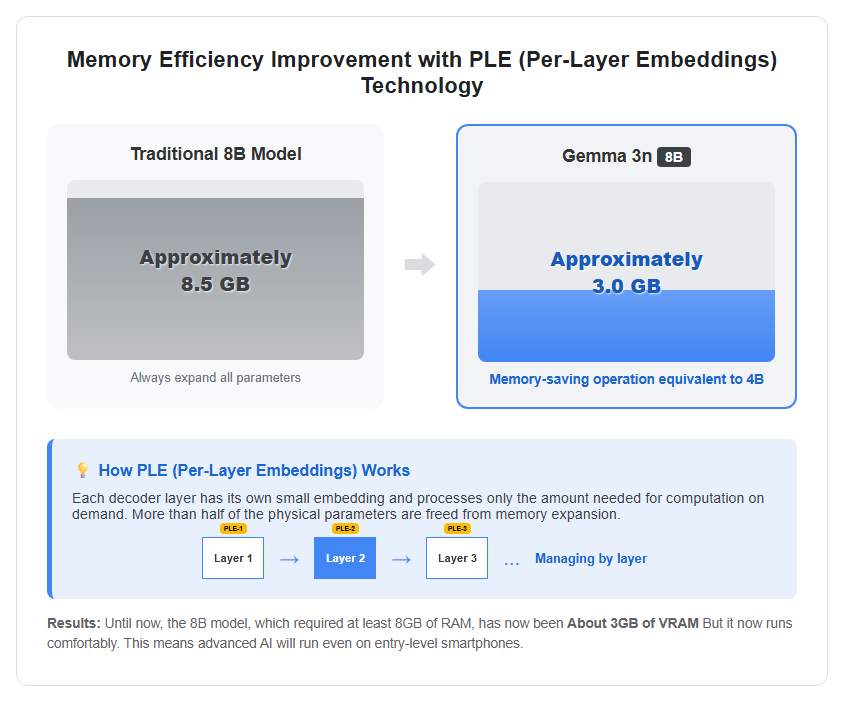
The secret behind Gemma 3n’s ability to operate with a relatively large number of parameters of 5B or 8B while operating with only 2GB to 3GB of memory space lies in an innovative technology called Per-Layer Embeddings (PLE). Typically, the size of an AI model directly affects the amount deployed to memory (RAM), but PLE employs a method of efficient management by assigning dedicated small embeddings to each decoder layer of the AI model.
Specifically, by efficiently handling data from specific embedded layers while retaining the model’s key weight parameters in a high-speed computational unit, they succeeded in significantly reducing the memory footprint compared to the conventional Gemma 3 4B. Even with a physical parameter count of 8B, the actual memory usage is limited to the equivalent of the 4B model. This made it possible to run full-fledged AI models even on entry-level smartphones and tablets with limited memory capacity.
This technology breaks through the hardware constraints that have been the biggest barriers to on-device AI adoption. In the rapidly growing edge AI market from 2025 to 2026, the figure of running with 3GB of VRAM represents a practical sweet spot for many mobile devices. For details on PLE technology, please refer to the structural diagram below.
MatFormer Architecture and Dynamic Scaling
Another important technology introduced in Gemma 3n is the MatFormer (Matryoshka Transformer) architecture. This refers to a structure like Russian Matryoshka dolls, where small, functionally independent sub-models are nested inside a large model. For example, from a basic model with 4 billion parameters, it is possible to dynamically extract and run a submodel with 2 billion parameters as needed.
This feature, called Mix and Match, allows AI to flexibly adjust its behavior according to application requirements and device load. For chat applications requiring high response times, a lightweight submodel is selected, and for more complex reasoning or high-quality translation, full-size models are used—all within a single model family.
Developers can optimize without making users aware of the trade-off between quality and latency, dramatically improving development efficiency. It also makes it easier to create custom models optimized for specific hardware. MatFormer’s philosophy is not simply to make models smaller, but to provide a new approach that provides a diverse layer of intelligence within a single model, and it is expected to become the de facto standard for future lightweight model design.
The power and versatility of mobile AI that overturn conventional wisdom
The shock of LMArena surpassing 1300
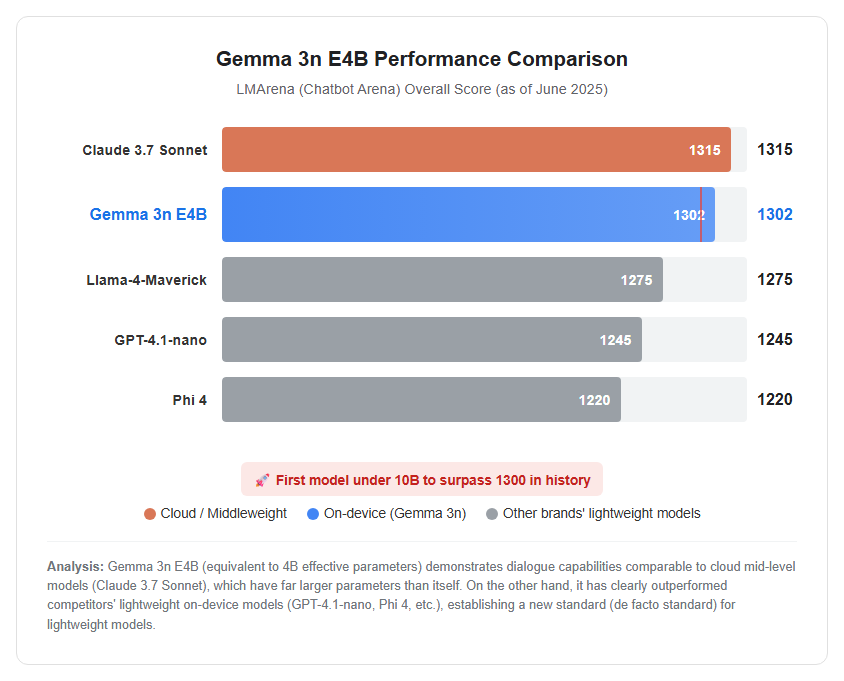
The Gemma 3n E4B model achieved the remarkable feat of surpassing 1300 in June 2025 as the first model with fewer than 10 billion parameters on the AI evaluation platform LMArena (Chatbot Arena). LMArena uses two anonymized models in a format where users actually compare them and vote, and the score serves as an industry-standard indicator of practical conversational skills. Until now, the high wall of 1300 has dominated massive cloud models with hundreds of billions of parameters.
This record proved that the intelligence of a model is not determined solely by the number of simple parameters (brain size). Gemma 3n has achieved benchmark scores close to high-performance mid-range cloud models like Anthropic’s Claude 3.7 Sonnet, demonstrating capabilities that surpass lightweight models from competitors such as GPT-4.1-nano, Llama-4-Maverick, and Microsoft’s Phi 4.
Despite being a mobile size under 10B, the ability to handle world-class intelligence right at the fingertips is highly significant. The paradigm shift from the traditional large-scale competition to the efficiency competition of how to efficiently extract high performance was clearly demonstrated by this figure of surpassing 1300. The graph below summarizes the performance comparison between the Gemma 3n and other models.
Advanced multimodal features and Japanese support
Despite its lightweight design, Gemma 3n features native multimodal capabilities that integrate not only text but also images, audio, and video. In particular, the improvement in audio processing power is remarkable, with high-quality automatic speech recognition and real-time multilingual translation now running on the device alone. This means delivering experiences such as real-time recording and summarization of meetings, as well as instant translation of signboards when the camera is pointed, all offline and fast.
Additionally, while previous open research models tended to be English-focused, Gemma 3n has significantly enhanced multilingual support, especially Japanese capabilities. In major languages such as Japanese, German, Korean, Spanish, and French, it has achieved reasoning accuracy far exceeding that of previous generations. This allows Japanese users to enjoy natural Japanese conversations on-device without any discomfort.
In terms of response speed, it achieves about 1.5 times faster performance compared to the previous Gemma 3 4B. The improved prefill speed from prompt input to response generation has ensured real-time stability that allows mobile users to feel stress-free. The experience of running multilingual and multimodal processing so smoothly on the device at hand is being described as one of the biggest surprises in the AI industry in 2025.
Future Developments and Ripple Effects on Society
The Privacy Revolution and the Democratization of AI
The arrival of Gemma 3n holds the potential to fundamentally change how we engage with AI. With the widespread adoption of advanced processing capabilities that are fully localized, it is expected that the use of AI in highly confidential fields such as healthcare, legal, and human resources—which had previously been hesitant to adopt AI due to concerns about data leaks—will accelerate rapidly. An environment is gradually being established where tasks such as patient record analysis and reviewing unpublished contracts can be performed safely on devices at hand without anyone knowing.
This is extremely important from the perspective of democratizing AI. Even individuals who cannot afford to continue paying high cloud subscription fees or users in regions with underdeveloped infrastructure can continue to use world-class intelligence for free once they acquire a device. Gemma 3n is offered under a free and commercially available license, providing a strong foundation for small businesses and individual developers to build their own AI applications at low cost.
Furthermore, as on-device adoption progresses, it also frees users from external factors such as internet congestion and service outages caused by server failures. Even in environments like mountain huts late at night or on airplanes, the presence of a personal assistant who stays by our side 24/7 will dramatically enhance our quality of life and boost productivity. AI is no longer just a giant brain in the sky, but has evolved into a familiar tool in our pockets.
Expanding Ecosystem and Future Outlook
Google has announced that the PLE technology and MatFormer architecture adopted in Gemma 3n will also be adopted in the next-generation Gemini Nano, scheduled for release in late 2025. As a result, on-device AI performance is expected to improve across Google’s major platforms, including Android smartphones and the Chrome browser. By integrating advanced AI features at the OS level, users can seamlessly receive AI assistance simply by pointing to information on the screen (Circle to Search), without switching apps.
Collaboration with chipset manufacturers will also deepen further. Through joint development with Qualcomm and Samsung, AI model algorithms and hardware computing units will be more closely optimized, leading to further power savings and faster performance. From 2027 to 2028, the range of unified memory (UMA) options is expected to increase dramatically, including for the x86 camp, and the benefits of large-capacity UMAs led by Apple Silicon will likely spread widely to Windows and Linux devices.
Going forward, a hybrid operation will not be dominated by a single powerful model but will be a hybrid approach where super-large cloud-based models and high-lightweight, efficient on-device models are used according to their needs. Gemma 3n is expected to be a historic model that pioneered this and opened the door to a new era of mobile AI. The intelligence in the palm of our hands will continue to evolve at an astonishing pace.


コメント