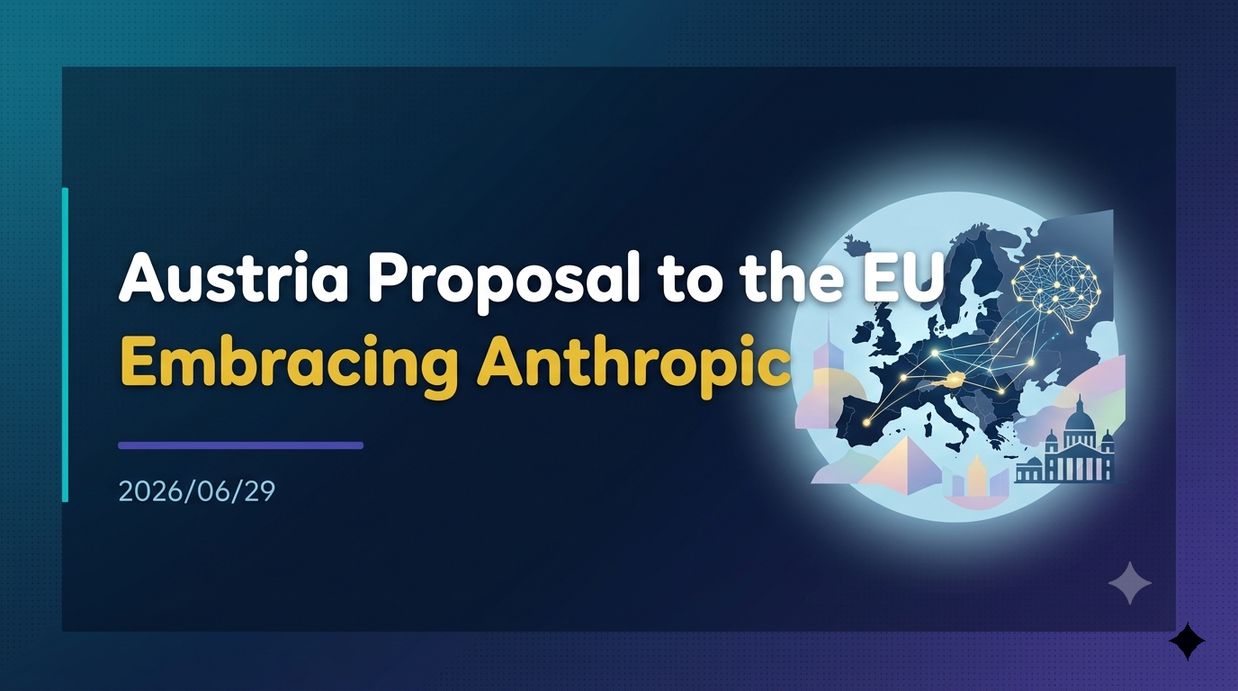
Austria proposed attracting Anthropic from the US to the European Union (EU) due to AI export controls originating from the United States. Behind this move is a strong sense of crisis that restrictions on access to cutting-edge AI threaten Europe’s economic activity and technological sovereignty.
- An urgent call to protect European technological sovereignty
- The sudden disabling of flagship models “Fable 5” and “Mythos 5”
- Overwhelming support among enterprise developers
- Rapid expansion of its European operations based in Ireland
- Legal and structural barriers hindering the feasibility of the bid
- Confidential S-1 filing and ensuring transparency for listing
- Compliance with the EU AI Code of Conduct and International Collaboration
- The shift companies should take toward a “multi-vendor” approach
An urgent call to protect European technological sovereignty
On June 28, 2026, the Austrian government formally proposed to the European Union (EU) to invite Anthropic, a U.S. artificial intelligence (AI) company, to the EU and consider its strategic establishment. Alexander Ploel, Austria’s State Secretary for Digitalization, strongly emphasized in a letter to EU Commissioner Henna Vilcknen that Europe should not be cut off from critical innovation. Proel argued that Anthropic should seek a “strategic participation” in Europe, backed by legal certainty, market access, capital, and European values.
This proposal shows that access to AI models has transformed from merely a matter of technological convenience into a matter of national sovereignty. Proel himself acknowledges skepticism about the realization of this proposal, but says he is questioning whether Europe will become the architect of its own technological future or remain the administrator of decisions elsewhere.
Please refer to the diagram below.
The sudden disabling of flagship models “Fable 5” and “Mythos 5”
The background to Austria’s strong move is the export control directive issued by the U.S. Department of Commerce on June 12, 2026. As a result of this directive, Anthropic was forced to abruptly suspend access to its latest models, the “Fable 5” and “Mythos 5,” for all non-U.S. nationals (including Anthropic non-U.S. employees), both inside and outside the United States. In particular, the Fable 5 was just publicly unveiled on June 9, and its suspension of service within just a few days sent shockwaves across both sides of the Atlantic.
What the U.S. government was concerned about was the national security risks associated with the “jailbreaking” technology that circumvents AI model safety guardrails. Anthropic is working to clear up misunderstandings, stating that the identified vulnerabilities are minor and comparable to other companies’ published models, but for European users, the cutting-edge tools they had been trying to place at the core of their workflows were suddenly taken away.
Anthropic’s presence and corporate demand in the European market
Overwhelming support among enterprise developers
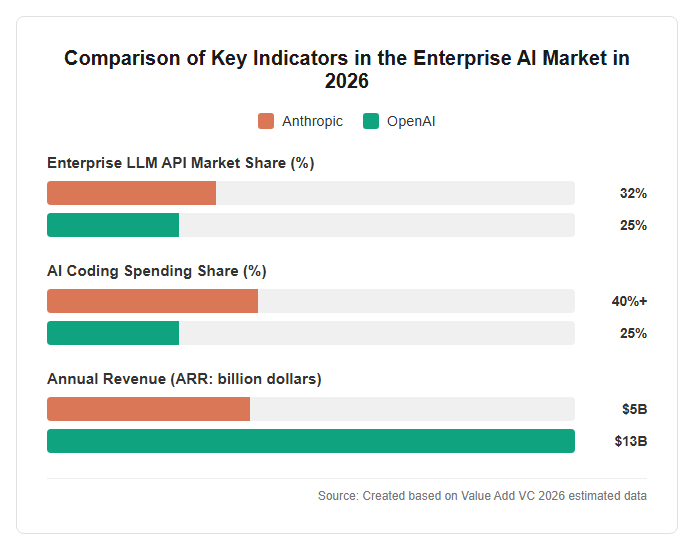
Anthropic’s significant position in Europe, especially in the corporate market, further enhances the significance of this invitation proposal. As of 2026, Anthropic will hold about 32% of the global enterprise LLM API market, surpassing OpenAI’s roughly 25%. In particular, its share in software engineering exceeds 40%, and the Claude series is becoming the de facto standard among developers.
-
Enterprise API Market Share: Anthropic (about 32%) vs OpenAI (about 25%)
-
AI Coding API Market Share: Anthropic (over 40%)
-
Number of corporate clients: Over 300,000 companies (used by 8 of the Fortune Top 10)
Because European companies heavily rely on Anthropic’s API as infrastructure for building products and services, access restrictions carry risks that ripple across economic activity.
Rapid expansion of its European operations based in Ireland
Anthropic itself places great emphasis on the European market, with a base in Dublin, Ireland, for the EMEA region. In April 2026, the company announced a significant expansion of the facility and revealed plans to hire 200 new employees in sales, engineering, finance, legal, and compliance fields by 2027.
The Irish government has welcomed this and is supporting it as part of the “Digital and AI 2030 Strategy,” which aims to establish the country as a global AI hub. Anthropic’s sales in the EMEA region have grown an astonishing 11-fold year-over-year, capturing the needs of major European companies seeking reliable AI—that is, secure and transparent systems. Irish Prime Minister Mihor Martin stated that the company’s expanded investment reflects strong confidence in the country’s technology ecosystem.
Institutional Barriers and Exploring Future Compliance
Legal and structural barriers hindering the feasibility of the bid
While there is high regard for Austria’s proposal, the current barriers to realization are extremely high. Experts point out that simply installing data centers in Europe will not circumvent U.S. export regulations.
-
Control of model weights: U.S. government orders apply to U.S. companies regardless of server location.
-
Technical barriers: Unless the very structure of who manages the model’s weight and who grants access is reconstructed, restoring access is difficult.
-
U.S. Response: Because the regulation is for national security reasons, political negotiations with the U.S. Department of Commerce are essential.
Austria’s letter does not specify a specific implementation mechanism, and this proposal is analyzed to be a political message aimed at highlighting the “provider concentration risk” of AI infrastructure.
Confidential S-1 filing and ensuring transparency for listing
Meanwhile, efforts are underway to make Anthropic’s economic realities transparent. On June 1, 2026, Anthropic submitted a confidential S-1 listing preparation document to the U.S. Securities and Exchange Commission (SEC) (OpenAI also submitted it on June 9). As a result, the previously black-box financial condition and risk factors of AI labs will now be subject to public audits.
Specifically, in addition to sales, losses, and cash balances, the details of multi-million-dollar computing resource contracts with cloud providers are expected to be disclosed. As companies require billions of dollars in capital, funding from the stock market is essential, and moves toward listing serve as a key criterion for European regulators and investors to assess the company’s sustainability.
Future Outlook and Key Points: The Multipolarizing AI Stack Strategy
Compliance with the EU AI Code of Conduct and International Collaboration
Anthropic continues to actively consult with EU regulators to smoothly expand its services in the European market in the future. According to European Commission spokesperson Thomas Regnier, Anthropic has formally committed to complying with the EU’s “Code of Conduct for AI” and is working to assess and mitigate potential risks regardless of whether services are provided.
This framework requires rigorous verification of cybersecurity, systemic risks, and social impacts. Anthropic’s early compliance with these requirements will directly lead to gaining trust in 27 European countries. Ireland, which will serve as the EU Council President in 2026, is also scheduled to host an international AI summit in collaboration with the European Commission, drawing attention to the rebuilding of transatlantic cooperation toward building a responsible AI ecosystem.
The shift companies should take toward a “multi-vendor” approach
This “access disconnection” incident has made companies around the world aware of the geopolitical risks of relying on specific AI providers. Going forward, architectures that use multiple models differently rather than relying on a single model are expected to become mainstream.
-
Multi-vendor strategy: Already, about 60% of companies have adopted two or more model vendors to diversify risk.
-
Utilization of open-weight models: The movement to keep open models you can manage locally as backups is accelerating to prevent them from being invalidated by specific policies.
-
Market Trends: The European Commission’s official response and whether other member states will align with Austria’s request will determine the future direction of AI attraction.
[#AI規制 #Anthropic #欧州連合 #技術主権 #経済安全保障 #Claude #DX]
コメント