The dollar-yen exchange rate rapidly moved toward a weaker yen and stronger dollar, reaching the 159.80 yen range. Behind this lies a standoff between expectations for additional rate hikes driven by an upside surprise in U.S. inflation and caution regarding potential currency intervention by Japanese monetary authorities.
- Rapid Depreciation of the Yen Toward the 159.80 Range and Market Trends
- The background behind the rise in US long-term interest rates and expectations for an additional rate hike in December
- Currency Authorities’ Warning Remarks and the History of Joint Intervention in 1998 and 2026
- Structural Yen Depreciation Pressure Driven by Interest Rate Differentials and the Balance of Payments
- The Bank of Japan’s Monetary Policy and the Scenario for Further Rate Hikes
- Key Points to Watch Regarding Major Economic Indicators and Geopolitical Risks
Rapid Depreciation of the Yen Toward the 159.80 Range and Market Trends
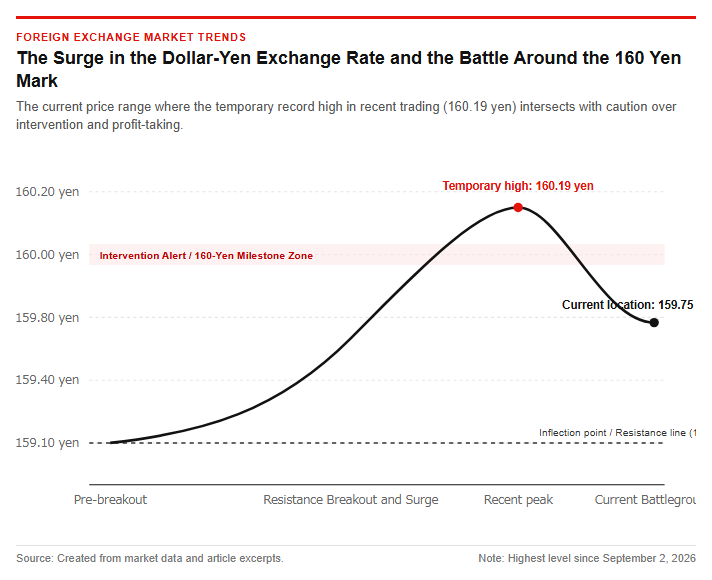
In the foreign exchange market, the US dollar-yen exchange rate surged rapidly from the upper 159 yen range to the verge of 160 yen per dollar. In recent trading, it temporarily rose to 160.19 yen, marking a high not seen in about two and a half months since September 2, 2026. Among market participants, the view is spreading that the upward momentum accelerated all at once after breaking above the 159.10 yen resistance level, which had been considered a crucial turning point. Meanwhile, as it approaches the 160 yen milestone, strong selling pressure for profit-taking, coupled with heightened caution regarding potential yen-buying intervention by the Japanese government and the Bank of Japan, has led to nervous price movements capping further upside. Currently, the battle around the 159.75 yen level is intensifying, and the biggest focus determining the future trend is not just whether a temporary break above 160 yen can be achieved, but whether it can firmly establish itself in the 160 yen range on a daily closing price basis. The latest price movements and the state of the battle in the foreign exchange market are as shown in the figure below.
The background behind the rise in US long-term interest rates and expectations for an additional rate hike in December
The primary causes of the recent depreciation of the yen and appreciation of the dollar are the persistence of inflationary pressure in the United States and growing caution regarding the continuation of monetary tightening. Following the release of the U.S. Consumer Price Index (CPI) for October 2026, which rose 0.4% month-on-month—exceeding the market consensus of a 0.3% increase—Federal Reserve officials made a series of hawkish remarks. In addition to Federal Reserve Governor Waller mentioning the possibility of considering a significant 0.5 percentage point rate hike depending on future price trends, New York Fed President Williams also emphasized the necessity of gradual tightening measures to bring the inflation rate back to the 2% target. In response to these developments, the Chicago Mercantile Exchange’s FedWatch priced in a nearly 100% probability of an additional rate hike at the December Federal Open Market Committee (FOMC) meeting, resulting in strong dollar-buying pressure pushing up the market alongside rising U.S. long-term interest rates.
Apprehension Over Currency Intervention and Structural Factors Behind the Weak Yen
Currency Authorities’ Warning Remarks and the History of Joint Intervention in 1998 and 2026
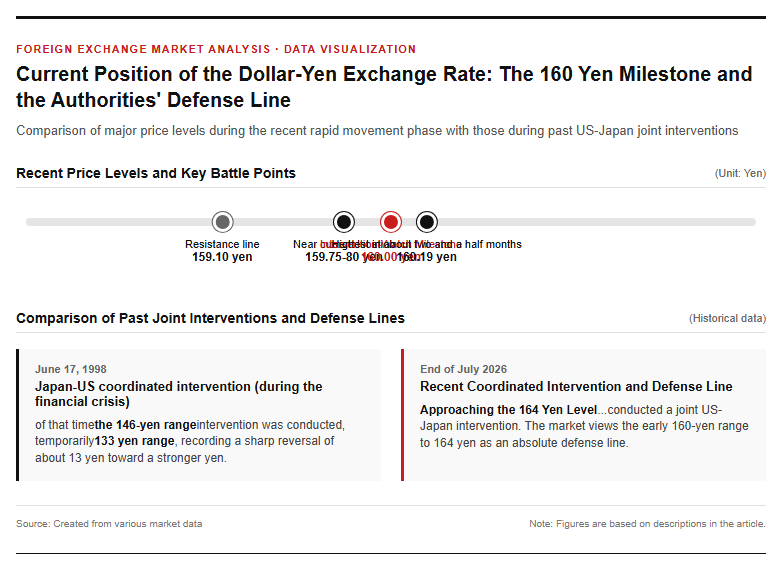
As the yen approaches the major 160 yen mark, Japanese monetary authorities are stepping up the intensity of their verbal warnings against the weak yen in stages. Finance Minister Satsuki Katayama emphasized her stance to work closely with the U.S. Treasury Department to respond appropriately to the recent one-sided and rapid depreciation of the yen, while Vice Minister of Finance Atsushi Mimura has also expressed strong concern over excessive market volatility. In the foreign exchange market, attention is focused on whether the authorities will move beyond verbal intervention and rate checks by the Bank of Japan to the next stages, such as unilateral stealth intervention or joint U.S.-Japan intervention. Looking back at the history of exchange interventions, a joint U.S.-Japan intervention was carried out on June 17, 1998, amid Japan’s financial crisis, triggering a sharp yen appreciation of up to roughly 13 yen, pushing the currency from the 146 yen range at the time to temporarily the 133 yen range. Furthermore, joint U.S.-Japan intervention was conducted at the end of July 2026 when the exchange rate was approaching 164 yen, and the market is acutely aware of the range from the early 160 yen to around 164 yen as an absolute defense line. The track record of past joint interventions and the structure of the defense lines are as follows.
Structural Yen Depreciation Pressure Driven by Interest Rate Differentials and the Balance of Payments
While foreign exchange intervention by monetary authorities brings temporary market-suppressing effects, the structural factors supporting the underlying depreciation of the yen remain deeply entrenched. Against the backdrop of the still-significant interest rate differential between Japan and the U.S., the yen carry trade—borrowing low-interest yen to invest in high-interest U.S. dollar assets—continues to be actively practiced. Furthermore, fundamental changes in Japan’s balance of payments structure cannot be ignored. There has been a shift from the former trade surplus-driven structure to one led by the primary income balance, such as dividends and interest from overseas investments. In particular, the expansion of reinvested earnings from overseas subsidiaries has increased surpluses that are not accompanied by actual yen-buying exchange transactions. Due to these structural challenges on both the demand and financial fronts, the prevailing analysis is that sole currency intervention alone makes it extremely difficult to reverse the yen depreciation trend over the medium to long term.
Future Market Outlook and Risk Factors
The Bank of Japan’s Monetary Policy and the Scenario for Further Rate Hikes
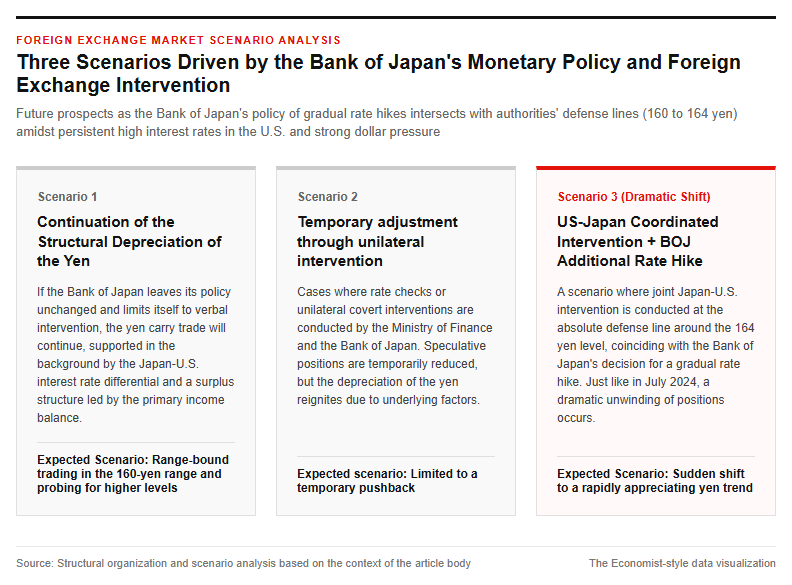
Another important axis that will influence the future direction of the market is the trend in monetary policy decisions by the Bank of Japan. BOJ Governor Kazuo Ueda is carefully analyzing the impact of rising import prices due to the weak yen on domestic prices and wages, and has not wavered from his basic stance of promoting gradual interest rate hikes in line with economic forecasts. Additionally, speaking engagements by board members known as hawks, such as Hajime Takata, are attracting attention as factors that sway speculation regarding policy decisions. It has also been pointed out that if large-scale currency intervention by monetary authorities and the BOJ’s decision on additional rate hikes coincide, the massive yen-sell positions accumulated by speculators up to now could be unwound all at once, triggering a dramatic shift toward a stronger-yen trend, much like in July 2024. The relationship between the BOJ’s policy trends and exchange rate scenarios is summarized in the figure below.
Key Points to Watch Regarding Major Economic Indicators and Geopolitical Risks
The future USD/JPY exchange rate is expected to be significantly influenced by both major U.S. economic indicators and global geopolitical risks. With the release of U.S. October retail sales, remarks by Fed Chair Warsh, and earnings reports from major tech companies like NVIDIA scheduled, stock market sentiment and outlooks on the future path of U.S. interest rates will be factors that sway the market. In addition, escalating tensions in the Middle East surrounding the situation in Iran could trigger both concerns over the expansion of Japan’s trade deficit through rising crude oil prices and safe-haven buying of the U.S. dollar, further intensifying downward pressure on the yen. Market participants are required to practice fund management and cautious risk hedging capable of coping with a sharp expansion in volatility, all while keeping a wide expected range of roughly 158.50 to 161.50 yen in mind.
Reference Page
- [Gaitame.com Money Education Channel] https://www.gaitame.com/media/entry/2026/11/13/125224
【#ExchangeRates #USDJPY #WeakYen #FXIntervention #BOJ #Fed #JapaneseEconomy】


コメント