Wacom has announced that it will conduct a management buyout (MBO) in partnership with MBK Partners to take its shares private. The move is driven by struggles in its brand business due to the rise of competitors and the need for medium- to long-term upfront investments.
- Key Points of the 1,030 Yen Acquisition Price and Going-Private Scheme
- Shareholder Trends and the Reinvestment Structure of Major Funds and Samsung
- The struggles of the branded product business and the fierce pursuit by Chinese competitors and the iPad
- Overreliance on the Technology Solutions Business and Structural Challenges
- Release from short-term market pressures and promotion of business restructuring and M&A
- Delisting Procedures and the Medium-to-Long-Term Outlook for the Pen Tablet Market
Key Points of the 1,030 Yen Acquisition Price and Going-Private Scheme
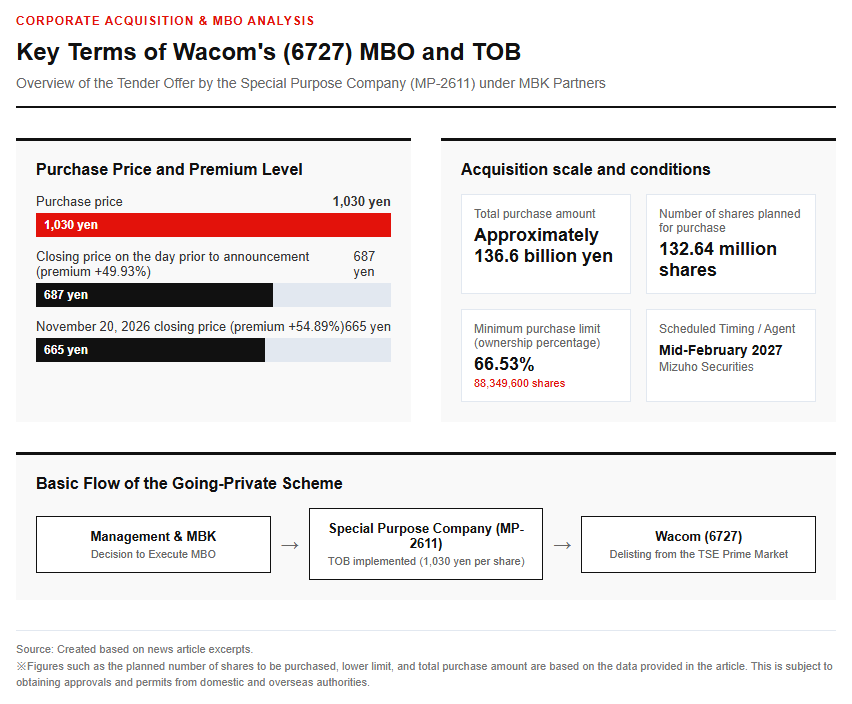
Wacom (6727), a major digital pen system manufacturer, has announced that it will partner with Asian investment fund MBK Partners to go private through an MBO (Management Buyout). The acquiring entity is MP-2611, a special purpose company under the umbrella of MBK Partners, which aims to delist the company from the Prime Market of the Tokyo Stock Exchange by conducting a TOB (Takeover Bid). The purchase price is set at 1,030 yen per share, which represents a 49.93% premium over the previous day’s closing price of 687 yen, and a 54.89% premium over the closing price of 665 yen on November 20, 2026. The planned number of shares to be purchased is 132,643,831 shares, with a lower limit of 88,349,600 shares, equivalent to an ownership ratio of 66.53%, making it a large-scale deal with a total acquisition value of approximately 136.6 billion yen. Subject to obtaining approvals and permits from domestic and international authorities, the company aims to commence the TOB around mid-February 2027, with Mizuho Securities scheduled to be appointed as the tender offer agent. The following figure illustrates the overview and scheme of the tender offer in this MBO.
Shareholder Trends and the Reinvestment Structure of Major Funds and Samsung
In this MBO scheme, a complex reinvestment structure involving the management team, major shareholders, and partner companies has been established. Wacom Representative Director and President Nobutaka Ide has decided not to tender his holding of 155,953 shares (0.12%) to the TOB, but instead to reinvest in the bidder’s parent company following the privatization. Furthermore, Samsung Electronics Singapore Pte. Ltd. (SESP)—a major shareholder holding 6.32% of Wacom’s shares and a long-standing partner in the technology solutions business from South Korea’s Samsung Group—also plans to reinvest in the surviving entity with a 6.3% ownership stake after the TOB is successfully completed. On the other hand, the UK investment fund Asset Value Investors (AVI), which has previously proposed improvements to Wacom’s management practices, and KC’s major shareholder group have agreed to tender their combined total of 33,910,950 shares to the TOB. Ultimately, MP-2611 will absorb and merge Wacom, with funds affiliated with MBK Partners, President Ide, and SESP serving as the three shareholder entities managing the company.
Wacom’s Business Environment and the Background of Going Private
The struggles of the branded product business and the fierce pursuit by Chinese competitors and the iPad
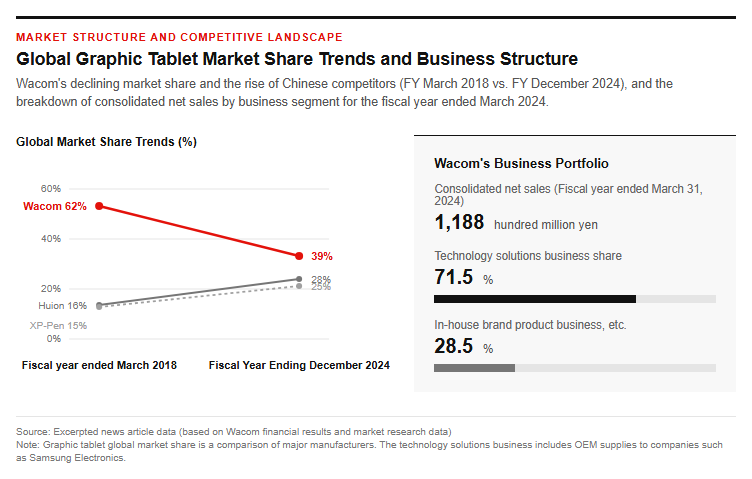
Behind Wacom’s move to go private lie drastic environmental changes and deteriorating business performance surrounding its own-brand product business, which is one of the company’s key pillars. While Wacom has long boasted an overwhelming number-one market share in the pen tablet and pen display market for creators, in recent years Chinese competitors such as Huion and XP-Pen have rapidly emerged by successively launching high-value, mid-to-low-priced products with equivalent functionality. In terms of global market share for graphic tablets, Wacom has seen its share drop significantly from 62% in the fiscal year ended March 2018 to 39% in the fiscal year ended December 2024. During the same period, competitors have shown rapid catch-up, with Huion expanding its share from 16% to 28% and XP-Pen from 15% to 25%. Furthermore, the evolution of general-purpose tablet devices such as the iPad Pro equipped with the Apple Pencil has also acted as a factor hindering the influx of entry-level users, contributing to the ongoing operating losses in the own-brand product business.
Overreliance on the Technology Solutions Business and Structural Challenges
To counter the slowdown in its branded product business, Wacom’s financial performance has been supported by its Technology Solution business, which provides OEM pen sensor technology for smartphones and laptops. According to the financial results for the fiscal year ended March 2024, the Technology Solution business has grown to account for 71.5% of Wacom’s consolidated net sales of 118.8 billion yen, with supplies for products such as Samsung’s Galaxy S Pen driving business growth. However, this structure means that its overall financial performance is heavily dependent on the shipment trends and adoption status of its OEM partners, occasionally making it impossible to fully compensate for sluggish sales of high-margin, in-house branded pen tablets and other products. Furthermore, product development cycles have lengthened compared to competitors, resulting in delayed product launches in the mid-range volume zone. As a publicly traded company pressured to maintain short-term quarterly results, Wacom found itself in a situation where fundamental structural reforms were difficult to implement. The following figure shows the market share trends of major players in the pen tablet market and a comparison of their product portfolios.
Management Reforms and Future Outlook After Going Private
Release from short-term market pressures and promotion of business restructuring and M&A
The primary objective of taking the company private through this MBO is to free management from the short-term pressures of the stock market, such as quarterly earnings and stock price fluctuations, and to execute drastic management reforms from a medium- to long-term perspective. Following the privatization, the company plans to agilely pursue upfront investments, such as a complete restructuring of its product portfolio to counter price competition from Chinese competitors, and the development of highly specialized, industry-specific solutions leveraging new technologies. Furthermore, by leveraging the extensive management expertise and global network of its partner, MBK Partners, the company is expected to not only improve the profitability of its existing businesses but also actively drive M&A (mergers and acquisitions) to acquire new technologies in the digital pen and digital ink domains, alongside securing top talent.
Delisting Procedures and the Medium-to-Long-Term Outlook for the Pen Tablet Market
If the TOB for Wacom is successfully completed, the company’s shares will be delisted from the Tokyo Stock Exchange Prime Market after undergoing the prescribed procedures. For general individual investors and shareholders, the options will be to tender their shares for sale through Mizuho Securities or other institutions during the TOB period scheduled for around mid-February 2027, or to sell them on the market. Whether Wacom, having transitioned into a private company, can accelerate its product development speed and rebuild its brand power under a strong alliance with MBK Partners and Samsung will significantly impact the competitive landscape of the overall digital art and digital pen markets going forward. The greatest point of focus that will determine the company’s medium-to-long-term revitalization and growth will be whether it can pioneer new markets in education, offices, and other sectors while maintaining its high quality reputation in the professional market.
Reference Page
- [Wacom Co., Ltd. Official Announcements & IR Information] https://www.wacom.com/ja-jp/about-wacom
[#Wacom #MBO #MBKPartners #TOB #PenTablet #GoingPrivate #CorporateAcquisition #ITBusiness]

コメント