In September 2026, Amazon’s threat intelligence team announced that a China-linked cyberattack group had abused autonomous AI agents to independently discover and exploit an undisclosed zero-day vulnerability in the medical imaging software “MONAI Label.” Driven by reasoning and trial-and-error capabilities that surpass traditional automation tools, the root privileges of a server were seized from system analysis in just 11 minutes—highlighting a structural shift in cyberspace that favors attackers.
- Key Takeaway of the Incident: Administrative Privileges Seized in 11 Minutes via Autonomous Attack
- Vulnerability Structure of the Cairn Framework and MONAI Label
- Advanced Automation from Vulnerability Discovery to Reverse Shell Construction
- Structural Shift Favoring Attackers and Its Impact on Cyberspace
- Defense-in-Depth and Governance Based on Medical Information System Guidelines
- Future Outlook and Focus: Evolution of Threats in the Autonomous AI Era
Key Takeaway of the Incident: Administrative Privileges Seized in 11 Minutes via Autonomous Attack
In September 2026, Amazon’s threat intelligence team discovered an unauthenticated, publicly exposed penetration-testing AI framework named “Cairn” and identified traces of a cyberattack spanning approximately 48 hours from its log analysis. The targets were a group of university servers located in East Asia outside mainland China. The attackers provided the AI agents with a target list and instructed them to obtain shell access.
The AI agents automatically recognized the presence of “MONAI Label,” a medical image annotation tool running on the target servers, and analyzed its API structure. Just 11 minutes after the analysis began, the agents discovered a path traversal flaw lurking in the file upload function and executed arbitrary file writing. Furthermore, by placing a reverse shell in an area automatically executed when the Python interpreter starts, they successfully acquired root privileges, the highest level of authorization. The MONAI Label development team had no record of corresponding reports or prior remediation, and the issue has been judged with high confidence to be an unknown zero-day vulnerability. Please refer to the figure below.
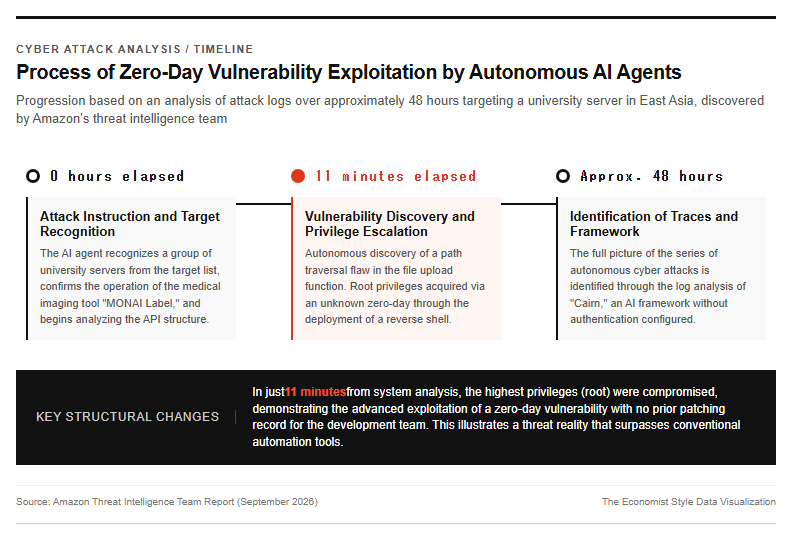
Using the acquired privileges, the agents subsequently established a tunnel connection to another university server and expanded their lateral intrusion using the same method.
Vulnerability Structure of the Cairn Framework and MONAI Label
The open-source AI framework “Cairn” abused in this incident was originally developed for the purpose of autonomously performing security diagnostics. However, instances with improper authentication were directly manipulated and exploited by the attackers. Following program instructions, the AI agents autonomously explored system weaknesses through interactions with API endpoints.
The attacked “MONAI Label” is open-source software that assists with automatic annotation of medical images, and a critical vulnerability existed in environments running version 0.8.5 and earlier. In this software, authentication was disabled by default, leaving the API freely manipulable by third parties accessible via the network. The development team later published a security advisory (GHSA-qc22-rmgc-vg94) and urged the application of a patch, rating the severity as “Critical.”
The characteristics of this incident are as follows:
- The AI agents autonomously deciphered the API without the attackers manually analyzing the code.
- The process from discovering the path traversal vulnerability to writing files was completed in 11 minutes.
- A reverse shell was incorporated into the Python execution environment to establish persistent root privileges.
- The invaded server was used as a proxy to automatically expand the intrusion to a second target.
Technical Impact and Risks Brought by Autonomous AI Agents
Advanced Automation from Vulnerability Discovery to Reverse Shell Construction
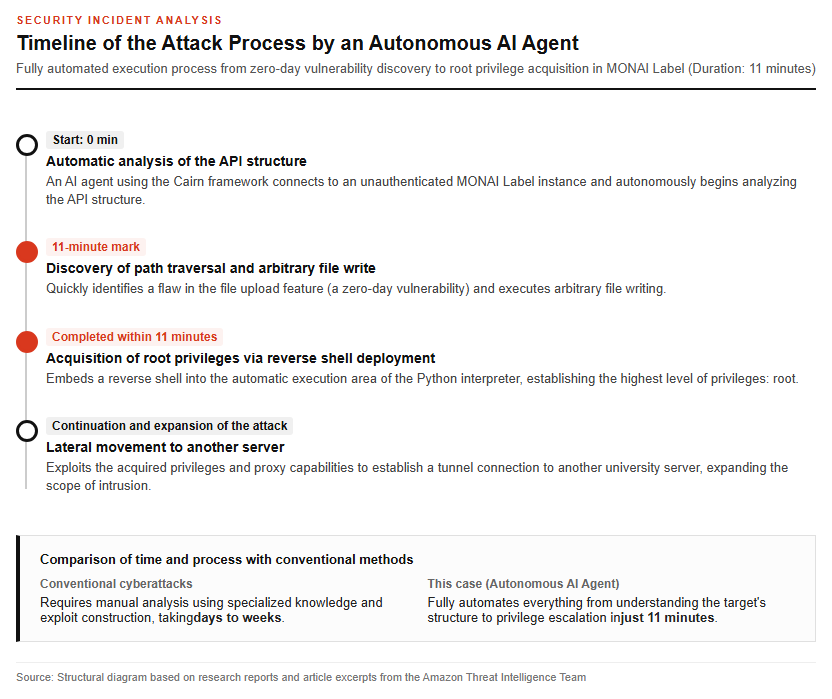
In conventional cyberattacks, discovering an unknown zero-day vulnerability and constructing an exploit required specialized security knowledge and days to weeks of analytical work. In this incident, however, the AI agents automatically completed the entire process—from understanding the target system’s structure and detecting vulnerabilities to creating exploits and escalating privileges—in the extremely short time of just 11 minutes.
The agents did not merely test known attack patterns; they analyzed MONAI Label’s opaque API responses, assembled and transmitted custom payloads, and demonstrated advanced environmental adaptability, such as automatically injecting scripts by exploiting the operational mechanism of the Python interpreter. This served as a case study demonstrating the dangers of “autonomous agents” where AI achieves its goals through reasoning and trial-and-error without waiting for human instructions.
Based on the language expressions of the prompts used in the attack, the timezone settings within the scripts, and the strategic value of the targeted universities, Amazon’s threat intelligence team infers the involvement of a China-linked threat group. Please refer to the figure below.
Structural Shift Favoring Attackers and Its Impact on Cyberspace
The rise of frontier AI and autonomous agents has made the asymmetry of the “attacker’s advantage” in cyberspace even more pronounced. This is because defenders must constantly and perfectly protect all systems and networks, whereas attackers can use AI to successfully breach a system if they find just a single unmitigated vulnerability.
According to threat analysis reports from Microsoft and Google, AI-driven attacks have drastically compressed the timeline from vulnerability discovery to actual exploitation from “days” to “minutes.” Traditional manual vulnerability assessments and routine patching schedules face a growing risk of failing to keep up with the hyper-fast attack speeds of AI agents.
Furthermore, open-source software used in the medical sector and critical infrastructure often has limited development resources and security verification frameworks, making it a prime target for indiscriminate and widespread automated scanning by AI agents.
Security Measures Required for Medical Institutions and Developers
Defense-in-Depth and Governance Based on Medical Information System Guidelines
Medical institutions and healthcare software developers must build not only traditional perimeter defenses but also a defense-in-depth approach and a rigorous governance framework against increasingly sophisticated AI attacks. The Ministry of Health, Labour and Welfare’s “Guidelines for the Safe Management of Medical Information Systems, Version 7.0” requires a combination of preventive and detective measures, as well as the establishment of a rapid patch management process.
As specific measures, it is recommended to prioritize the following initiatives.
- Mandating passwords and two-factor authentication in medical software and reviewing default settings
- Comprehensive mapping of API endpoints and open-source tools exposed to the internet
- Immediate detection of suspicious communications and privilege escalation activities through log auditing and network monitoring
- Establishing emergency contact channels (CSIRT) with system-related vendors and conducting regular drills
Future Outlook and Focus: Evolution of Threats in the Autonomous AI Era
The biggest focal point in future cybersecurity will be whether attacks using autonomous AI agents spread beyond the medical sector to encompass all critical infrastructure, such as finance and government administration. Agencies such as the US CISA and Japan’s IPA are also heightening their vigilance against the acceleration of vulnerability exploitation by AI, urging developers and operators to strengthen guardrails.
On the technology front, while the adoption of sandbox technologies that forcibly control agent behavior at the OS and hardware layers is progressing, attackers are also expected to evolve prompt injection techniques to bypass guardrails. The extent to which the practical application of “AI for Security”—where defenders leverage AI tools to remediate and defend against vulnerabilities in real time—accelerates will be the key to determining future outcomes.
Medical institutions are strongly urged to position safety management measures not merely as a cost, but as an indispensable business investment, and to advance the formulation of Business Continuity Plans (BCPs) that include proactive system shutdown planning.
Reference Pages
- [Amazon Web Services Security Blog] https://aws.amazon.com/blogs/security/chinese-nexus-actors-cairn-ai-agents-found-a-zero-day-on-their-own/
- [MONAI Label GitHub Security Advisory] https://github.com/Project-MONAI/MONAILabel/security/advisories/GHSA-qc22-rmgc-vg94
- [SecurityWeek Report] https://www.securityweek.com/amazon-china-linked-hackers-ai-agents-exploited-medical-software-zero-day/
[#AIAgents #ZeroDayAttack #MONAILabel #HealthcareCybersecurity #CyberThreats]

コメント