On June 24, 2026, OpenAI released the latest version of its flagship model, GPT-5.5 Instant. This update significantly enhances the ability to maintain conversational context, enhancing its autonomous agent functions beyond merely presenting knowledge.
- Improving Interaction Quality and Rolling Out to Users
- Concise answers and refined personalization features
- Reducing hallucinations and reliability in high-risk areas
- Autonomous task execution as a business agent
- Enhancing Cyberattack Capabilities and Security Risks
- Application of the European AI Act and the Legal Responsibilities of Japanese Companies
Improving Interaction Quality and Rolling Out to Users
On June 24, 2026 (local time), OpenAI announced a new version of GPT-5.5 Instant, the standard model for ChatGPT. The main focus of this update is to improve the overall quality of conversations, and the company emphasizes that it is “content that makes talking much more enjoyable.” Specifically, the ability to “grasp intent” to discern the true purpose behind questions has improved, and the ability to maintain context across multiple interactions has been significantly enhanced. This improves practicality in complex contextual understanding, such as assisting decision-making and advising, planning strategies, and comparing options.
Regarding the rollout schedule, it will be available to paid users starting from the announcement date, June 24, 2026. It is scheduled to be gradually released to free users starting June 25, 2026, ensuring that all users can access the new “intelligence.” The diagram below shows the main changes brought by this update.
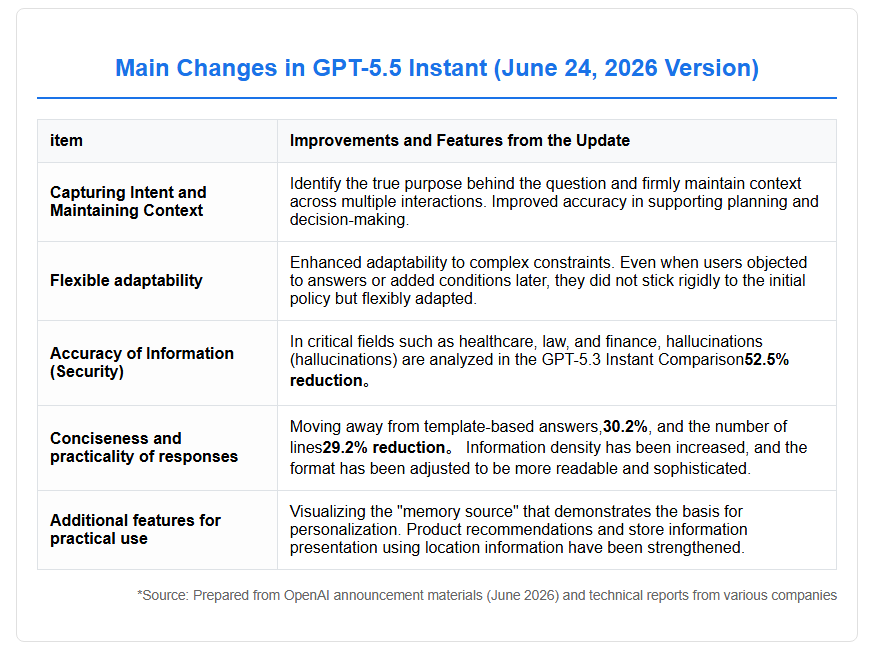
。 OpenAI also emphasizes that when users add conditions later or object to answers, they can flexibly adapt instead of sticking to the initial policy. This means that interactions with AI have evolved into more interactive and natural.
Concise answers and refined personalization features
One notable change in this version update is the improvement in the “readability” and “efficiency” of responses. According to OpenAI data, the new GPT-5.5 Instant has reduced output redundancy compared to before, recording reductions of 30.2% in word count and 29.2% in line count. This adjustment is intended to reduce the cost for humans to read passages that are too long generated by AI, successfully increasing the density of information per response. We have moved away from template-like formatting, with each response designed to match the user’s intent.
Additionally, personalization features that utilize contextual information such as past chat content, connected files, and Gmail have also evolved. Notably, a new feature called “memory sources” now visualizes the contexts in which AI generated responses. This increases the transparency of personalized responses and makes it easier to fulfill the important “accountability” of enterprise usage. Location data for shopping and local information has also been strengthened, making it possible to present product recommendations and store details in a coherent way along with images.
Dramatic improvement in practical skills and the evolution toward “AI at work”
Reducing hallucinations and reliability in high-risk areas
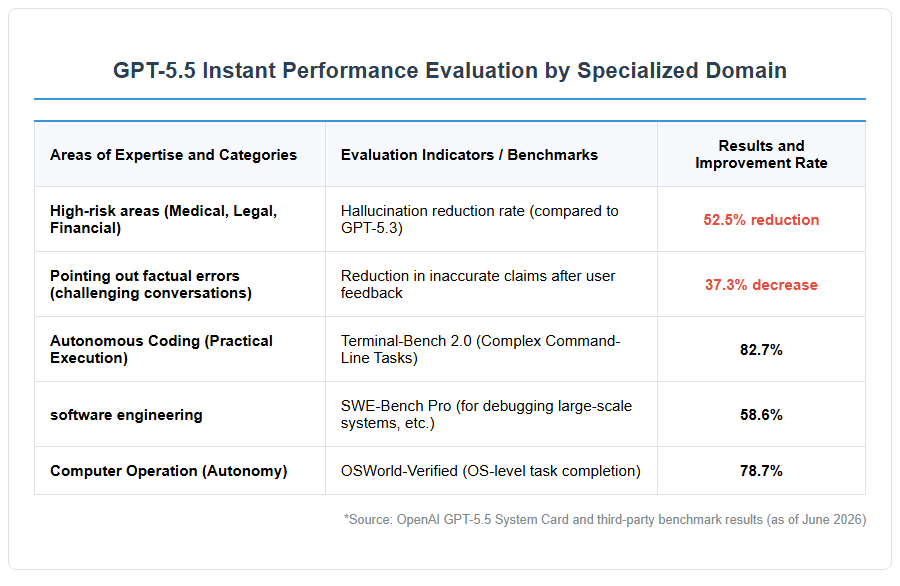
Since its announcement in May 2026, GPT-5.5 Instant has been highlighted as a major feature of reducing “hallucinations.” According to OpenAI’s report, in highly specialized and high-risk fields such as healthcare, law, and finance, it has succeeded in reducing hallucination by 52.5% compared to the previous generation GPT-5.3 Instant. Furthermore, in difficult conversations where users actually pointed out factual errors, inaccurate claims decreased by 37.3%, demonstrating a practical improvement in information accuracy.
This improvement in accuracy helps dispel concerns about “information uncertainty,” which had been a major barrier for Japanese companies when implementing generative AI company-wide. In particular, it delivers significant results in tasks where “80 points of quality is consistently required,” such as preparing sales materials, drafting regulations by the management department, and conducting initial market research in corporate planning. While 100% accuracy is not guaranteed, the reduction in error rates in the default model is a key factor accelerating on-site penetration. The chart below summarizes the accuracy improvement rates in each specialized field.
。
Autonomous task execution as a business agent
The latest GPT-5.5 has evolved from a “smart model” that simply answers questions to a “working model” autonomously completing tasks. OpenAI is collaborating with PwC (PricewaterhouseCoopers) in the CFO domain, and has announced a policy to redesign core tasks such as procurement, forecasting, reporting, tax, and contract review with AI agents. In practice, OpenAI’s finance department integrated with Codex to process five times the number of contracts with the same workforce and completed over 20,000 tax document reviews two weeks earlier than usual.
This evolution of “agent-based” technology shows that AI can now autonomously cycle “analyze, plan, execute, and verify” without waiting for human instructions. In the programming field, it also achieved a high score of 82.7% on Terminal-Bench 2.0, proving its ability to handle complex command-line tasks, system debugging, and testing. This means AI has become not just a support tool, but a “partner” that enters the business processes themselves and responsibly advances them to specific outputs.
Safety Challenges and Compliance with International Regulations
Enhancing Cyberattack Capabilities and Security Risks
Improved model performance brings more than just convenience. According to a report published by the UK’s AI Safety Institute (AISI) on April 30, 2026, GPT-5.5 demonstrated extremely high cyberattack capabilities in research environments. In CTF format assessments, which measure vulnerability discovery and attack code execution capabilities, the most challenging challenges achieved an average success rate of 71.4%, surpassing existing expert models. There have been cases where reverse engineering challenges were solved in just 10 minutes and 22 seconds, which is equivalent to a task that would require about 12 hours for human experts.
OpenAI itself was the first to classify GPT-5.5 Instant’s System Card as “High capability” in cybersecurity and bio/chemical weapons preparedness assessments. This suggests that even standard lightweight models have recognized that the risks of misuse have exceeded certain thresholds. While the general version includes safety measures, Red Team trials still confirm methods to circumvent safety measures, so companies are required not to overestimate the status of “safe because it’s a default model,” but to implement their own guardrails in operational design.
Application of the European AI Act and the Legal Responsibilities of Japanese Companies
International regulatory movements are also accelerating. Based on the European AI Regulatory Act (EU Artificial Intelligence Act) that came into effect in August 2024, regulations on “banned AI systems” began in February 2025. This law has provisions for extraterritorial application, and even Japanese companies that provide AI services within the EU or whose AI output is used within the EU may face massive fines of up to 35 million euros, or 7% of global sales.
In particular, general-purpose AI models (GPAI) like GPT-5.5 are subject to strict obligations such as ensuring transparency and creating technical documentation. Models deemed to involve systemic risk are also required to conduct additional risk assessments and adversarial tests. Japanese companies need to inventory the AI systems they have implemented and carefully examine whether they fall under the standards of the European AI Act as “high risk” and whether there are legal issues with how the outputs are used. Given the speed of technological evolution, establishing legal regulations and governance frameworks is becoming more important than ever.
Future Developments and Key Milestones
With this update, GPT-5.5 Instant has established itself as the standard intelligence layer for everyday operations. The future focus will be on the division of roles with higher-end and next-generation models. Observations of confidential testing of GPT-5.6 have already emerged in the market, and the next focus is how to overcome the “latency” issues that arise in exchange for further improvements in generation quality. OpenAI is also focusing on improving computational efficiency, aiming to increase token generation speed by over 20% by optimizing for NVIDIA’s latest systems (GB200/GB300).
Furthermore, as in Microsoft’s proposed “Frontier Firms” work model, there will be a growing trend to redesign human-AI collaboration into four patterns: “Author,” “Editor,” “Director,” and “Orchestrator.” GPT-5.5 Instant will primarily elevate the role of “Author” and “Editor,” but beyond that, the shift to “Orchestrator” types of tasks overseeing multiple agents is expected to become the main battleground in the latter half of 2026. From the stage of competing in technological ‘intelligence,’ the era of practical competition has truly arrived: how to integrate AI into ‘standardized operations’ and achieve actual productivity as numbers.
[#OpenAI #GPT55 #生成AI #AIエージェント #サイバーセキュリティ #欧州AI法 #DX]


コメント