On November 21, 2026, China’s National Data Bureau announced national standards for the measurement, billing, and quality evaluation of AI tokens. The backdrop includes growing confusion over billing units among telecommunications carriers and AI operators, alongside a push for standardization to maximize the operational efficiency of domestic computing resources.
- The National Data Bureau’s Standardization Policy Statement and Background
- Phased Implementation Schedule for Cloud Providers and Research Institutions
- Deployment of Token Plans by the Three Major Telecom Carriers and Confusion Over Units
- Extreme Low-Price Offensives by DeepSeek and Others and Their Impact on the Market
- Initiatives for “Tianyi Token Coins” and the Construction of a Computing Power Exchange Rate
- The Role of Generative AI Regulations and the AI Security Governance Framework 3.0
- Proper Valuation of Computing Power Assets and Future Points of Interest in the Global AI Market
The National Data Bureau’s Standardization Policy Statement and Background
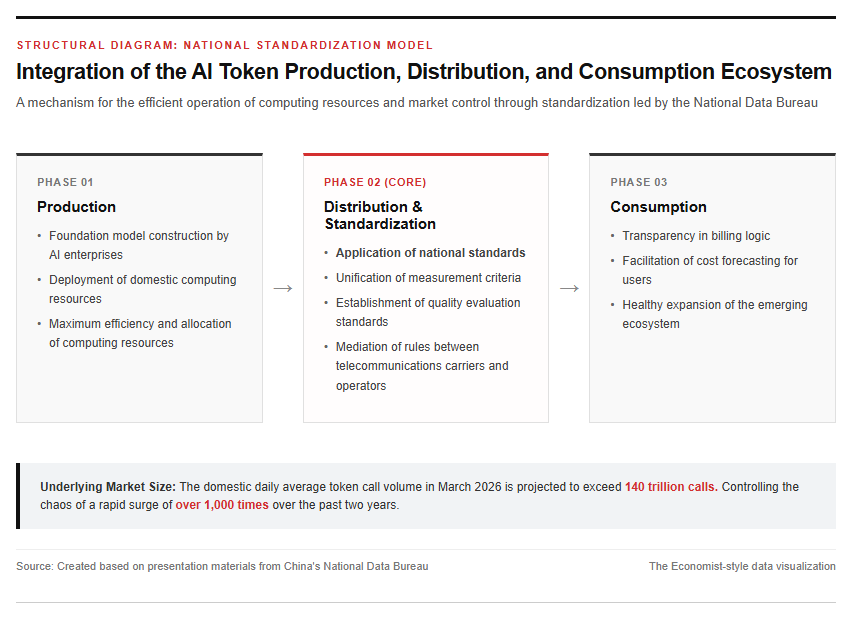
On November 21, 2026, Liu Liehong, Director of China’s National Data Bureau, announced a national plan to uniformly standardize AI token measurement, billing, and quality evaluation criteria. Daily average token call volumes in China exceeded 140 trillion in March 2026, surging more than 1,000-fold over the past two years. While the adoption of large language models has expanded, different operators use varying token counting methods and billing logics, causing confusion that makes it difficult for users to predict consumption costs. This institutionalization by the National Data Bureau aims to regulate the entire emerging ecosystem—from AI token production and distribution to consumption—under clear standards. By enhancing market transparency, the initiative seeks to maximize the utilization efficiency of domestic computing resources and strengthen the industrial sector’s foundational infrastructure. The figure below illustrates the concept of standardization and distribution structures within AI infrastructure.
Phased Implementation Schedule for Cloud Providers and Research Institutions
The announced national standards establish a phased rollout roadmap. Major cloud providers such as Alibaba Cloud, Tencent Cloud, and Huawei Cloud are required to introduce compliance systems within six months of the official announcement. Meanwhile, universities, research institutions, and small-to-medium-sized AI operators have been granted a grace period until the end of 2027 to advance full implementation. Regulatory compliance audits are scheduled to begin in mid-2027, with penalties expected for operators failing to meet the requirements. The government has also allocated dedicated funding channels to support smaller organizations unable to secure infrastructure upgrade costs. By setting a clear transition period, authorities aim to achieve smooth standardization while preventing overall ecosystem disruption.
Proliferation of Token Billing and Price Destruction in the Chinese Market
Deployment of Token Plans by the Three Major Telecom Carriers and Confusion Over Units
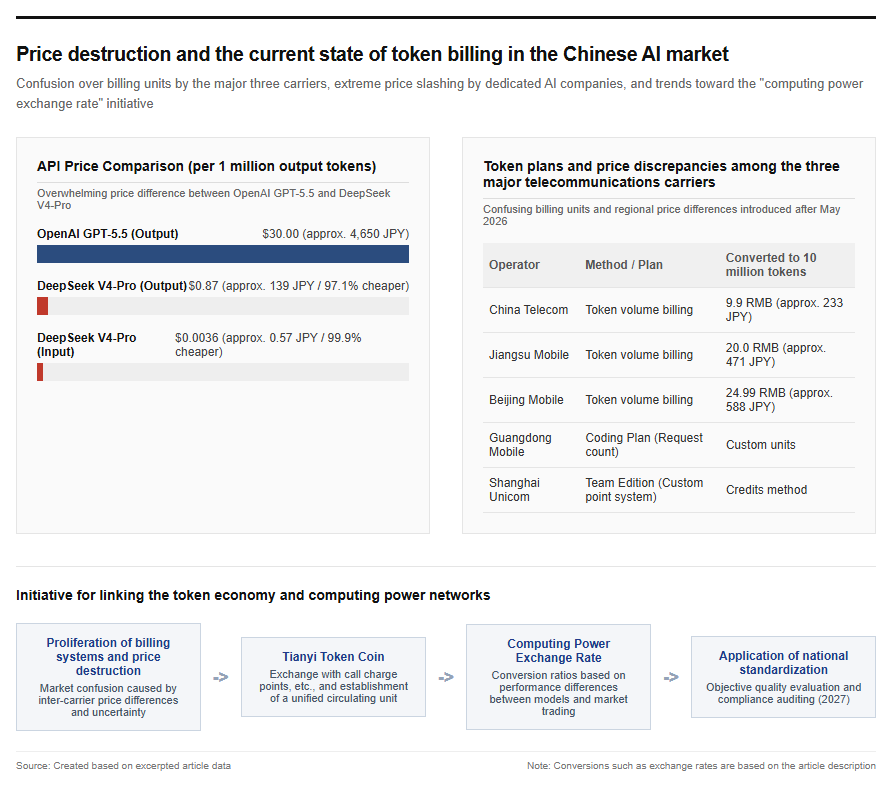
Behind the national standardization effort lies a rapid shift in billing models led by China’s three major telecom carriers (China Mobile, China Telecom, and China Unicom). Around World Telecommunication Day in May 2026, the three major carriers simultaneously announced a transition from data volume sales to token sales. However, the billing units of the provided plans were extremely chaotic. While China Telecom and Beijing Mobile billed by token volume, Guangdong Mobile introduced a Coding Plan based on request counts, and Shanghai Unicom’s team edition adopted a proprietary points system (Credits). Price ranges converted per 10 million tokens also showed significant regional and price disparities, ranging from 9.9 RMB (~$1.38 USD) at China Telecom to 24.99 RMB (~$3.48 USD) at Beijing Mobile and 20 RMB (~$2.79 USD) at Jiangsu Mobile. Users faced uncertainties where consumption varied greatly depending on model types and chains of thought, strongly driving the need for intuitive billing standards.
Extreme Low-Price Offensives by DeepSeek and Others and Their Impact on the Market
While telecom carriers search for new billing models, fierce price destruction by dedicated Chinese AI companies is reshaping the market structure. DeepSeek, in particular, lowered API prices for its flagship V4-Pro model, making permanent rates of $0.0036 per million input tokens (~$0.0036) and $0.87 per million output tokens. This is an extreme level—97.1% cheaper on output and 99.9% lower on input—compared to OpenAI’s GPT-5.5 pricing ($5 for input, $30 for output). Additionally, Zhipu AI, Moonshot AI (Kimi K3), Alibaba (Qwen), and others have strengthened low-price tiers and cash discounts, driving down the effective cost of long-context and agent tasks. This fierce price competition diminishes the price advantage of telecom carriers while making it difficult to monetize AI models standalone, accelerating a value shift toward the cloud and infrastructure layers.
Initiatives for “Tianyi Token Coins” and the Construction of a Computing Power Exchange Rate
To cope with this confusion and price competition, China Telecom has announced the upcoming introduction of “Tianyi Token coins,” aiming to establish a unified token circulation unit. This is not merely an attempt to allow telecom users to exchange calling points for token packs and AI apps; it is also intended to form a “computing power exchange rate” that sets conversion ratios based on performance differences and quality between models. For instance, the concept is to convert the value per token of GLM-5 and DeepSeek-V4 based on objective evaluation criteria and trade them using market-determined price coefficients. However, analysts point out that establishing an objective quality evaluation system among heterogeneous models presents many challenges, and forming a market consensus will take time. The National Data Administration’s current standardization of quality evaluation criteria is also drawing attention as an attempt to provide a unified index that serves as a prerequisite for such computing power exchange rates. The figure below shows the conceptual integration of the token economy and the computing power network.
Future Outlook for Governance Control and AI Infrastructure
The Role of Generative AI Regulations and the AI Security Governance Framework 3.0
China’s AI standardization movement is closely linked not only to technical and economic aspects but also to national security and governance control. In August 2023, Chinese authorities enforced the “Interim Measures for the Management of Generative Artificial Intelligence Services,” which stipulated the embodiment of socialist core values, safety evaluations, and filing obligations while balancing development and security. Furthermore, on September 14, 2026, the National Information Security Standardization Technical Committee (TC260) released the “AI Security Governance Framework 3.0,” organizing guidelines to categorize AI risks into three types—endogenous, application-based, and derivative risks—and conduct tiered management (risk grading). The token measurement and quality evaluation standards promoted by the National Data Administration are expected to coordinate with these governance frameworks and function as a technical foundation supporting the filtering and auditing of unauthorized data use and illegal outputs.
Proper Valuation of Computing Power Assets and Future Points of Interest in the Global AI Market
While Chinese open-source models have expanded to account for 85% to 89% of global token traffic in the agent and code generation fields, their revenue share remains at just 10% to 16%, creating a severe discrepancy with the United States in the market capitalization valuation of computing power assets. Whereas the total enterprise value of U.S. AI computing infrastructure reaches approximately $175 billion, similar assets in China amount to only about $20 billion. However, driven by successes such as Huawei’s model training using a scale of 50,000 Atlas 950 chips, China’s self-sufficiency rate for domestic AI chips is projected to reach 70% by 2030, and in terms of power supply, China is expected to secure a surplus capacity of 400 gigawatts, significantly outperforming the United States. If the national standards presented this time take root, the effective value of AI tokens will become clear, potentially driving a reassessment of China’s currently undervalued computing infrastructure assets.
References
- 【China Strengthens AI Token Standards in Computing Push】https://emergent.sh/news/china-strengthens-ai-token-standards
【#ChinaAI #AITokens #NationalStandards #GenerativeAIRegulations #DeepSeek #TelecomCarrier #ComputingPowerAssets】


コメント