Cloudera, a provider of data and AI platforms, announced its enterprise governance solution “Cloudera for Digital Sovereignty” on November 24, 2026. This move is driven by the tightening of data sovereignty regulations in various countries and the skyrocketing costs associated with AI token consumption, creating a demand for environments where companies can autonomously control the entire data and AI lifecycle.
- Key Points of the Solution Announcement and the Integrated Platform
- Challenges of Cost and Governance in the Full-Scale Implementation of Enterprise AI
- The Three Sovereignties and the Data Residency Trap Defined by Gartner
- A Technical Approach to Delivering Computational Processing Without Moving Data
- Practical Challenges of Operating Air-Gapped Environments and Local LLMs
- Future Developments and Key Areas for Corporate Attention
Key Points of the Solution Announcement and the Integrated Platform
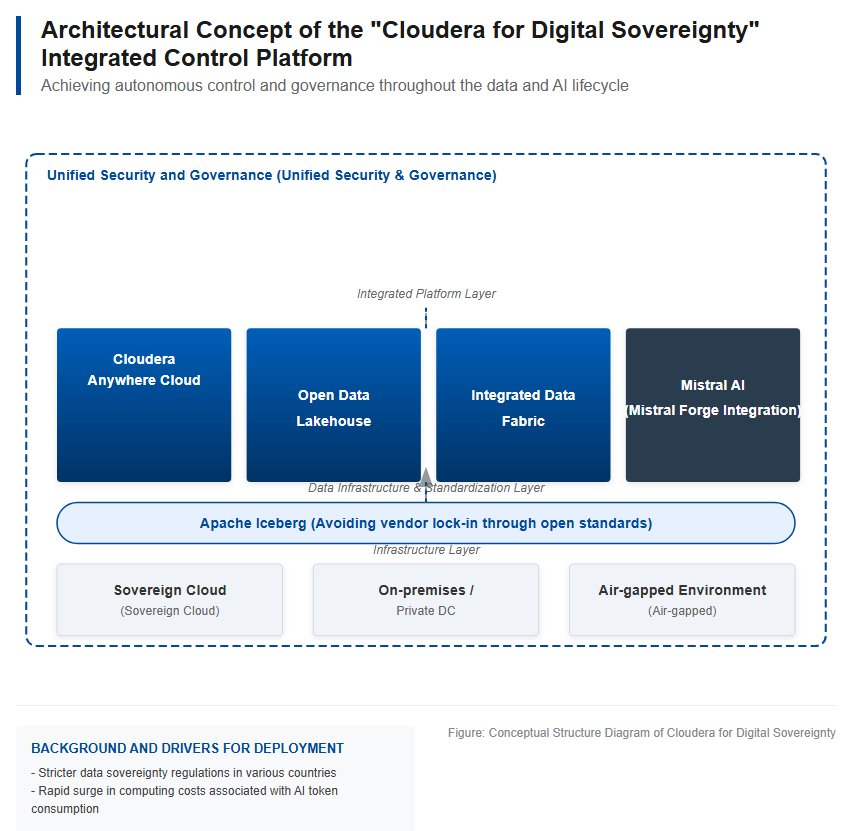
Cloudera, which deploys hybrid data and AI foundations in San Jose, California, USA, and Madrid, Spain, officially announced “Cloudera for Digital Sovereignty” on November 24, 2026. This solution natively integrates the company’s hybrid cloud foundation “Cloudera Anywhere Cloud,” an open data lakehouse, an integrated data fabric, and the open-weight models and “Mistral Forge” from Europe’s Mistral AI.
It is designed to enable AI workloads to run while maintaining unified security and governance, regardless of whether corporate data resides in a sovereign cloud, an on-premises private data center, or an air-gapped environment completely disconnected from external networks. By adopting the open standard Apache Iceberg, the solution avoids vendor lock-in for foundational data and enables autonomous data operations that are not tied to specific infrastructure. The following figure shows an overview of the governance platform configuration.
The most significant feature is the flexibility to freely change the computing environment in response to changes in legal regulations or business requirements, without needing to modify existing applications or duplicate data.
Challenges of Cost and Governance in the Full-Scale Implementation of Enterprise AI
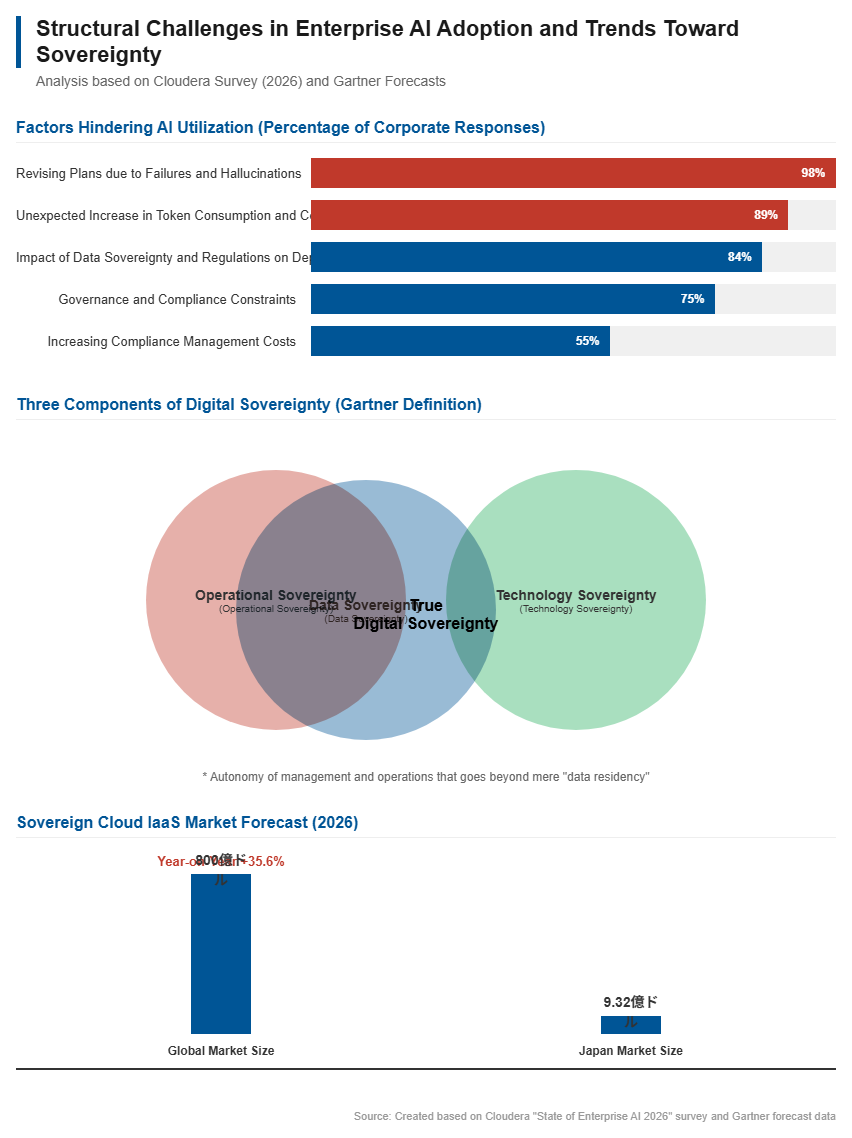
The launch of this solution is driven by serious structural challenges that companies face as AI utilization shifts from the experimental stage to a core business foundation. According to the “State of Enterprise AI 2026” survey conducted by Cloudera in September 2026 targeting 1,500 IT decision-makers worldwide, it was revealed that a staggering 89% of companies have already been forced to limit or redesign AI use cases due to AI model execution token consumption and costs increasing beyond their initial projections.
Furthermore, 84% of respondents stated that data storage locations and country-specific data sovereignty regulations directly impact where AI workloads are deployed. Additionally, 75% of companies cited governance and compliance as limiting factors for AI expansion, and 55% reported that compliance management costs are increasing at a faster pace than expected. Moreover, 98% of companies have revised their implementation plans due to failures or hallucinations (generation of false information), exposing the limitations of relying solely on traditional cloud-dependent approaches to manage unpredictable cost fluctuations and the risk of regulatory violations.
Three Pillars of Data Sovereignty and Governance
The Three Sovereignties and the Data Residency Trap Defined by Gartner
IT research firm Gartner categorizes digital sovereignty into three domains: “Data Sovereignty,” “Operational Sovereignty,” and “Technology Sovereignty.” A critical point to note here is that simply ensuring “Data Residency”—storing data on servers within one’s own country—does not mean true sovereignty has been established. Even if data is physically located within the country, if authentication systems, model update procedures, or operational management services depend on foreign jurisdictions, the risk of unauthorized external access or service interruptions cannot be completely eliminated.
According to Gartner’s forecasts, global spending on sovereign cloud IaaS will reach $80 billion in 2026, a 35.6% increase from the previous year, and the Japanese market is also expected to expand rapidly to $932 million in the same year. In response to rising geopolitical risks, addressing digital sovereignty has become a priority at the board level; it has transformed from a mere compliance cost into an essential investment for maintaining business continuity and long-term competitiveness. The following figure shows the interrelationship between the three sovereignties.
A Technical Approach to Delivering Computational Processing Without Moving Data
To overcome the challenges of data sovereignty, Cloudera is proposing an “active guardrail” strategy. This moves away from the traditional approach of moving data to where AI is executed, and instead moves computing to where the data resides under strict governance. Unlike traditional data systems, in an AI environment where data circulates fluidly and at high speeds, data lineage—which enables constant tracking of origin, change history, and access permissions—becomes indispensable.
Based on a zero-trust security model, this solution achieves consistent policy management that complies with international regulatory standards, such as the EU AI Act, DORA for financial institutions, NIS2, and the Seals Sovereignty Framework. According to the “Data Readiness Index 2026” survey for the financial industry, while 83% of financial institutions know the location of their data, 38% responded that insufficient performance of existing infrastructure is hindering their daily operations. This highlights the urgent need to establish a secure and high-speed data access foundation in distributed environments.
Future Outlook for Enterprise AI and Implementation Considerations
Practical Challenges of Operating Air-Gapped Environments and Local LLMs
Through the strengthened partnership between Cloudera and Mistral AI, enterprises now have the means to securely build and operate “Sovereign AI” tailored specifically to their highly confidential data. By running open-weight models in local environments or private data centers, companies can build fine-tuned models specialized for specific tasks and agent workflows while preventing information leakage to the outside world.
However, when operating in an “air-gapped environment” with complete disconnection from the internet, several technical trade-offs must be understood. Deploying models and infrastructure locally is a different dimension of challenge compared to safely maintaining system updates, identity federation, and audit log collection over the long term in an offline environment. Companies considering implementation are strongly encouraged to conduct prior verification not only of functional requirements but also of maintenance update procedures and authentication infrastructure integration methods in a network-isolated state.
Future Developments and Key Areas for Corporate Attention
Cloudera plans to launch the recently announced partner ecosystem for digital sovereignty in the European market, with plans to expand to countries worldwide, including the Asia-Pacific region. In an era of remarkable evolution in AI technology, ensuring digital sovereignty is not an afterthought to be addressed after system construction, but a critical architectural decision that must be formulated at the initial stage.
By maintaining “AI sovereignty”—where companies can proactively choose their own data, infrastructure, and models used—they can drive flexible and sustainable innovation without being tossed about by waves of technological change. Moving forward, avoiding simple dependency on specific cloud vendors and promoting modular architectural designs that can respond immediately to business changes and regulatory amendments will serve as a true defensive barrier for enterprises.
Reference Pages
- 【GlobeNewswire】Cloudera Launches Digital Sovereignty Solution https://www.globenewswire.com/news-release/2026/11/24/3409315/31982/en/cloudera-launches-digital-sovereignty-solution-that-gives-enterprises-complete-control-of-data-and-ai-across-the-entire-lifecycle.html
- 【Cloudera】Mastering Data Sovereignty: The Ultimate Competitive Advantage https://jp.cloudera.com/
【#Cloudera #DataSovereignty #SovereignAI #DataGovernance #AIInfrastructure #AnywhereCloud #Mistral】
コメント