
At the 31st Conference of the Parties (COP31) to the UN Framework Convention on Climate Change held in Antalya, Turkey, the direct wording of “transition away from fossil fuels” was removed from the draft outcome document, and the adoption of an outcome document was abandoned following intense confrontation. In the background lie the pushback from oil-producing nations and major energy-consuming countries, alongside deep-seated historical and structural conflicts with climate-vulnerable nations and energy-transition economies.
- Section 1-1: Background on How “Transition Away from Fossil Fuels” Receded from Direct Mention in the Draft Outcome Document
- Section 1-2: Introduction of the “35by35” Electrification Target and CCUS Promotion Measures, and Their Background
- Section 1-3: Abandonment of the Outcome Document’s Adoption Due to Intensifying Confrontation and the Details of the Session Extension
- Section 2-1: Trends Among Oil-Producing Nations Like Saudi Arabia and Russia, and the US-China-Russia Summit
- Section 2-2: Pushback from the France-Panama 10-Nation Coalition and the LDC and African Groups
- Section 2-3: Criticism of the Removal of Adaptation Finance Targets and the Retreat on “Clean Electrification”
- Section 3-1: Concerns Posed by Fossil Fuel Dependency Risks, Geopolitics, and Inflationary Pressures
- Section 3-2: Challenges for Japanese Companies and the International Community Toward GX Promotion and Institutional Frameworks
- Section 3-3: Future Negotiation Focal Points Toward the 2028 Global Stocktake
Section 1-1: Background on How “Transition Away from Fossil Fuels” Receded from Direct Mention in the Draft Outcome Document
In November 2026, at COP31 held in Antalya, Turkey, the full picture of the pivotal draft outcome document came to light. While COP28 (Dubai) in 2023 marked the first time in history that a clear agreement was reached on “transitioning away from fossil fuels,” the revised draft at COP31 completely deleted any direct reference to “transitioning away from fossil fuels.” Although the initial draft presented on November 16 included wording committing to “accelerate efforts to phase out,” it was ultimately rejected due to fierce opposition from major oil-producing countries such as Saudi Arabia and Russia. A new draft published by the COP31 presidency of Turkey in the early hours of November 22 avoided direct mentions in the main text, limiting itself to the modest expression in the preamble of “recalling” the COP28 decision. This rollback spread worldwide concern that the international framework for climate change countermeasures might effectively become hollowed out.
Section 1-2: Introduction of the “35by35” Electrification Target and CCUS Promotion Measures, and Their Background
As an alternative to the removal of the wording on “fossil fuel phase-out,” the COP31 presidency of Turkey and co-host Australia proposed the “35by35” electrification target, which aims to raise the share of electricity in global final energy consumption to 35% by 2035. The Japanese government has also expressed its support for this target. However, the draft omitted the definition of “clean electrification” combined with renewable energy that Europe and environmental NGOs had demanded, making it a mechanism where the targets could be achieved even while maintaining coal- and natural gas-fired power generation. The figure below illustrates the structure of electrification and technology deployment in global energy demand.
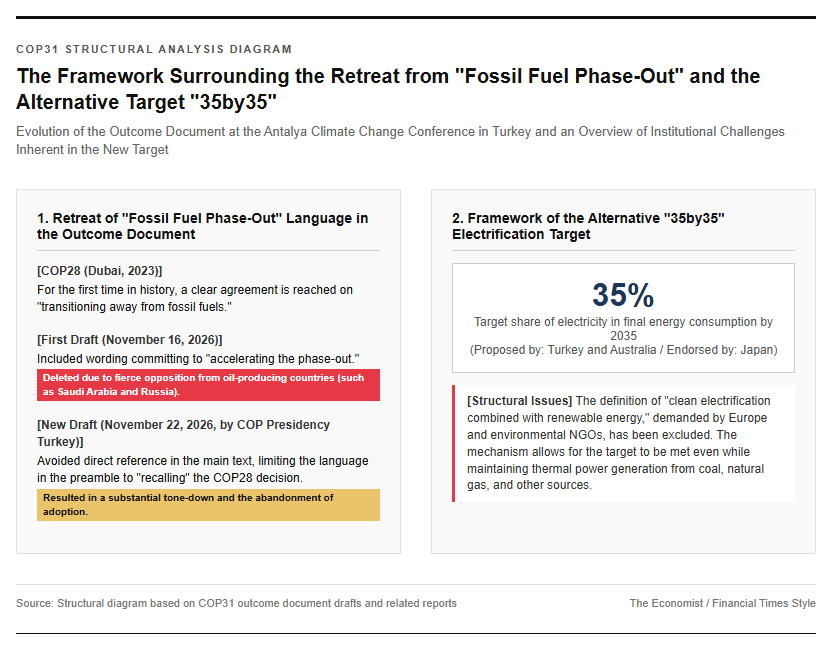
The draft also explicitly stated a target to scale up carbon capture, utilization, and storage (CCUS) technologies to a gigaton scale globally by 2035. However, criticism erupted that the current volume captured by CCUS remains below 0.2% of total fossil fuel emissions, serving as nothing more than a get-out-of-jail-free card to prolong the life of the fossil fuel industry.
Section 1-3: Abandonment of the Outcome Document’s Adoption Due to Intensifying Confrontation and the Details of the Session Extension
Negotiations failed to conclude even after passing the original end date of the session on November 20, 2026, leading to an unprecedented extension exceeding two days. COP31 President Murat Kurum appealed to various nations during the plenary session to demonstrate the results of multilateralism, but many countries raised consecutive objections to the gutted draft outcome document. It became clear that the consensus required for consensus-building could not be achieved, and on the afternoon of November 22, President Kurum officially stated, “The decision document will not be adopted,” deciding to abandon the adoption of the outcome document. This marked an unprecedented development—the first time in 17 years since COP15 (Copenhagen Conference) held in Denmark in 2009—that a COP concluded without adopting a comprehensive outcome document. As the climate crisis rapidly manifested in various parts of the world, the dysfunction of international negotiations was laid bare.
[Structure and Lines of Confrontation] The Deep Gulf Between “Oil-Producing and Dependent Nations” and “Climate-Vulnerable and Transition Nations”
Section 2-1: Trends Among Oil-Producing Nations Like Saudi Arabia and Russia, and the US-China-Russia Summit
In the background of the friction during these negotiations lies the systematic resistance of oil-producing and resource-consuming countries with powerful oil and natural gas interests. In closed-door consultations, Saudi Arabia and Russia maintained an obstinate refusal to include the wording on “transition away from fossil fuels.” Furthermore, OPEC Secretary General Haitham al-Ghais justified the continued dependence on fossil fuels by citing that petroleum products and heavy machinery are indispensable for infrastructure expansion. This movement was reinforced by the US-China-Russia summit held in Shenzhen, China, during the COP31 session. US President Trump, Chinese President Xi Jinping, and Russian President Putin issued a joint statement to expand the production and supply of refined petroleum products. The fact that major emitters pledged to increase fossil fuel production outside the formal international negotiation arena dealt a serious blow to the negotiation site in Antalya.
Section 2-2: Pushback from the France-Panama 10-Nation Coalition and the LDC and African Groups
The omission of the phase-out of fossil fuels from the draft sparked fierce backlash from countries facing climate impacts and advanced energy-transition nations. Led by France and Panama, a coalition of 10 countries—including Belgium, Sweden, and Vanuatu—expressed opposition to the draft, demanding science-based decision-making and an explicit commitment to an orderly phase-out of fossil fuels. Panama’s Minister of Environment, Juan Carlos Navarro, strongly condemned the proceedings, stating that “this plenary session has been hijacked by the oil lobby,” and even advocated for revising the consensus-based system to a majority-voting system. In addition, the Least Developed Countries (LDCs) group, comprising 44 nations, and the African Group of Negotiators denounced the unfulfillment of past promises and the lack of support. The figure below illustrates the conflict structure between climate-vulnerable countries and emitting nations.
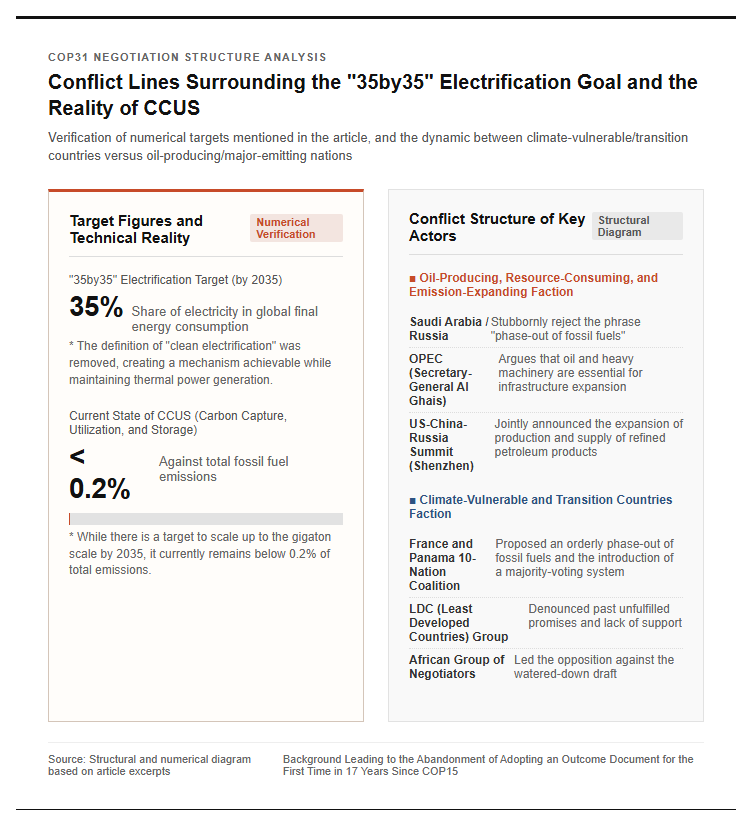
As a result, the former dichotomy of “developed versus developing countries” has been decisively replaced by a new structural confrontation between “fuel-producing and fuel-dependent nations” and “climate-crisis and energy-transition nations.”
Section 2-3: Criticism of the Removal of Adaptation Finance Targets and the Retreat on “Clean Electrification”
Serious conflict also arose surrounding “adaptation finance,” which developing countries rely on to mitigate the impacts of climate change. The specific numerical target of “at least $120 billion annually by 2035,” which had been included in the first draft, was deleted in the revised proposal, regressing to the formulation of a “roadmap” devoid of financial targets. According to a UNEP report, the adaptation finance needs of developing countries amount to $305 billion per year, and the lack of concrete support brought disappointment and anger to the developing side. Furthermore, direct language regarding the reduction of air pollution and short-lived climate pollutants (such as methane and black carbon) was also cut, hollowing out the perspective of mitigating health hazards. While the impacts of the climate crisis are escalating, international criticism has reached its peak against the stance of wealthy nations and major emitters attempting to evade their burdens and concrete reduction actions.
[Impact on Economy and Industry and Medium-to-Long-Term Outlook] The Future of Energy Markets and the Business Environment
Section 3-1: Concerns Posed by Fossil Fuel Dependency Risks, Geopolitics, and Inflationary Pressures
The failure of this political agreement has introduced significant uncertainty into the global economy and international financial markets. Due to the risks in the Strait of Hormuz driven by escalating tensions in the Middle East and supply chain disruptions, energy prices in 2026 are projected to rise by an average of 24%. The Network for Greening the Financial System (NGFS), a group consisting of central banks and other institutions, has warned that climate inaction and delays in the energy transition will trigger macroeconomic instability and strong inflationary pressures. Soaring energy prices and rising interest rates drive up the financing costs necessary for decarbonization investments, acting as a deterrent to corporate environmental spending. The continued reliance on fossil fuels increases the risk of future sharp spikes in carbon prices and asset stranding, expanding risks across the entire financial system.
Section 3-2: Challenges for Japanese Companies and the International Community Toward GX Promotion and Institutional Frameworks
Amid the stagnation of international multilateral negotiations, the transition to practical frameworks led by companies and individual countries is gaining heightened importance. Within Japan, the full-scale operation of the “GX Emissions Trading Scheme (GX-ETS)” will begin in April 2026, launching a mandatory scheme requiring emissions quota submissions for companies emitting 100,000 tons or more annually. Furthermore, the Japanese government has set a new Nationally Determined Contribution (NDC) target of a 60% reduction by fiscal year 2035 compared to fiscal year 2013, pressing industry to implement concrete decarbonization technologies. However, as international rule-making proves difficult and trade regulations such as Europe’s Carbon Border Adjustment Mechanism (CBAM) are tightened, Japanese companies face challenges such as ensuring a level playing field in overseas markets and shouldering increased cost burdens. There is an urgent need to build practical technology transfers and industrial support utilizing coalitions of willing countries (platforms).
Section 3-3: Future Negotiation Focal Points Toward the 2028 Global Stocktake
With the COP31 outcome document being postponed, climate change negotiations under the Paris Agreement have entered an extremely difficult phase. The next major milestone is the second Global Stocktake (GST) scheduled for COP33 in 2028. Even if all current national targets (NDCs) are fully achieved, they fall far short of the reductions needed to keep the temperature increase since pre-industrial times within 1.5°C, making a “1.5°C overshoot” within the next few years virtually certain. As the UN-led consensus-building process has exposed its limitations in the face of accelerating climate crises, future negotiations are expected to see a growing emphasis on COP institutional reforms—including the introduction of majority voting—and sector-specific agreements among willing nations. Whether global climate measures can be reconstructed will be the focal point for the international community moving forward.
Reference Pages
- [UNFCCC Document – COP31 Draft Decision] https://unfccc.int/documents/665726
[#COP31 #ClimateChange #FossilFuelPhaseOut #EnergyPolicy #GX]


コメント