Aiming to strengthen anti-money laundering measures and economic security, the government has approved a new bill at a Cabinet meeting that mandates all corporations, excluding listed companies and others, to report their “Beneficial Owners (BO).” This is driven by a strong background of overhauling Japan’s legal system—which has lagged in adapting to international standards—and preventing the abuse of corporate accounts by criminal organizations as well as opaque capital flows.
- Key Points of New Legislation Enactment and Cabinet Decisions
- A dramatic shift from the traditional voluntary system to a legal mandate
- International Calls Regarding the 5th FATF Evaluation and G7 Delays
- Countermeasures against Anonymous and Fluid Groups and Their Application to Economic Security and Land Policies
- Burdens on Small and Medium-Sized Enterprises and Key Practical Issues
- Preparations Companies Should Take Immediately and Future Points to Watch
Key Points of New Legislation Enactment and Cabinet Decisions
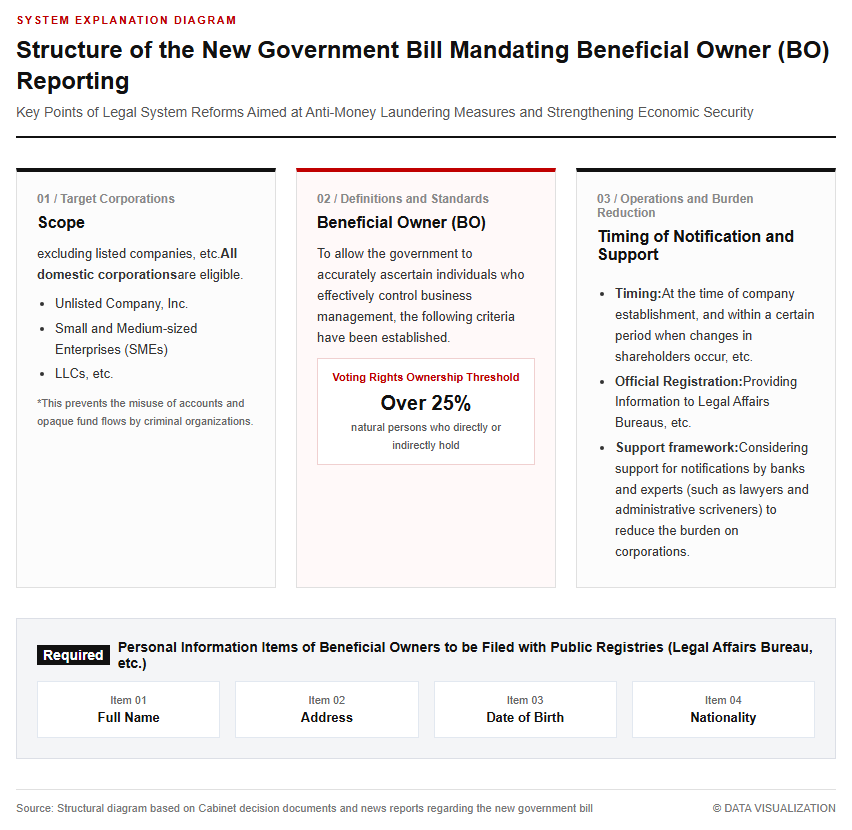
The Japanese government has approved a bill at a Cabinet meeting making it mandatory to report Beneficial Owners (BO) in order to enable the state to identify individuals who effectively control the business management of companies and organizations, with the aim of strengthening anti-money laundering measures and enhancing economic security. The new law will apply to almost all domestic corporations in Japan excluding listed companies and the like, encompassing not only joint-stock companies (kabushiki kaisha) but also unlisted small and medium-sized enterprises (SMEs) and limited liability companies (godo kaisha). Under the proposed system, natural persons who directly or indirectly hold more than 25% of voting rights are defined as beneficial owners, and it will be mandatory to report their name, address, date of birth, and nationality information to a public registration authority (such as the Legal Affairs Bureau). Notification will be required not only at the time of company establishment, but also within a specified period when events such as changes in shareholders occur. To reduce the burden on corporations, a framework that allows banks and professionals (such as lawyers and certified administrative scriveners) to assist with the filings is also being considered. The figure below shows the overall concept of the notification system.
A dramatic shift from the traditional voluntary system to a legal mandate
Even previously, under the Act on Prevention of Transfer of Criminal Proceeds, mechanisms existed for financial institutions such as banks to verify beneficial owners when conducting transactions with corporations. In addition, a voluntary “beneficial owner list system” was launched by the Ministry of Justice in January 2022, but it remained merely a free system based on voluntary applications by companies. Consequently, the shareholder structures of unlisted companies have been difficult to discern from the outside, leaving unaddressed the risk that criminal organizations could exploit substance-free paper companies as a “cover.” The new law marks a fundamental shift from the conventional “voluntary” approach to a “legal reporting obligation for all corporations.” Corporations that fail to report will receive formal notices and be subject to penalties such as non-penal fines, while criminal penalties are also under consideration for concealment or false reporting. Furthermore, stringent measures—such as the closure of registrations—are included if the matter is left unreported for three years from the reporting deadline, resulting in a highly effective system design.
Why Mandatory Notification for All Corporations Is Necessary Now
International Calls Regarding the 5th FATF Evaluation and G7 Delays
The biggest factor driving Japan’s rapid formulation of the new legislation is a request from the Financial Action Task Force (FATF), an international anti-money laundering body. In the FATF’s 4th Mutual Evaluation Report on Japan published in August 2021, Japan received only a “Partially Compliant” (PC) rating for “Recommendation 24” regarding corporate transparency, designating it as a “regular follow-up” country (note: actually “enhanced follow-up” in FATF terminology, but will translate faithfully), the second-lowest of four tiers. Among the Group of Seven (G7) nations, Japan was the only country lacking a public notification and registration system for Beneficial Ownership (BO) information for all corporations. There are concerns that if Japan receives another low evaluation in the 5th FATF Mutual Evaluation of Japan scheduled for around the summer of 2028, it could adversely affect the real economy, leading to delays in international remittances by Japanese financial institutions, increased fundraising costs, and a decrease in direct investment in Japan. The government clearly stated the promotion of drafting this in the Basic Policy on Economic and Fiscal Management and Reform in July 2026, and is rushing to establish a system that meets international standards.
Countermeasures against Anonymous and Fluid Groups and Their Application to Economic Security and Land Policies
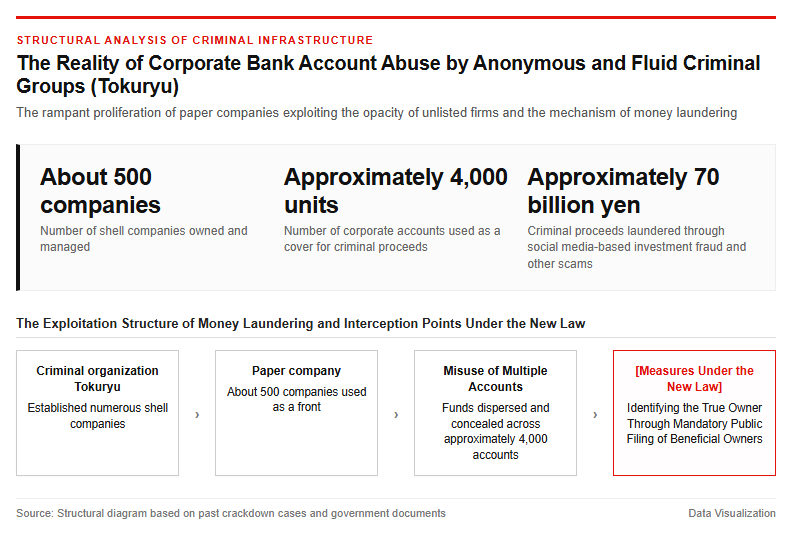
As a pressing domestic issue, the abuse of corporate bank accounts by anonymous and fluid criminal groups (tokuryu) is becoming increasingly severe. Past crackdown cases have revealed that approximately 500 paper companies and 4,000 corporate bank accounts were managed to launder roughly 70 billion yen in criminal proceeds generated by social media-based investment scams and other activities. The new law aims to dismantle malicious criminal infrastructure by enabling the identification of true controllers. Furthermore, capturing beneficial ownership (BO) information is considered crucial from the perspectives of economic security and land policies. Based on the comprehensive policy guidelines for foreign national policies set for January 2026, a system will be established to ascertain the nationality information of ultimate beneficial owners of foreign-affiliated corporations and foreign companies that own security-sensitive land, allowing administrative agencies to cross-sectionally check and inquire whether international sanction targets are lurking behind them. The figure below illustrates the money laundering methods and the structure of the abuse cases.
Impact on Corporate Management and Practical Measures to Be Taken
Burdens on Small and Medium-Sized Enterprises and Key Practical Issues
As the framework is being fleshed out, there are several key issues and concerns at the operational level of small and medium-sized enterprises (SMEs). The first issue is the criteria for determining beneficial owners (BOs). In contrast to the proposal of “more than 25%” of voting rights, discussions are underway to adopt “25% or more” in alignment with U.S. and EU standards. If “25% or more” is adopted, all four relatives in a family-owned company where four family members each hold 25% of the shares would qualify as BOs, which would have a significant practical impact. The second issue is the scope of viewing authority; from the perspective of privacy protection, the basic design is a closed framework limited to administrative agencies and financial institutions. Furthermore, at the SME operational level, there are many cases where shareholder registries of companies that do not issue share certificates are unorganized, or registrations have not been updated for a long period. Risks have also been pointed out that the notification procedures could trigger the surfacing of conflicts among relatives regarding the ownership of shares.
Preparations Companies Should Take Immediately and Future Points to Watch
Ahead of the enforcement of the new law, companies are required to review and organize their governance structures without waiting for the law to take effect. As a first step to take, it is important to examine the shareholder registry based on Article 121 of the Companies Act to accurately grasp the presence of nominal shares and the actual status of share ownership. Next, it is necessary to visualize who the beneficial owners of the company are, including indirect ownership relationships via parent companies, holding companies, funds, and the like. Furthermore, it is recommended to conduct preliminary rehearsals by utilizing the free “Beneficial Owner List System” provided by the Ministry of Justice, and to establish a management system that can promptly detect and report any changes in shareholders internally when they occur. Going forward, following the submission of the bill to an extraordinary Diet session, preparations will proceed for the FATF evaluation in the summer of 2028, making it crucial for companies to review their corporate governance systems at an early stage.
Reference Page
- [Cabinet Secretariat] Expert Meeting on Capturing Information Regarding Beneficial Owners of Corporations and Other Entities
内閣官房ホームページ内閣官房のホームページです。内閣の補助機関であるとともに内閣の首長たる内閣総理大臣を直接に補佐・支援しています。www.cas.go.jp - [Cabinet Office] Regarding Responses to FATF Recommendations on Beneficial Ownership Information of Corporations and Special Provisions for the Certification of Articles of Incorporation to Reduce the Burden on Entrepreneurs
 内閣府ホームページ - 内閣府内閣府のホームページです。内閣府の組織、政策、報道発表資料、統計・調査などに関する情報を掲載しています。www.cao.go.jp
- [Ministry of Finance, Financial Services Agency] FATF (Financial Action Task Force) 4th Mutual Evaluation Report on Japan
金融庁金融庁の公式ウェブサイトです。現在、「金融庁職員」や著名人を装った詐欺等が多発しています。くれぐれもご注意ください。金融庁の組織、報道発表、政策・審議会等、所管法令等に関する情報、広報誌「アクセスFSA」などを掲載しています。www.fsa.go.jp


【#BeneficialOwner #NewBOAct #MoneyLaundering #FATF #EconomicSecurity #CabinetDecision】

コメント