US President Donald Trump has announced a policy to impose massive taxes and sanctions on American companies that build artificial intelligence (AI) data centers overseas. The background to this includes defending AI technology against China and political and social friction stemming from surging domestic electricity demand in the United States.
- Announcement of “Massive Taxes” and Sanctions on Companies Building Overseas Data Centers
- The US-China AI Hegemony Struggle and Closing the “Loophole” in Export Controls Against China
- Intensifying Public Backlash in Midterm Elections and Surging Power Supplies and Electricity Rates
- Overseas Investment Trends of Major US IT Companies and Barriers to Securing Electricity
- Positive Effects on Domestic Data Center Demand and Risks of Rising Costs
- Challenges Faced by Japanese Enterprises and Mid-to-Long-Term Response Strategies
Announcement of “Massive Taxes” and Sanctions on Companies Building Overseas Data Centers
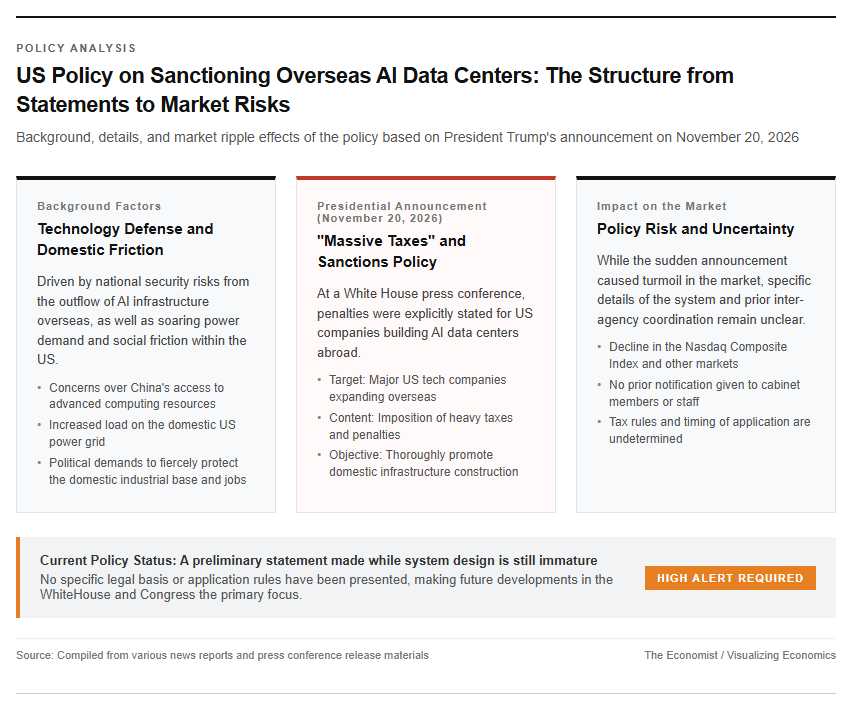
On November 20, 2026, during a press conference at the White House, US President Donald Trump stated a strong sanction policy to impose “massive taxes” and penalties on major American tech companies that build AI data centers abroad. The President emphasized a firm stance demanding the thorough promotion of domestic construction, citing concerns that the outflow of data centers—which are critical infrastructure—to other countries would allow China access to advanced computing resources. However, specific institutional details such as taxation rules, legal grounds, targeted companies, and application timing have not been presented, remaining incremental remarks that were not even notified in advance to White House cabinet ministers or responsible staff at the time of the announcement. Following the remarks, the Nasdaq Composite Index fell, and a sense of caution spread across the market regarding sudden policy risks. Please refer to the image below for an overview showing the policy chain of this hardline statement.
The US-China AI Hegemony Struggle and Closing the “Loophole” in Export Controls Against China
This sanction warning by the Trump administration is not a sudden occurrence, but rather an extension of the geopolitical conflict between the US and China over AI and semiconductor hegemony. On November 16, 2026, the Bureau of Industry and Security (BIS) of the US Department of Commerce revised the Export Administration Regulations (EAR) concerning advanced semiconductors for AI, and announced an interim final rule restricting roundabout methods by which Chinese companies secure computing power by remotely utilizing third-country data centers via the cloud. By making it mandatory to obtain permits when re-exporting advanced chips to five countries including Malaysia, Singapore, Thailand, Indonesia, and Brazil, the administration is advancing the effective closure of “loopholes.” While the administration promotes the designation of “national champion” companies to back exports by packaging advanced semiconductors and models together, it is simultaneously trying to prevent technology leakage through overseas facilities and repatriate physical computing infrastructure back to the United States.
Caught Between Domestic Issues and US Tech Companies
Intensifying Public Backlash in Midterm Elections and Surging Power Supplies and Electricity Rates
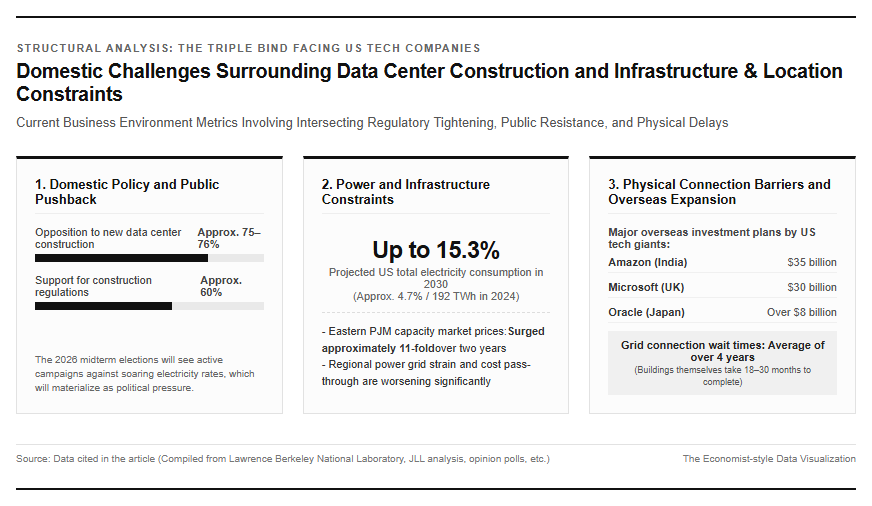
While the administration strongly urges domestic construction, local resident opposition to the over-construction of data centers is rapidly intensifying across the United States. In the November 2026 midterm elections, candidates opposing the deterioration of the living environment and soaring electricity rates associated with large-scale infrastructure gained the upper hand in various regions, leading to political consequences such as the Republican Party losing its congressional majority. According to polls, approximately 75% to 76% of Americans oppose the construction of new data centers in their local areas, and about 60% support construction regulations. According to estimates by the Lawrence Berkeley National Laboratory, electricity consumption by US data centers is projected to expand from about 192 terawatt-hours in 2024 (about 4.7% of total electricity) to a maximum of 15.3% by 2030. With capacity prices in the eastern PJM market skyrocketing about 11-fold in two years, regional power grid strains and cost pass-throughs have become social issues.
Overseas Investment Trends of Major US IT Companies and Barriers to Securing Electricity
Major US IT companies such as Amazon, Microsoft, Google, and OpenAI have deployed massive data center investments reaching billions to tens of billions of dollars on a global scale. Specifically, Amazon plans to invest $35 billion in India, Microsoft $30 billion in the UK, and Oracle over $8 billion in Japan. Behind the choice of overseas bases by US companies, in addition to responding to local demand and complying with data retention regulations (sovereign AI), there is the reality that securing electricity within the United States is taking a long time. According to JLL analysis, although building construction itself is completed in 18 to 30 months (about 2 years), the waiting time to connect to the transmission grid and receive power in major US markets exceeds an average of 4 years, and in some regions requires 5 years or more. Major US tech companies are facing a triple bind: pressure from the administration for overseas sanctions, local resident opposition movements, and physical power supply delays. An overview summarizing these structural challenges regarding site selection is posted as a figure.
Ripples for Japanese Companies and Countermeasures to Be Taken
Positive Effects on Domestic Data Center Demand and Risks of Rising Costs
The Trump administration’s hints at sanctions on overseas data centers are sending multifaceted ripples through Japan’s IT market and industrial structure. If U.S. hyperscalers adopt a more cautious stance toward new large-scale developments overseas, the relative value and stability of cloud regions already under development within Japan—such as in Tokyo and Osaka—could see increased recognition. Additionally, positive effects are anticipated, such as strengthening Japan’s bargaining power against U.S. vendors regarding the demand for sovereign AI (where domestic data is retained and managed within the country) and the tightening of government cloud specifications. Furthermore, for Japanese electrical and infrastructure companies providing transformers, air conditioning, and cooling equipment, this could present a prime opportunity to expand orders driven by the reinforcement of power infrastructure within the United States. On the other hand, if the global supply of cloud services stagnates and competitive pressure in the market slows, it risks driving up cloud usage fees and AI API prices, thereby pushing up digitization costs for Japanese companies overall.
Challenges Faced by Japanese Enterprises and Mid-to-Long-Term Response Strategies
At present, the legal framework and application conditions for the sanctions policy remain undecided, and it is recommended that Japanese companies avoid overreacting and immediately tearing up existing procurement plans. However, to minimize policy risks associated with U.S. dependency, it is crucial for companies to promptly audit the deployment status of their AI workloads and make practical preparations to evaluate the feasibility of dispersing them across multi-cloud and multi-region configurations. Furthermore, it is necessary to monitor the impact on the usage of U.S. computing resources in academic and research fields, such as the restrictions on remote access to advanced chips introduced on November 16, 2026. For Japan as a whole, the key going forward will be to leverage renewable energy locations and power source development to polish its locational advantage as a “country where electricity flows quickly and stably,” thereby building a resilient economic security framework unaffected by U.S.-led regulatory changes.
References
- [U.S. Department of Commerce Bureau of Industry and Security (BIS) Interim Final Rule on AI Semiconductors and Remote Access Regulations] https://www.bis.doc.gov/
- [The White House Official Announcement] https://www.whitehouse.gov/
- [Lawrence Berkeley National Laboratory (LBNL) Data Center Power Demand Study] https://www.lbl.gov/
[#PresidentTrump #DataCenter #AIInfrastructure #USChinaConflict #EconomicSecurity #PowerIssues]


コメント