The Prime Minister’s Office has cabinet-approved its basic policy package on economic measures, centered on the “Basic Policy on Economic and Fiscal Management and Reform 2026.” This overview examines the policy roadmap aimed at realizing a “strong economy,” anchored by a consumption tax cut on food products to 1%, all-generation social security reform, and strategic growth investments.
- The Overview of the Takaichi Policy Guidelines and the Intent Behind Food Tax Cuts
- Coordination with the Ministry of Finance and Legislation Submission to the 2026 Extraordinary Diet Session
- Revising Out-of-Pocket Expenses for Seniors Aged 70 and Older and Promoting Healthcare DX
- Responsible Active Fiscal Policy and Medium-to-Long-Term Fiscal Discipline
- AI and Digital Infrastructure Investment alongside Sector Earnings Trends
- Financial Market Volatility and Key Focus Points Ahead
The Overview of the Takaichi Policy Guidelines and the Intent Behind Food Tax Cuts
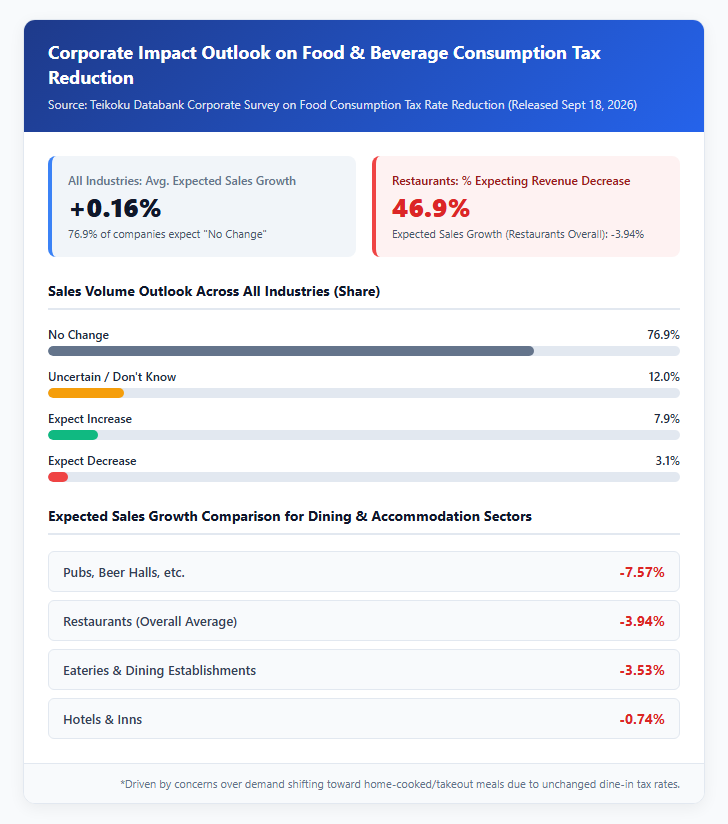
One of the central pillars of the basic policy package approved by the Cabinet is combating rising inflation from the consumer’s perspective while driving economic growth. Prime Minister Sanae Takaichi is strongly pushing for a major tax reduction that lowers the consumption tax rate on food products to 1%. This policy aims to directly alleviate household burdens facing rapid inflation and rising living costs, thereby stimulating domestic consumption. In the September 2026 Cabinet reshuffle, key appointments were solidified to ensure execution: Satsuki Katayama was retained as Minister of Finance, alongside Vice President Taro Aso and Secretary-General Shunichi Suzuki. The tax cut is estimated at approximately 5 trillion yen (around \$32 billion) annually, serving as the administration’s flagship economic policy. However, concerns have emerged regarding the tax rate gap between dining-out businesses and home-meal/takeout operators. According to a corporate survey released by Teikoku Databank on September 18, 2026, 46.9% of restaurant-related businesses expect a drop in revenue, with expected sales growth falling to -3.94%. Please refer to the figure below.
Thus, a key challenge lies in minimizing administrative burdens and adverse impacts on specific sectors while maximizing relief for households.
Coordination with the Ministry of Finance and Legislation Submission to the 2026 Extraordinary Diet Session
The formidable hurdle in implementing the food tax cut was securing financial resources and coordinating policies with the Ministry of Finance (MOF). MOF initially expressed strong reluctance toward consumption tax reductions due to fiscal consolidation concerns and tax revenue shortfalls, preferring cash handouts instead. However, Prime Minister Takaichi established political dominance within the party and government by securing the support of influential LDP heavyweights and keeping Finance Minister Katayama, who favored the tax cut effort. The administration plans to introduce tax-cut legislation in the Extraordinary Diet session convened in October 2026, aiming for swift passage following debate. Regarding the funding of approximately 5 trillion yen, measures under review include reviewing special tax measures and subsidies, alongside reprioritizing existing budget allocations. Furthermore, based on an agreement with the coalition partner Japan Innovation Party (Nippon Ishin no Kai), the government intends to pursue dual-track reform of revenues and expenditures through thorough regulatory and spending reforms. Yet, market anxiety over expanding government spending has pushed Japan’s 10-year benchmark bond yield to 3.0%, a 30-year high, putting to the test how well the administration can balance fiscal discipline with economic stimulus.
All-Generation Social Security Reform and Fiscal Sustainability
Revising Out-of-Pocket Expenses for Seniors Aged 70 and Older and Promoting Healthcare DX
A priority item in the Cabinet-approved policy framework is all-generation social security reform, aimed at modernizing the system into a sustainable structure. To curb and reduce social insurance premium hikes for the working-age population, the government is shifting out-of-pocket medical expenses toward a fair ability-to-pay model regardless of age. Specifically, guidelines were established to adjust out-of-pocket copayments for elderly citizens aged 70 and older toward parity with the 30% rate for working-age generations, while incorporating safeguards for low-income seniors. The government plans to formulate a detailed reform roadmap by the end of 2026. Moreover, Healthcare DX (Digital Transformation) was heavily emphasized to boost efficiency and service quality across the system. Initiatives include building a nationwide medical information platform, expanding electronic health records (EHR) and electronic prescriptions, and integrating My Number cards with health insurance cards. The government targets a 100% EHR adoption rate in hospitals with 200 or more beds by FY2028, alongside deploying cloud-native systems and reinforcing cybersecurity measures.
Responsible Active Fiscal Policy and Medium-to-Long-Term Fiscal Discipline
Japan faces one of the highest debt-to-GDP ratios among major advanced economies, where the expanding “crocodile mouth” gap between expenditure and tax revenues funded by government bond issuances has been a long-standing structural vulnerability. In response, the Cabinet-approved medium-to-long-term economic and fiscal plan aims to reconcile a “strong economy” with “fiscal sustainability.” Shifting away from uniform, cap-based spending restraints, the government adopted a “responsible active fiscal policy” framework that concentrates capital on growth investments and crisis management. For social security expenditures, a cap was set to ensure the social security burden ratio in FY2027 does not exceed FY2025 levels, sustaining structural reform efforts alongside adjustments for aging and economic trends. In non-social security domains, strict adherence to PDCA cycles and EBPM (Evidence-Based Policy Making) will eliminate low-impact programs in favor of high-priority initiatives. By maintaining transparent fiscal management informed by global discussions on medium-term fiscal frameworks and independent fiscal institutions, Japan aims to preserve market trust.
Industrial Growth Strategy and Impacts on Corporate Earnings and Financial Markets
AI and Digital Infrastructure Investment alongside Sector Earnings Trends
Another core pillar of the Cabinet decision, the “Japan Growth Strategy,” explicitly promotes public and private investments across 17 strategic sectors, including drug discovery, advanced healthcare, digital tech, and cybersecurity. Concentrated investments are pouring into semiconductors, electronic components, and telecommunications infrastructure, propelled by surging global demand for AI servers and data center expansions. According to the Business Outlook Survey (July–September 2026), corporate performance forecasts for FY2026 saw substantial upward revisions in both sales and ordinary profits across sectors such as information and communication electronics, electrical machinery, and industrial machinery. Please refer to the figure below.
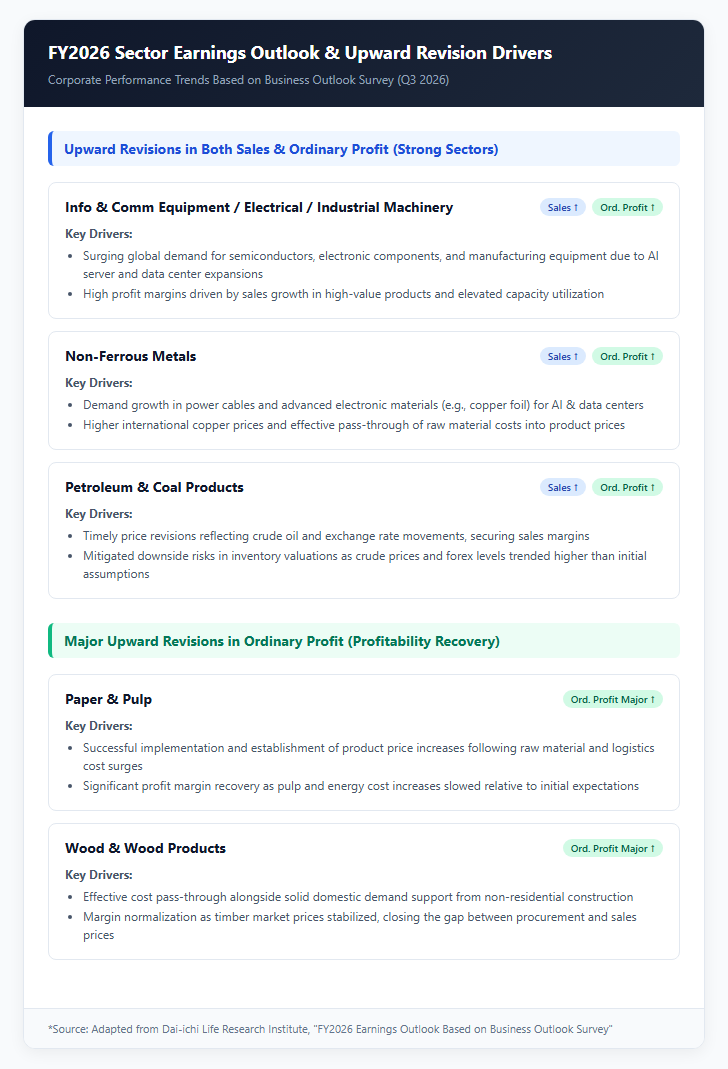
Furthermore, profitability is improving across broader industries due to non-ferrous metals producing power cables and advanced materials for AI infrastructure, as well as established price-pass-through practices in energy and materials sectors. The government is executing a roadmap to elevate Japan’s industrial competitiveness to top global levels through commercializing advanced technology, supporting startups, and expanding venture capital investments in pharmaceuticals.
Financial Market Volatility and Key Focus Points Ahead
Parallel to the government’s economic policy decisions, the financial landscape is undergoing a major turning point. The Bank of Japan decided to raise its policy rate by 0.25% during its Monetary Policy Meeting on September 17–18, 2026. Coupled with Federal Reserve actions, this marked the seventh historical instance of simultaneous U.S.-Japan rate hikes since 1972. Historically, the TOPIX index tends to fluctuate sideways for several months following simultaneous hikes before trending upward six to twelve months later. In equity markets, rate hikes are being priced into financial sectors like banks and insurance, while AI and semiconductor stocks remain backed by medium-to-long-term growth fundamentals. Looking ahead, key focus areas include the legislative debates over the consumption tax cut in the October 2026 Extraordinary Diet session and the concrete funding strategy for the 5 trillion yen annual tax relief. Whether the government and ruling coalition can execute inflation relief and structural reforms while maintaining alignment with fiscal consolidation targets will be decisive for Japan’s sustained economic growth.
References
- [Basic Policy on Economic and Fiscal Management and Reform 2026 – Ministry of Health, Labour and Welfare] https://www.mhlw.go.jp/
- [Challenges Toward Fiscal Reconstruction in Japan – House of Councillors] https://www.sangiin.go.jp/
【#TakaichiCabinet #EconomicPolicy #ConsumptionTaxCut #BasicPolicy2026 #SocialSecurityReform #HealthcareDX #USJapanRateHikes #JapaneseEconomy】

コメント