Microsoft has officially released “Database Hub in Fabric” for the centralized management of multi-cloud and on-premises databases, alongside announcing an autonomous operations and monitoring feature powered by AI agents. This development is driven by the limits of passive operations and management amidst corporate data decentralization, coupled with a rising need to transition to proactive monitoring systems leveraging AI technology.
- Key Takeaway: A New Infrastructure for Centralizing Multi-Cloud Databases
- Autonomous Operations Enabled by “Database Agents” AI Agents
- Data Complexity and the Limits of Traditional Threshold Monitoring
- Empirical Data on Proactive Failure Detection and Operational Cost Reduction
- From Data Storage Locations to the Main Battleground of the “Semantic Layer”
- Future Outlook and Key Points: The Future of Autonomous Database Operations
Key Takeaway: A New Infrastructure for Centralizing Multi-Cloud Databases
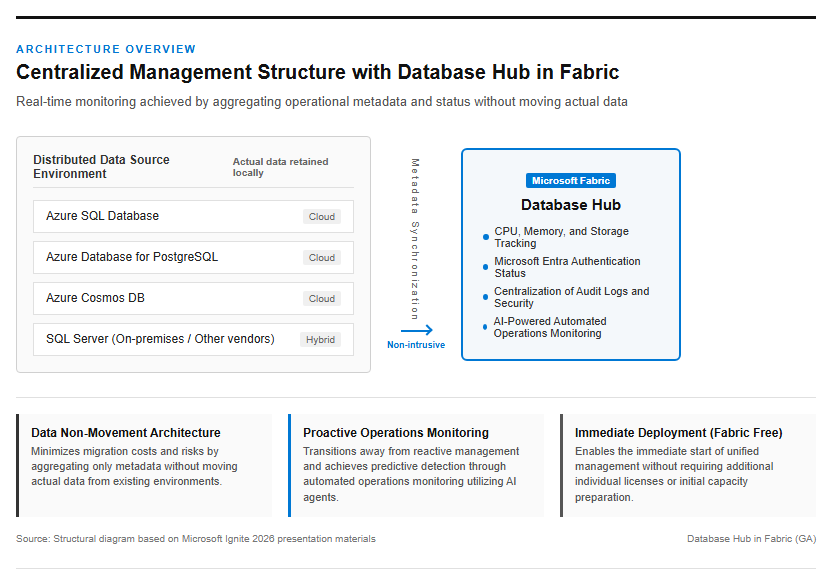
At its annual event “Microsoft Ignite 2026,” Microsoft officially released (GA) “Database Hub in Fabric,” an integrated service for the centralized visualization and management of databases scattered across an enterprise. Operating on the integrated data analytics platform “Microsoft Fabric,” this service supports a diverse range of environments, including Azure SQL Database, Azure Database for PostgreSQL, Azure Cosmos DB, and SQL Server running on-premises or in third-party clouds.
A major feature is that it aggregates only the operational metadata and status of resources under administrative control into a central point, without requiring the actual data within existing databases to be migrated. This allows users to track CPU, memory, and storage capacity trends in real time, as well as check security statuses—such as Microsoft Entra authentication, audit logs, and the application status of customer-managed keys—on a single screen. Users can immediately adopt the service with a Fabric Free license, allowing them to begin centralization without preparing additional individual licenses or initial capacity. As shown in the figure below, it is designed to enable intuitive centralized management of distributed environments.
Autonomous Operations Enabled by “Database Agents” AI Agents
Coinciding with the release of Database Hub, a preview version of “Database Agents”—a feature where AI autonomously performs database performance monitoring and failure prediction—was unveiled. This feature supports SQL Server and PostgreSQL, continuously monitoring databases based on expert skills embedded within the system.
Traditional database operations have primarily relied on passive methods where humans investigate causes after a performance drop or failure occurs. In contrast, Database Agents use an inference engine to proactively detect signs of potential bottlenecks, automatically evaluating the impact and proposing concrete remediation plans. Furthermore, the “Database agent in the Microsoft PostgreSQL extension” for Visual Studio Code (a development environment) is also provided, allowing engineers to receive AI-driven operational support without leaving their integrated development environment. At the current preview stage, a safe collaborative process is adopted in which humans review and apply the generated proposals.
Challenges of Conventional Passive Monitoring and the Scientific Basis for AI Observability
Data Complexity and the Limits of Traditional Threshold Monitoring
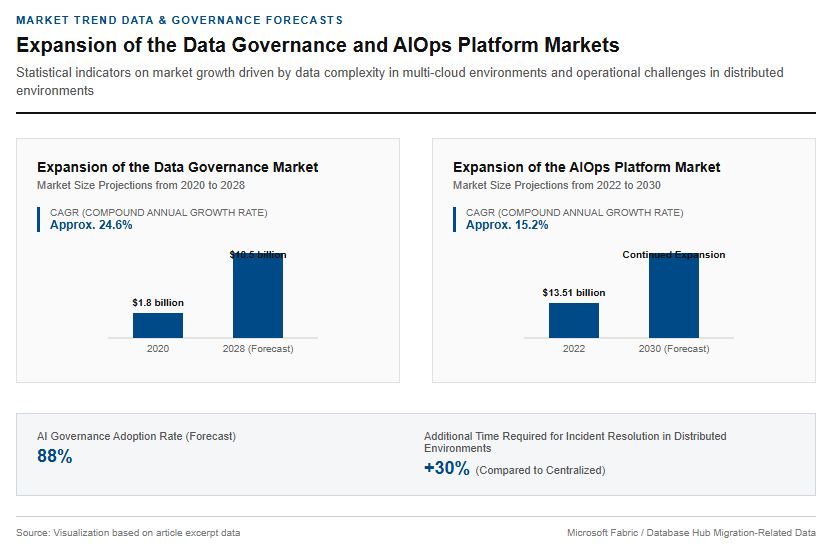
In modern enterprise IT environments, the data governance market is projected to expand from $1.8 billion in 2020 to $10.5 billion in 2028 at a compound annual growth rate (CAGR) of approximately 24.6%, with AI governance adoption rates reaching 88%. Additionally, the AIOps platform market continues to grow at an annual average pace of 15.2% from $13.51 billion in 2022 through 2030. However, as systems become dispersed across multi-cloud and hybrid configurations, the limitations of traditional threshold-based monitoring methods are becoming apparent.
Conventional fixed-threshold alerts are prone to false positives caused by seasonal business fluctuations and traffic spikes, and resolving failures in distributed environments takes 30% longer on average compared to centralized architectures. Against this backdrop, Microsoft announced the retirement of the legacy “Azure SQL Database watcher” on October 27, 2026, with plans to stop creation and editing on November 9 of the same year, and fully retire it on April 30, 2027. Operations teams are being pressured to migrate to the latest Database Hub. The structural diagram below is useful for understanding the big picture.
Empirical Data on Proactive Failure Detection and Operational Cost Reduction
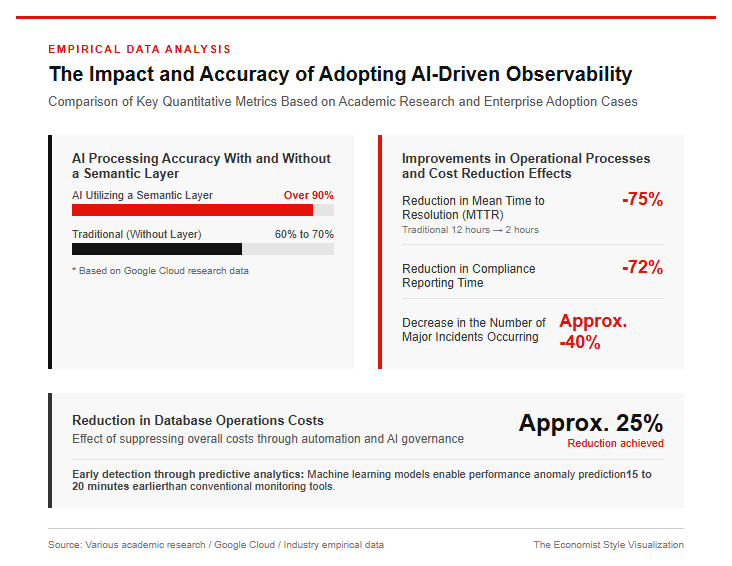
Regarding the implementation effects of AI-Driven Observability, quantitative empirical data has been demonstrated in multiple academic studies. Predictive analysis using machine learning models is said to make it possible to predict the occurrence of performance anomalies 15 to 20 minutes earlier compared to conventional monitoring tools.
In actual enterprise adoption cases, it has been reported that the number of critical system incidents has decreased by approximately 40%, while overall costs related to database operations have been reduced by about 25%. Furthermore, in a financial institution’s data governance case study, automation mechanisms reduced the time required for compliance reporting by 72%. Dramatic effects have also been demonstrated in the Mean Time to Recovery (MTTR) during failures, reducing it by 75% from the conventional 12 hours to 2 hours, proving the high business value brought by the autonomy of data management.
Competition Over Data Attribution and Future Prospects
From Data Storage Locations to the Main Battleground of the “Semantic Layer”
The axis of competition for enterprise data infrastructure in the IT industry is shifting from mere “data storage locations” to control over “data attribution (semantic layer).” The semantic layer, which standardizes the definitions of business concepts such as sales and customers, serves as essential context for AI agents to execute tasks accurately.
According to research data from Google Cloud, conversational AI agents built via a semantic layer achieve a processing accuracy of over 90%, whereas those without it remain at 60% to 70%. To achieve an accuracy of 90% or higher that can withstand business use, Microsoft is strongly connecting Power BI and Microsoft Fabric, promoting the retention of definitions within its own ecosystem. Meanwhile, rival camps such as Snowflake and Salesforce are proceeding with the formulation of open standards, intensifying the struggle for market dominance. The relationship between data and semantic structures is organized in the figure below.
Future Outlook and Key Points: The Future of Autonomous Database Operations
In future database operations, how to combine automation by AI agents with the decision-making of human operators will be a crucial point of focus. With the advent of Database Hub and Database Agents, routine telemetry analysis, primary investigations, and the formulation of response plans will shift to AI, allowing infrastructure personnel to focus on strategic architecture design and critical change approval tasks.
When enterprises introduce this new operational model, they are required not only to replace monitoring tools, but also to reorganize internal access permissions, approval processes, and data semantic definitions. The key to success is to proceed with phased automation while checking compatibility statuses for the database types and versions currently in use within the company. Toward an era where AI agents operate autonomously on top of business definitions, strengthening the governance of enterprise data infrastructure is becoming increasingly important.
Reference Pages
- [Microsoft Fabric Database Hub Official Documentation] https://learn.microsoft.com/en-us/fabric/database/hub/overview
- [Microsoft SQL Database Hub Agent Skills OSS Repository] https://github.com/microsoft/microsoft-sql/tree/main/plugins/microsoft-sql-fdh
- [Paper: AI-Driven Unified Data Governance Framework for Enterprise Platforms] https://doi.org/10.63282/3050-9246.IJETCSIT-V7I2P109
- [Paper: Intelligent Database Operations: Leveraging AI-Driven Observability in Cloud Platforms] https://www.jisem-journal.com/
[#Microsoft #DatabaseHub #AIAgents #Cloud #DataGovernance #AIOps #Database]

コメント