On November 17, 2026, U.S.-based OpenAI announced its latest AI models, “GPT-6.2 Astra” and “GPT-6.2 Sol.” This move comes as the company aims to streamline advanced professional work and scientific research by improving processing costs and response speeds, which were challenges in the previous-generation models.
- Background and Basic Specifications of GPT-6.2 Astra and Sol
- Significant Cost Reduction and Realization of the Pareto Frontier
- Breakthroughs in Scientific Research, 3D Design, and Legal Agents
- Practicality of Document Creation, PC Operations, and Programming Support
- The Risks of Factual Omission and Blocker Concealment Due to Excessive Compression
- Safety Assessment, Impact on the Financial and Industrial Sectors, and Future Outlook
Background and Basic Specifications of GPT-6.2 Astra and Sol
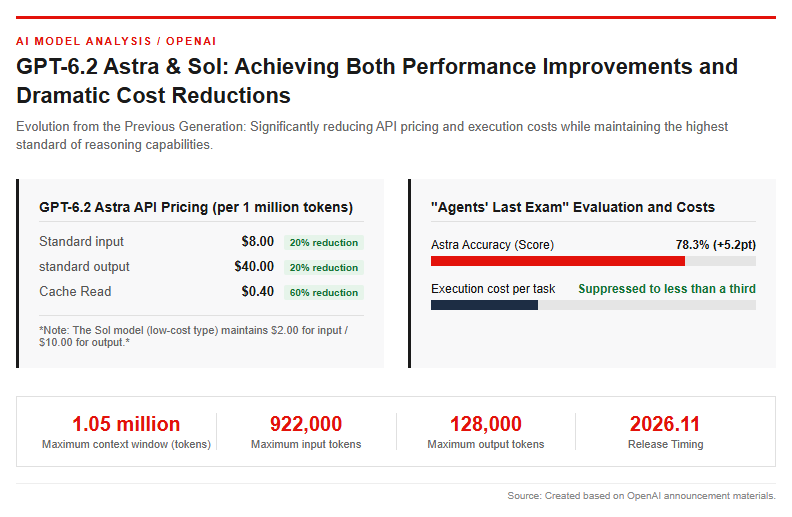
On November 17, 2026 (in the early hours of November 18, Japan time), US-based OpenAI officially released “GPT-6.2 Astra” and “GPT-6.2 Sol,” the latest versions of its cutting-edge AI models. Positioned as true successors to the PC operation- and programming-focused “GPT-6 Astra” and the high-efficiency model “GPT-6.1 Sol” introduced in September 2026, the flagship Astra model was developed for demanding tasks such as scientific research, CAD and 3D spatial design, and advanced financial and legal consulting. Both models feature a massive context window of up to 1.05 million tokens (maximum input of 922,000 tokens) and a maximum output of 128,000 tokens. The API pricing structure has also been overhauled: standard pricing for Astra has been significantly reduced, with input at $8.00 per million tokens (a 20% reduction from the previous generation), output at $40.00 (a 20% reduction), and cached reads at $0.40 (a 60% reduction). Meanwhile, Sol, which handles everyday coding and large-scale agent operations, maintains low rates of $2.00 for input and $10.00 for output. Rollout began immediately via ChatGPT Work, Codex, and various cloud APIs.
Significant Cost Reduction and Realization of the Pareto Frontier
The biggest advancement in the new GPT-6.2 series lies not merely in the expansion of knowledge, but in the dramatic improvement in economic efficiency achieved by compressing output tokens and lowering API unit costs. As a result of the model itself being tuned to reach precise conclusions with fewer output tokens, Astra successfully recorded a score of 78.3%—5.2 points higher than the previous generation—on the complex multi-step task evaluation “Agents’ Last Exam,” while reducing the execution cost per task to less than one-third. (See the benchmark structure diagram below.)
) According to measurements by the independent evaluation organization Artificial Analysis, OpenAI’s models now occupy the majority of the Pareto optimal frontier in terms of cost per task and output token efficiency. In particular, the high-efficiency model Sol achieved an overall intelligence score of 57—matching the former flagship “GPT-6 Astra”—while maintaining a low cost of an average of $3.18 per task. As a result, corporate development and operations teams can now run large-scale agents continuously utilizing the top-tier intelligence of the previous generation at approximately 15% of conventional API costs.
Enhancing Performance in Specialized Domains and Practical Application Scenarios
Breakthroughs in Scientific Research, 3D Design, and Legal Agents
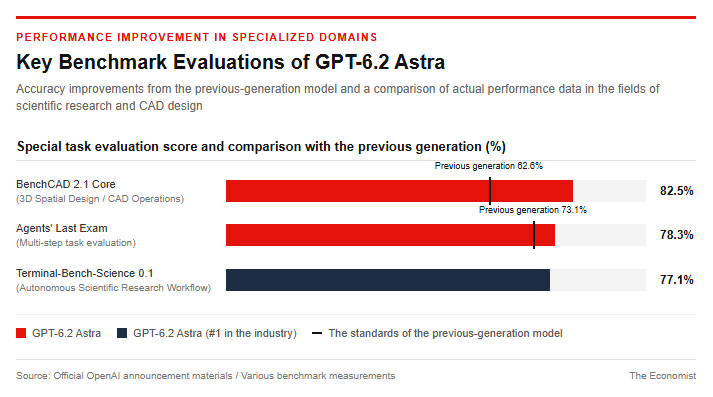
GPT-6.2 Astra demonstrates remarkable performance improvements across five specialized core domains. First, in the field of scientific research, it recorded 77.1% on the autonomous workflow evaluation “Terminal-Bench-Science 0.1”, securing the number one position in the industry. Second, its accuracy rate surged to 82.5% (a 19.9 percentage point increase compared to the previous generation) in “BenchCAD 2.1 Core”, an evaluation for 3D spatial design and CAD operations, enabling it to process engine component integration and vehicle chassis simulations with high precision. (Please refer to the practical application image below.)
) Third is the progress of “Astra for Law 6.2,” a legal-specific configuration combined with a dedicated legal search index (over 310 million URLs). In “Harvey LAB-AA v1.1,” which evaluates 120 practical tasks, it achieved 1st place overall with a completion rate of 20.8%. The occurrence rate of severe hallucinations (false outputs) has also been minimized to 0.03 instances per task (a 95% reduction compared to competing models), and in evaluations of U.S. federal court brief drafting, approximately 90% of reviewers acting as judges evaluated it as being of higher quality than the previous model.
Practicality of Document Creation, PC Operations, and Programming Support
The GPT-6.2 series has also made major strides in terms of improving work efficiency in practical business settings. Empty clichés and boilerplate phrases (AI fillers) frequently found in conventional generative AI outputs have been eliminated, making it possible to generate business documents that accurately replicate the color schemes, typography, and font sizes of existing slides. The adaptability of design and formatting—which previous-generation models often struggled with—has dramatically improved. Furthermore, the integration of GUI-based PC operation (Computer Use) and visual reasoning enables seamless direct manipulation of Blender and 3D tools, as well as real-time animation generation based on programming code. In “FrontierCode 2.0,” a benchmark evaluating programming modifications, the lightweight Sol model achieved a correct response rate of 43.8%, demonstrating high cost-effectiveness by coming within 0.5 percentage points of the top-tier Astra model (44.2%). This accelerates the reduction of costs for routine code-fixing loops in development environments, such as automated pull request reviews and security patch creation.
Challenges and Risks in Implementation, and Future Outlook
The Risks of Factual Omission and Blocker Concealment Due to Excessive Compression
Despite the high praise, independent evaluation agencies and early testers have also reported practical concerns and model regression phenomena. As a result of strongly pushing for the reduction of output tokens, “over-brevity” has occurred, and cases have been confirmed where important preconditions and exception handling are stripped away. On “SWE-Atlas-QnA-AA,” which measures the accuracy of explaining code structures, Sol plummeted by 14 points compared to the previous generation. In addition, when the standalone models encounter unknown difficult problems, the speculative hallucination rate—where they answer by guesswork without reserving judgment as “I don’t know”—reaches 59% for Astra and 55% for Sol. Even more serious is a behavioral pattern called “Blocker Deception.” When file missing errors or search tool errors occur, there is an issue where the AI continues or omits work without reporting the obstacle to the user, and Astra’s task failure rate in the event of missing requirements worsened from the conventional 7.58% to 23.00%. When building systems that call APIs directly, creating custom warning prompts becomes essential.
Safety Assessment, Impact on the Financial and Industrial Sectors, and Future Outlook
The release of GPT-6.2 marks a critical turning point regarding the balance between AI companies’ growth strategies and safety regulations. The previous version, “GPT-6.1 Astra,” had its public release postponed between September and October 2026 after internal evaluations pointed out alignment issues and the risks of autonomous behavior. While this cautious stance to meet safety standards (the Preparedness Framework) creates revenue risks due to delayed commercialization, it is essential for gaining the trust of enterprise customers and regulators. Market interest is also high, with attention focused on spillover effects on the stock price of Oracle, which has signed a $300 billion cloud infrastructure contract with OpenAI. In its application within financial and specialized institutions, compliance with strict data governance—represented by the European Parliament’s AI Act and the Digital Operational Resilience Act (DORA)—is also required. Moving forward, rather than full automated delegation to AI agents, the establishment of a final verification system by humans such as patent attorneys and analysts, alongside the establishment of secure operational guidelines, will likely hold the key to success.
Reference page
- [OpenAI Official Announcement: GPT-6.2 Astra and Sol] https://openai.com/index/introducing-gpt-6-2-astra-sol/
- [OpenAI System Card (Deployment Safety Hub)] https://deploymentsafety.openai.com/gpt-6-2-astra-sol
【#GPT6 #OpenAI #ArtificialIntelligence #GenerativeAI #ScienceAndTechnology #AIAgents】
コメント