
Citrix announced a major expansion of its DaaS capabilities for Azure environments at Microsoft Ignite 2026. This move is driven by the need for improved scalability, enhanced security, and stronger data protection as cloud environments continue to expand.
- Seven New Features Announced at Microsoft Ignite 2026
- Doubling Desktop Capacity and Azure Infrastructure Integration
- Enabling Multi-Cloud Support and Offline Operations
- Sensitive Data Protection Technology Utilizing Local AI
- Evaluating Operational Costs and Comparison with Existing Architectures
- Future Outlook and Key Highlights in the Cloud Desktop Market
Seven New Features Announced at Microsoft Ignite 2026
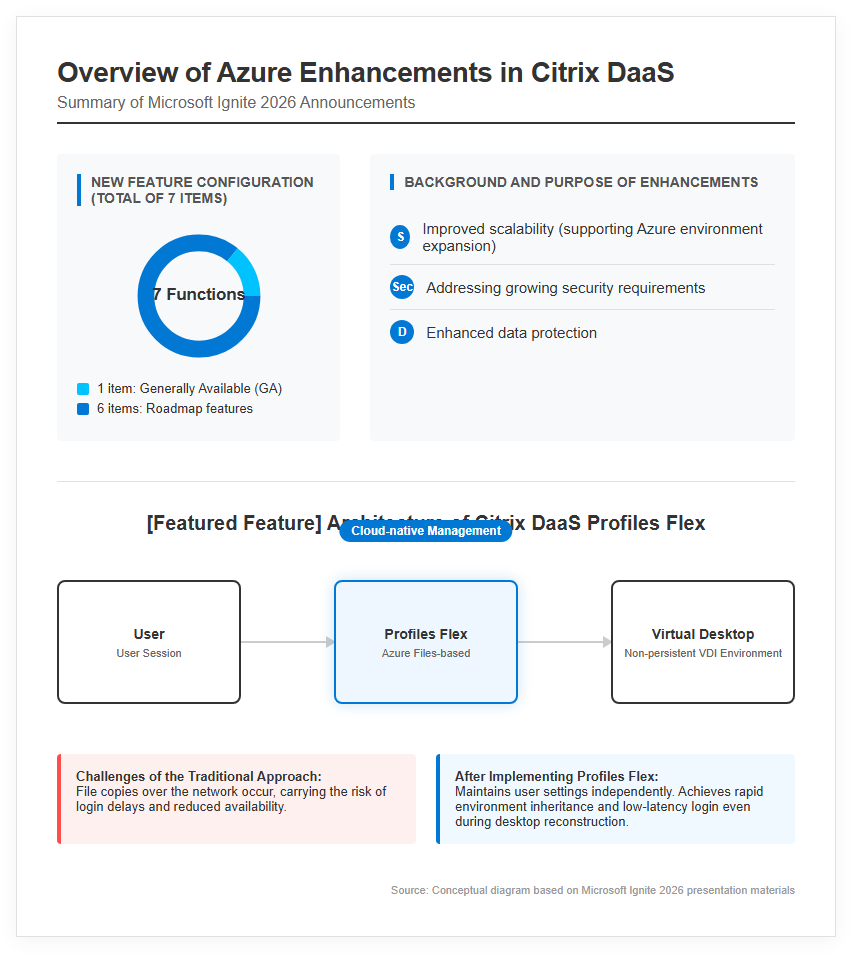
Citrix (a subsidiary of Cloud Software Group) announced seven key features at Microsoft Ignite 2026 aimed at improving the operational efficiency of cloud desktop environments. These features are designed to meet the growing expansion of corporate cloud environments and increasing security requirements, consisting of one generally available (GA) feature and six roadmap features. Specifically, these include doubling the number of virtual desktops hosted per Azure subscription, bulk processing for large-scale operations, and automatic disaster recovery capabilities.
The only feature made immediately available in this announcement is Citrix DaaS Profiles Flex. This is a cloud-native profile management service based on Azure Files that allows user settings and profile data to be maintained independently, even in non-persistent virtual desktop environments. This enables individual user environments to be quickly restored when a desktop is rebuilt and helps prevent login delays caused by transferring files over the network. The following figure shows an image of the cloud-native management environment.
Doubling Desktop Capacity and Azure Infrastructure Integration
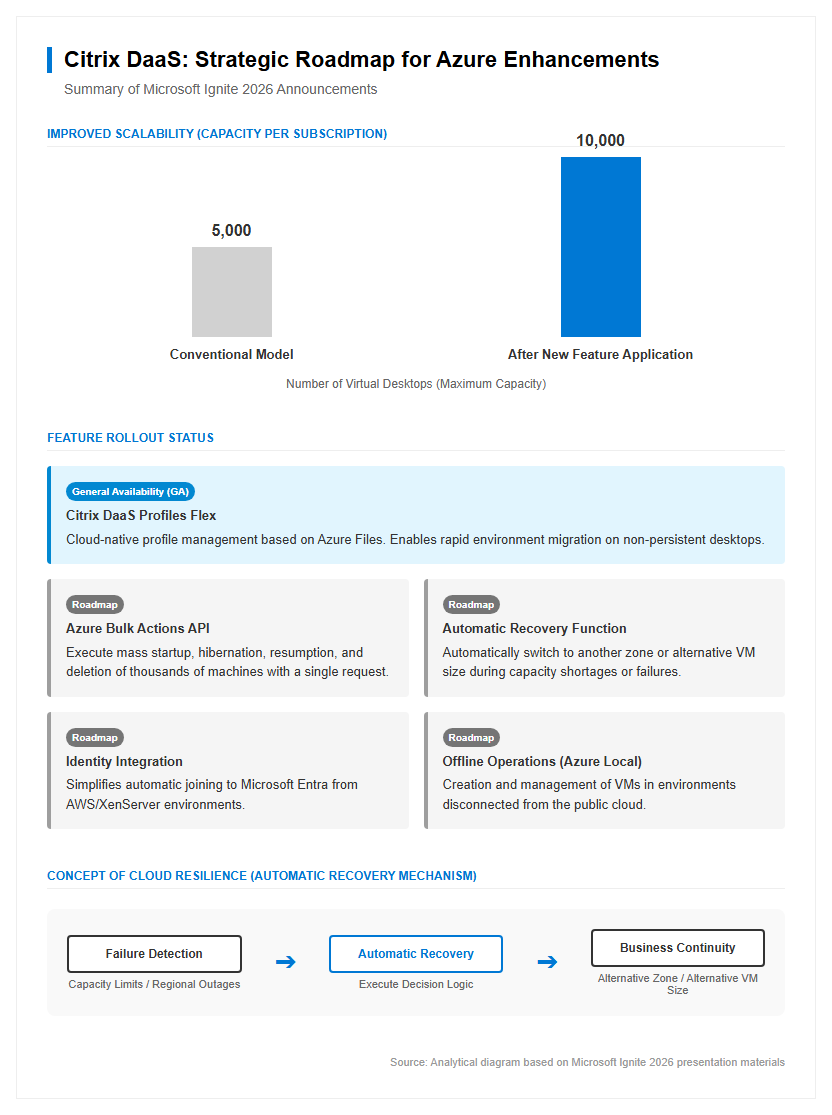
Among the roadmap features presented, one of the most impactful is the doubling of the number of supported virtual desktops per Azure subscription and region, increasing from the traditional 5,000 to a maximum of 10,000. This expansion allows enterprise IT teams managing large-scale cloud operations to reduce the number of subscriptions they need to manage, thereby simplifying administration and reducing operational costs.
Additionally, the introduction of bulk actions, hibernation, and resume functions through integration with the Azure Bulk Actions API is planned. This will enable the starting, deallocating, hibernating, and deleting of thousands of virtual desktops with a single request. By utilizing the hibernation feature, companies can significantly reduce computing costs during unused periods, such as nights and weekends, while providing an environment where employees can immediately resume work upon arriving at the office.
Cloud Resilience and Advanced Security Protection
Enabling Multi-Cloud Support and Offline Operations
Citrix is strengthening its automatic recovery mechanisms for Azure environment failures. The planned automatic recovery feature provides a mechanism where virtual desktops will automatically start in a different Availability Zone or switch to an alternative VM size when capacity limits are reached or cloud failures occur. This ensures business continuity even in the event of regional failures or VM resource shortages.
Furthermore, the simplification of identity integration across multi-cloud and on-premises environments was also announced. Machines running on AWS or Citrix XenServer will be able to automatically join Microsoft Entra without requiring an on-premises Active Directory. Additionally, for regulated environments or remote locations that cannot connect directly to the public cloud, offline operation support is planned, allowing for the creation and management of virtual machines on Azure Local. The following figure illustrates the architectural concept of the automatic recovery.
Sensitive Data Protection Technology Utilizing Local AI
With the proliferation of AI tools in the digital workplace, addressing the risk of sensitive information leakage has become an urgent priority for enterprises. To tackle this challenge, Citrix is developing a local AI data protection feature powered by the Citrix Intelligence Engine. This feature adopts a mechanism that runs AI models within the customer’s own environment, ensuring data is never sent to external cloud services.
Specifically, the AI model will automatically detect sensitive information within text or data copied to the clipboard and perform real-time blocking or masking in accordance with configured security policies. Because the entire inspection process is contained within the organization’s closed environment, it is possible to achieve both secure AI utilization and cloud operations while preventing information leaks.
Considerations for Implementation and Future Outlook
Evaluating Operational Costs and Comparison with Existing Architectures
Administrators considering the adoption of new features need to develop operational plans that clearly distinguish between generally available features and those in the roadmap stage. While evaluation in a pilot environment is recommended for the immediately available Profiles Flex, features such as the doubling of capacity to 10,000 machines and automatic recovery require waiting for the official release decision. In particular, regarding hibernation functionality, limitations exist in terms of available VM sizes (such as up to 64GB RAM) and OS versions, making preliminary verification essential.
Additionally, native integration with Azure Virtual Desktop (AVD) and cost/operational comparisons with other tools are important. While standalone AVD operations have an advantage in cost reduction by leveraging Microsoft 365 E3/E5 licenses, Citrix DaaS extensions hold a significant advantage for enterprise companies requiring advanced GPU rendering (HDX protocol) or multi-cloud governance. The image below shows a functional comparison of each configuration.
Future Outlook and Key Highlights in the Cloud Desktop Market
The cloud desktop market is projected to grow by over 12% annually, driven by the establishment of remote work, rising security requirements, and advances in AI integration. Amidst this, Citrix and Microsoft have entered into an 8-year strategic partnership, rapidly deepening their collaboration by positioning Azure as the preferred cloud for Citrix DaaS.
Going forward, attention will focus on the official release timing of roadmap features scheduled to be rolled out sequentially from 2026 onwards, as well as their actual implementation effects. IT departments are required to proceed with phased verification and preparation on how to incorporate Citrix’s latest features, aligning them with their own cloud migration plans, Zero Trust security strategies, and AI data governance policies.
Reference Pages
- 【Citrix Official Announcement】https://www.citrix.com/news/announcements/2026-11/citrix-daas-to-double-virtual-desktops-per-microsoft-azure-subscription-and-add-private-ai-data-protection
【#Citrix #Azure #DaaS #CloudDesktop #VirtualDesktop #MicrosoftIgnite2026 #ZeroTrust】

コメント