The preliminary U.S. manufacturing PMI for November 2026, announced by S&P Global, stood at 54.5, meeting market expectations and remaining above the 50 threshold that signifies economic expansion. While improvements in new orders and employment are supporting robust demand, a sharp spike in the input price index has heightened concerns in financial markets regarding a potential resurgence of inflation.
- Key Points: Expansion in Manufacturing Sentiment and Breakdown of Major Indices
- Expansion in New Orders and Employment: Broadening Demand and the Current State of Production Activity
- Rapid Rise in Input Costs: Factors Behind the Surge in the Input Price Index
- Implications for Monetary Policy and Interest Rate Outlook: Heightened Vigilance Regarding Fed Rate Hikes
- Stock and Commodity Market Reactions: Gold and Crude Oil Prices, and Sector Performance Divergence
- Future Outlook and Points to Watch: Business Cycles and Market Areas of Caution
Key Points: Expansion in Manufacturing Sentiment and Breakdown of Major Indices
The preliminary U.S. manufacturing Purchasing Managers’ Index (PMI) for November, released on November 23, 2026, recorded 54.5, matching the market forecast of 54.5. Although this was a slight decrease from the previous month’s reading of 54.9, it has remained above the 50 threshold—the boundary between economic expansion and contraction—for nine consecutive months, indicating that the overall U.S. manufacturing sector maintains an expansionary trend. The preliminary services PMI for November, released on the same day, was 54.7 (previous forecast: 55.5; previous month: 56.1), while the composite PMI, combining both manufacturing and services, was 54.6 (previous forecast: 55.6; previous month: 55.9), confirming robust overall business activity. The PMI, calculated based on surveys of purchasing managers, is a diffusion index that reflects the proportion of respondents reporting improvement versus those reporting deterioration, and it is highly valued as a leading indicator that swiftly captures real economic trends. This latest indicator serves as evidence that the U.S. private economy maintains considerable resilience even amidst a high-interest-rate environment and ongoing geopolitical risks. The following graph shows the trend in manufacturing business sentiment.
Expansion in New Orders and Employment: Broadening Demand and the Current State of Production Activity
Examining the detailed sub-indices reveals strong resilience in both final demand and the labor market. The new orders index, which represents new customer orders, rose from 53.7 last month to 55.3, indicating an acceleration in the pace of expansion. Additionally, the backlog index, which shows unfulfilled orders, reached 56.4, up 4.6 points, highlighting a situation where orders are flowing in at a rate that exceeds the processing capacity of factories. The employment index also expanded from 51.2 last month to 52.7, marking its third consecutive month of growth. Since manufacturers typically increase personnel only when they are confident in the sustainability of demand, growth in employment serves as a strong signal confirming the recovery of real demand. Growth was reported in 12 out of the 18 manufacturing sectors, showing a broadening base of demand. On the other hand, the current production index decelerated slightly from 58.3 last month to 56.7. This indicates a situation where supply systems and material procurement on the production floor are failing to keep pace with the surge in orders, resulting in a lag behind demand. The fact that customer inventory levels remain low is also a factor prompting additional orders for future inventory rebuilding.
Background of the Price Index Spike and Concerns Regarding Inflation and Interest Rates
Rapid Rise in Input Costs: Factors Behind the Surge in the Input Price Index
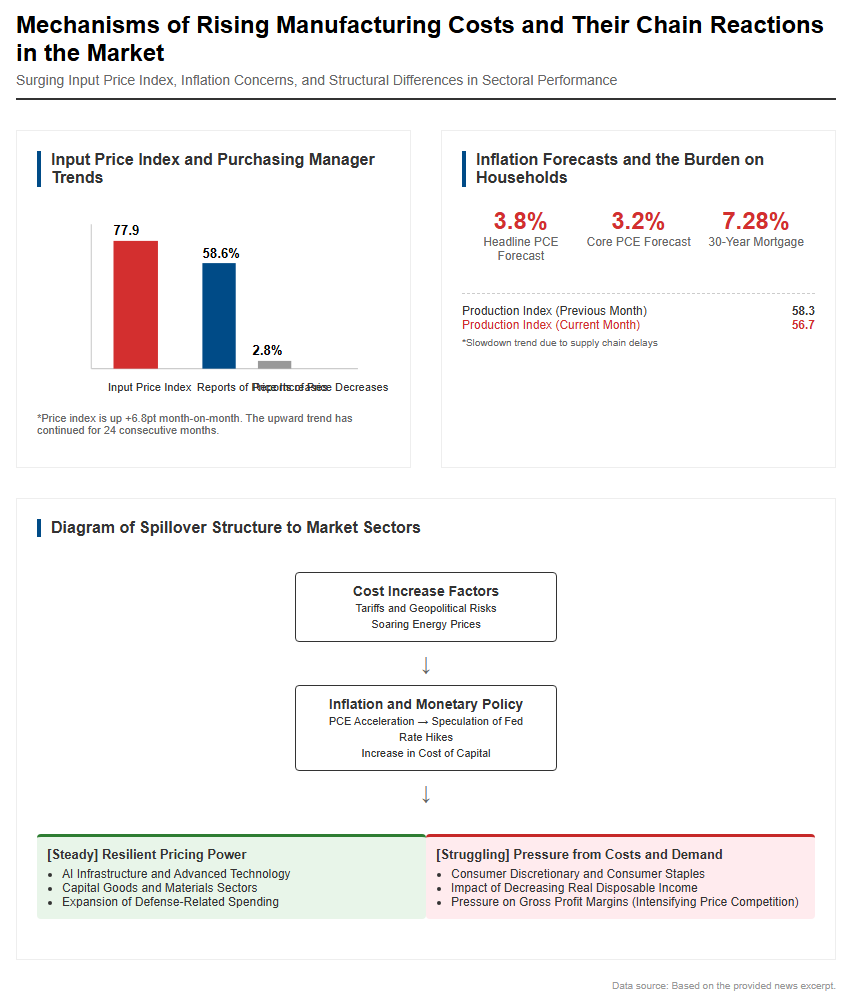
The most significant point of attention—and simultaneously a major cause for concern—in this survey was the remarkable rise in the input price index. The price index rose 6.8 points from the previous month to reach 77.9, jumping to levels comparable to periods of rapid escalation associated with intensifying tensions in the Middle East. While 58.6% of responding purchasing managers reported an increase in raw material prices, the proportion reporting price decreases was only 2.8%, marking 24 consecutive months of an upward price trend. The primary drivers of cost increases include the implementation of tariff policies on steel and aluminum, as well as the volatility of energy prices due to geopolitical risks. Approximately 60% of the surveyed companies expressed strong concerns regarding tariffs and high material costs. Companies with the pricing power to pass high input costs on to their product selling prices can maintain profitability, but companies positioned in highly competitive markets are being forced to endure squeezed gross margins.
Implications for Monetary Policy and Interest Rate Outlook: Heightened Vigilance Regarding Fed Rate Hikes
The rapid rise in raw material and material prices serves as a factor that directly stimulates the risk of resurgent inflation, which the Federal Reserve (Fed) is monitoring closely. In the market, speculation regarding interest rate hikes for the next Federal Open Market Committee (FOMC) meeting is beginning to resurface, putting pressure on liquidity in both equity and bond markets. In the forthcoming Personal Consumption Expenditures (PCE) price index, the headline inflation rate is expected to accelerate to +3.8% year-on-year, and the core inflation rate to +3.2% year-on-year, once again highlighting the stickiness of inflation. The U.S. 10-year Treasury yield, a benchmark for mortgage rates, also remains at high levels; with 30-year fixed mortgage rates reaching 7.28%, the increasing borrowing costs for households are becoming a burden on the overall economy. If high inflation rates are confirmed, there is a high possibility that the Fed’s period of monetary tightening will last longer than expected, raising concerns about a cycle where increased capital costs due to rising interest rates inhibit the desire for capital investment in the manufacturing sector.
Spillover Effects on Financial Markets and Mid-to-Long-Term Outlook
Stock and Commodity Market Reactions: Gold and Crude Oil Prices, and Sector Performance Divergence
The release of preliminary PMI figures and the surge in price indices had an immediate impact on major financial markets and commodity markets. In the commodity markets, gold futures and crude oil experienced volatile price swings driven by concerns over resurgent inflation and upward pressure on interest rates. In the stock market, the capital goods and materials sectors have maintained relatively robust performance, supported by capital expenditure demand for AI infrastructure and expanded defense spending. While advanced technology companies dealing in semiconductors and data center materials are maintaining earnings growth through strong pricing power, the consumer discretionary and consumer staples sectors are facing narrowing profit margins due to the direct impact of declining real disposable household income and slowing consumption. The conceptual diagram below illustrates the impact structure on major market sectors.
Future Outlook and Points to Watch: Business Cycles and Market Areas of Caution
Regarding the manufacturing outlook for the coming months, inflation trends and central bank policy stances will be the primary focal points. In the short term, market liquidity is expected to decrease during the shortened trading sessions surrounding the Thanksgiving holiday in late November, creating a risk of heightened volatility driven by economic data releases. In the medium to long term, while government policies promoting reshoring serve as a supportive factor, persistently high production costs and a shortage of skilled labor remain structural barriers to manufacturing expansion. Furthermore, the strength of final demand will be tested once the restocking cycle of client companies has concluded. Companies that can secure new orders in structurally growing sectors—such as data center construction, defense, and energy—are expected to establish a competitive advantage in the upcoming growth phase.
Reference Pages
- 【ISM Report On Business – Manufacturing PMI】https://www.ismworld.org/supply-management-news-and-reports/reports/ism-report-on-business/
【#USEconomy #ManufacturingPMI #Inflation #FRB #FinancialMarkets】


コメント