
In the New York foreign exchange market on November 23, 2026, the USD/JPY pair rose to 159.50 yen following an increase in U.S. long-term interest rates triggered by the sudden return of NVIDIA CEO Jensen Huang. However, the pair subsequently turned lower due to slowing U.S. economic indicators and a decline in U.S. interest rates. The foreign exchange market is seeing volatile price movements as two opposing factors intersect: the recovery of risk appetite driven by a sharp rebound in semiconductor stocks and the downside miss in U.S. economic indices.
- 1-1 Rapid Dollar Surge and Rising U.S. Interest Rates Following the Return of NVIDIA’s CEO
- 1-2 Dollar Retreat Driven by Weak U.S. Economic Indicators and Lower Oil Prices
- 2-1 The Truth Behind CEO Huang’s Sudden Return via Political Intervention
- 2-2 Overheating After Currency Intervention and the Persistent Influence of U.S. Interest Rates
- 3-1 Legal Risks and Challenges in Data Center Financing
- 3-2 Monetary Policies of Japan and the U.S. and Future Outlook for the Exchange Rate
1-1 Rapid Dollar Surge and Rising U.S. Interest Rates Following the Return of NVIDIA’s CEO
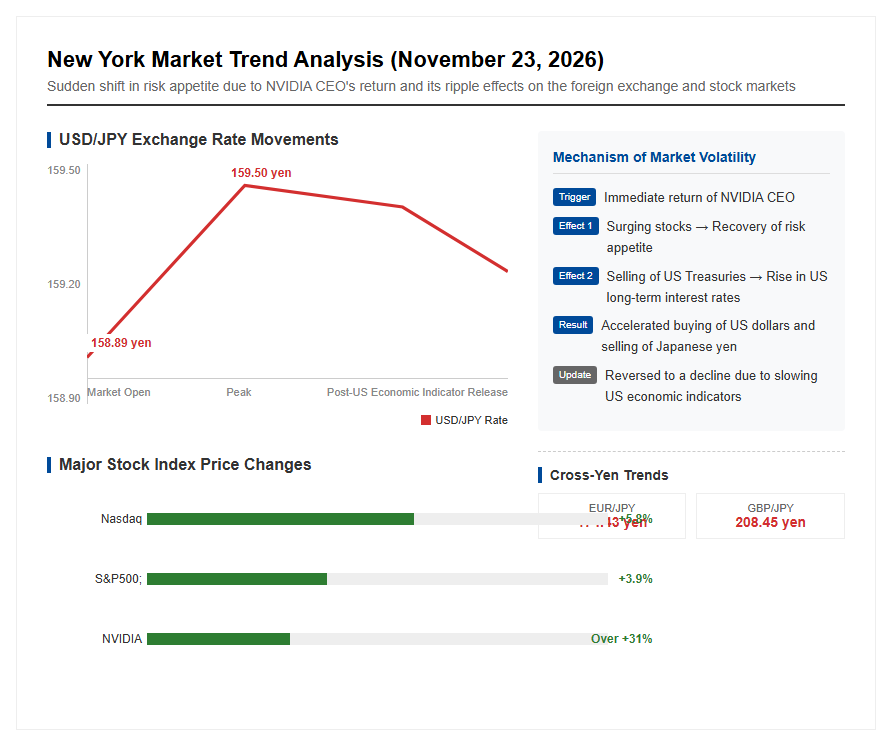
In the New York foreign exchange market on November 23, 2026, the USD/JPY exchange rate surged sharply from 158.89 yen to 159.50 yen. The primary driver of this dollar strength and yen weakness was news that the board of directors of the U.S. semiconductor giant NVIDIA had unanimously decided to immediately reinstate its founder, Jensen Huang—who had resigned due to a scandal—as President, CEO, and Director. As recent management uncertainty was rapidly resolved, risk aversion eased, leading to a phenomenal buyback of NVIDIA shares that exceeded 31 percent at one point during both after-hours and regular trading. Consequently, major stock indices saw a sharp rebound, with the Nasdaq Composite up 5.8 percent and the S&P 500 up 3.9 percent. Following this rapid recovery of risk appetite in the equity markets, U.S. Treasuries, which had previously been bought as safe-haven assets, were sold, driving up U.S. long-term interest rates. As interest rates rose, dollar buying and yen selling accelerated instantly, causing rapid yen depreciation across all cross-yen pairs, with EUR/JPY rising to 174.43 yen and GBP/JPY rising to 208.45 yen. The following image is an illustration of the sharp rebound in major market indices.
1-2 Dollar Retreat Driven by Weak U.S. Economic Indicators and Lower Oil Prices
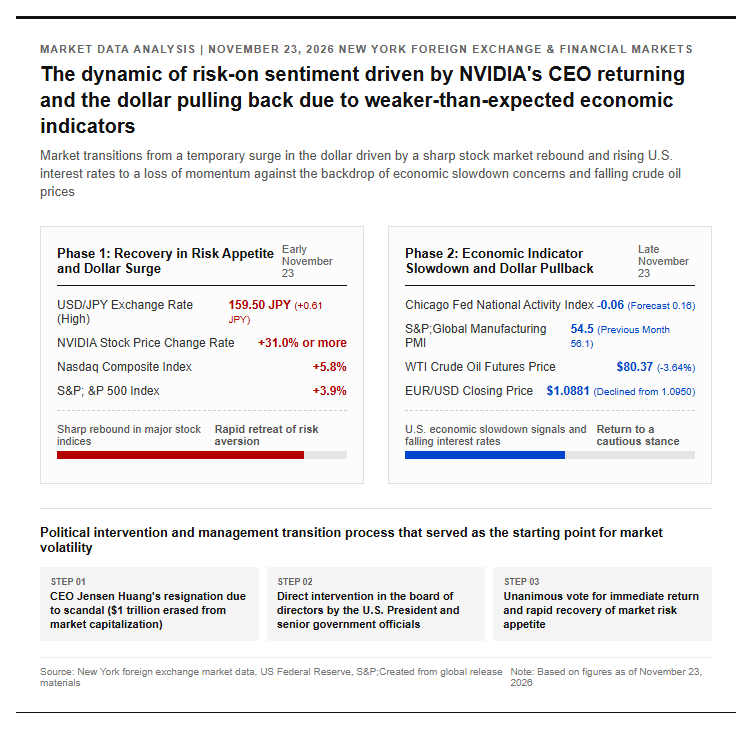
However, after being bought up to 159.50 yen, the USD/JPY pair lost momentum once the buying subsided and ended the session on a downward trend. The reason the dollar’s rise did not last was the slowing of key U.S. economic indicators announced on the same day. The Chicago Fed National Activity Index for October came in at -0.06, a clear deterioration from the market forecast of +0.16 and the previous month’s 0.05. Additionally, the S&P Global Manufacturing PMI preliminary reading for November was 54.5 and the Services PMI preliminary reading was 54.7, both declining from the previous month’s 56.1 and suggesting a slowdown in the U.S. economy. Furthermore, dollar-selling pressure was applied by WTI crude oil futures prices falling 3.64 percent to $80.37 per barrel amid increased crude oil supply from the Middle East, as well as a strong result in the 2-year U.S. Treasury auction that induced a decline in interest rates. As the rise in interest rates plateaued, the dollar’s upside became heavy, and the market returned to a cautious stance focused on the weak economic indicators, with EUR/USD also falling from $1.0950 to end at $1.0881.
Background of Market Trends and the Development of the NVIDIA Management Crisis
2-1 The Truth Behind CEO Huang’s Sudden Return via Political Intervention
Behind Mr. Huang’s sudden return after an 11-day absence was unusual direct intervention by U.S. President Trump. Mr. Huang had resigned on November 12 after admitting to an extramarital affair with a woman suspected of being a Chinese spy, an event that caused global market turmoil and wiped out more than $1 trillion in market capitalization over the following seven trading days. However, President Trump strongly requested his reinstatement to the board via social media and further exerted pressure by participating directly in the board’s conference calls and sending proxies to persuade them. When high-ranking U.S. government officials, such as Treasury Secretary Bessent and Commerce Secretary Lutnick, provided assurances to the board that “Mr. Huang’s return does not pose a national security risk,” the board—which had initially denied his return—performed a 180-degree turn and unanimously voted for his immediate reinstatement. The fact that the management crisis was being resolved under administration leadership provided temporary relief to the market. The following image is a conceptual diagram showing the involvement of the government and the semiconductor industry.
2-2 Overheating After Currency Intervention and the Persistent Influence of U.S. Interest Rates
On July 30 and 31, 2026, the USD/JPY pair had plummeted from a 39-year and 8-month high of 163.99 yen to as low as 155.23 yen following a coordinated yen-buying intervention (Phase 6) by Japanese and U.S. currency authorities, the first in approximately 28 years. However, persistent yen-weakening pressure remained even after the coordinated intervention, and maintaining the effects of the intervention has become a challenge, as the rate has recently climbed back into the 159 yen range. In the United States, expectations for interest rate hikes by the FRB remain strong against a backdrop of AI-driven inflation and economic resilience, creating an environment where rising high-tech stocks easily stimulate U.S. long-term interest rates. Because the interest rate differential between Japan and the U.S. remains wide, yen-selling/dollar-buying positions are easily rebuilt during phases where risk appetite in the stock market recovers; this recent rise to 159.50 yen is also driven by such structural factors.
The Future Potential of High-Tech Stocks and Key Market Focus Areas Ahead
3-1 Legal Risks and Challenges in Data Center Financing
Although tech stocks rebounded sharply following Huang’s return, vigilance cannot be lowered regarding remaining risk factors. NVIDIA is facing potential accounting scrutiny by the U.S. Securities and Exchange Commission (SEC), while ongoing investigations by the California Attorney General regarding export control violations and information leaks are underway. Furthermore, legal and political uncertainties remain, such as a U.S. Senate hearing scheduled for December 3 concerning export controls. In addition, soaring financing costs for large data centers and neo-cloud companies supporting AI infrastructure are viewed as problematic, and there are growing concerns that the worsening profitability of capital expenditures could lead to a slowdown in the AI boom. It remains unclear whether strong overall stock market gains can be sustained by stellar financial results alone.
3-2 Monetary Policies of Japan and the U.S. and Future Outlook for the Exchange Rate
The primary focus in the future foreign exchange market is the U.S. Federal Reserve’s policy rate decision and the timing of the Bank of Japan’s additional rate hike. If expectations strengthen that the Fed will implement further rate hikes to curb inflation, a scenario where the dollar-yen exchange rate temporarily tests the 160 yen range cannot be ruled out. However, the Bank of Japan also plans to proceed with rate hikes at a pace of roughly once every three months against the backdrop of underlying price increases, meaning an unlimited expansion of the Japan-U.S. interest rate differential is expected to be avoided. The cooperative stance of Japanese and U.S. monetary authorities also functions as a heavy lid capping the upside. Over the medium to long term, as AI investments settle down and the Japan-U.S. interest rate differential contracts, the dollar-yen exchange rate is expected to shift its trading range downward into the mid-150 yen range.
Reference Page
- [Investing.com] NY Forex Market Overview for November 23 (https://jp.investing.com/news/forex-news/article-1768224)
[#ForeignExchangeMarket #DollarYen #NVIDIA #USEconomicIndicators #FinancialMarkets]


コメント