
In November 2026, “Ignis,” a high-efficiency LLM inference engine for the NVIDIA RTX series, was released as open source. It is attracting significant attention from the developer community as a technology that enables the execution of advanced AI agents in edge environments and local browsers.
- The Arrival of the Edge AI Era and the Development Background of Ignis
- Proprietary Architecture Optimized for the NVIDIA RTX Series
- Inference Performance Delivering Overwhelming Processing Speeds
- Efficient VRAM Management and Compression Techniques
- Advanced Features and Safeguards to Support Agentic Workflows
- The Future of Browser-Based AI Driven by Open Source and Future Outlook
The Arrival of the Edge AI Era and the Development Background of Ignis
In recent years, with the rapid development of generative AI, interest in edge AI—running LLMs directly in local environments or web browsers for the purpose of ensuring security and privacy, reducing communication latency, and curbing cloud API costs—has been growing. Until now, high-performance cloud servers were considered essential for advanced AI processing, but thanks to advancements in model quantization technology and improvements in consumer GPU performance, an environment for running AI on personal workstations and local PCs is falling into place. Against this backdrop, Ignis was released as an open-source LLM inference engine in November 2026. Ignis was designed with the objective of running coding agents locally on PCs routinely used by developers, while sharing resources with web browsers and IDEs. It is expected to serve as a new infrastructure that achieves freedom from cloud dependency and allows sensitive code to be processed safely and at high speed in a developer’s local environment.
Proprietary Architecture Optimized for the NVIDIA RTX Series
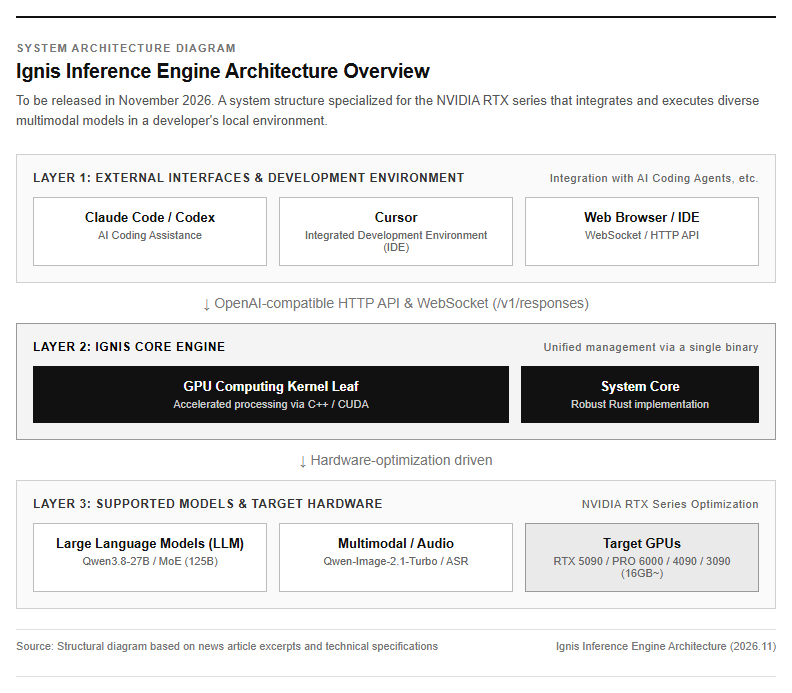
Rather than pursuing general-purpose versatility, Ignis achieves extreme processing speeds by specializing in NVIDIA RTX series graphics cards (RTX 5090, RTX PRO 6000, RTX 3090, RTX 4090, and RTX 40/50 series with 16GB VRAM classes). The core part of the system is implemented in robust Rust, while the kernel leaf parts responsible for GPU computation are built in C++ and CUDA. As external interfaces, it provides an OpenAI-compatible HTTP API as well as a high-speed WebSocket endpoint (/v1/responses), enabling smooth integration with modern AI coding agents such as Claude Code, Codex, and Cursor. It comprehensively supports everything from its mainstay language model, Qwen3.8-27B, to the MoE model Qwen3.8-Flash-Next boasting 125B parameters, the image generation model Qwen-Image-2.1-Turbo, and even the speech recognition model Qwen3-ASR running on the CPU, all within a single binary. Please refer to the system configuration diagram below.
Inference Performance Delivering Overwhelming Processing Speeds
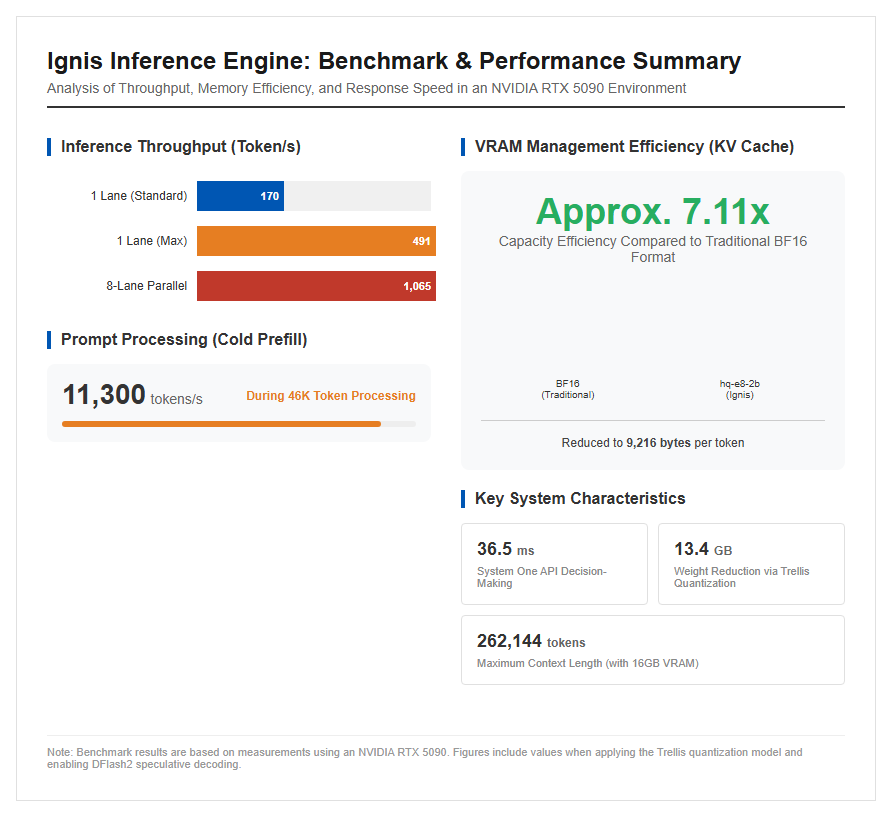
The greatest feature of Ignis lies in its overwhelming inference speed, which surpasses cloud-based services despite being a local environment. In benchmark tests using a single NVIDIA RTX 5090, with DFlash2 speculative decoding enabled, it recorded astonishing generation speeds of approximately 170 to 370 tokens per second for a single coding prompt (1 lane) processing, and up to 491 tokens per second depending on conditions. Furthermore, during 8-lane parallel processing where multiple sub-agents access simultaneously, it achieved a high total throughput of 1,065 tokens per second. In addition, for prompt processing (cold prefill) when a model reads a large amount of context, it processes massive 46K-token prompts at high speeds of approximately 11,300 tokens per second. It achieves speeds several times faster than conventional inference engines, providing an environment where developers can interact with AI in real-time without experiencing waiting times.
Memory Optimization and Implementation of Advanced Features
Efficient VRAM Management and Compression Techniques
The biggest challenge when running large LLMs in a local environment is VRAM (Video RAM) consumption. To solve this problem, Ignis introduces its own advanced memory management mechanism. For KV cache management, it adopts a quantization format called “hq-e8-2b,” which improves VRAM efficiency by approximately 7.11 times compared to the conventional 16-bit floating-point (BF16) format, reducing it to 9,216 bytes per token. This prevents memory pressure even when maintaining long contexts. Furthermore, by providing a Trellis quantization model that re-encodes the body at approximately 3 bits per weight, it achieves a 13.4GB reduction in size, enabling operation with an expansive context length of up to 262,144 tokens on GPUs equipped with 16GB of VRAM, such as the RTX 5060 Ti and RTX 5070 Ti. Additionally, it features a power-saving and memory-saving function that automatically unloads the model from VRAM and releases the memory to other applications if requests cease for five minutes.
Advanced Features and Safeguards to Support Agentic Workflows
Ignis is more than just a text generation engine; it is equipped with an advanced suite of security features and functionalities specifically designed for the operation of autonomous AI agents. It features “Reasoning Loop Guard” as a standard, which detects in real-time when an LLM falls into an identical output loop during its reasoning process and automatically rewinds the response during streaming to prompt a correction. This prevents issues where agents continue to consume unnecessary tokens. It also features the “System One API (/v1/decide),” which performs binary choices or score determinations directly from logits without generating tokens, completing decision-making processes in just approximately 36.5 milliseconds. Furthermore, it includes a built-in, browser-accessible integrated WebUI (Playground) and a real-time system monitor, allowing users to grasp VRAM usage plans and throughput at a glance. Please refer to the management screen image below.
The Future of Browser-Based AI Driven by Open Source and Future Outlook
The arrival of Ignis represents a groundbreaking step that greatly expands the possibilities for AI utilization in web browsers and local PCs. By simply launching a single binary, users gain access to an ecosystem that encompasses text generation, image generation, speech recognition, and advanced coding assistance. In particular, its fully local architecture—where user personal information and corporate confidential code are never transmitted to external servers—serves as a powerful option for development environments requiring strict data governance. While optimization is currently focused on the NVIDIA architecture, further evolution is expected, including deeper integration with WebGPU technology, broader hardware compatibility, and the stabilization of ultra-large context processing. As development progresses within the open-source community, the spread of free and secure personal AI environments that do not depend on centralized cloud AI services will accelerate.
Reference Pages
- [Ignis Official GitHub Repository] https://github.com/gpillon/ignis
[#AI #LLM #OpenSource #GPU #WebTech #NVIDIA]


コメント