GPT-6.2, announced by OpenAI in November 2026, designed protein three-dimensional structures and amino acid sequences without using specialized biology AI, and successfully demonstrated binding in a laboratory setting. This development is driven by improvements in the reasoning capabilities of general-purpose AI and strong demand for natural language-based molecular design.
- Key points of the announcement and the evolution of the GPT-6 series
- Binding success rates and target-specific results in laboratory tests
- Computational benchmark evaluation in structure prediction and docking
- Combination with specialized AI tools and current limitations
- Impact on Drug Discovery Pipelines and Precision Biology
- Challenges Toward Practical Application and Future Focus Areas
Key points of the announcement and the evolution of the GPT-6 series
On November 24, 2026, OpenAI released a preprint paper titled “GPT-6 as a Universal Foundation Model for Protein Biology: Beyond Specialized Models.” Conventionally, task-specific biology AI such as AlphaFold, RFdiffusion, and ProteinMPNN has been considered indispensable for protein structure prediction and molecular design. However, this study demonstrated that the GPT-6 series (GPT-6, GPT-6.2, and an unreleased internal research model) can design novel protein structures and amino acid sequences using only reasoning capabilities and general-purpose coding tools, without directly calling specialized AI models. As large language model generations advance, task processing capabilities in the life sciences domain have improved remarkably, with a major feature being that researchers can flexibly control and specify target binding positions and shapes simply by giving conditions in natural language prompts.
Binding success rates and target-specific results in laboratory tests
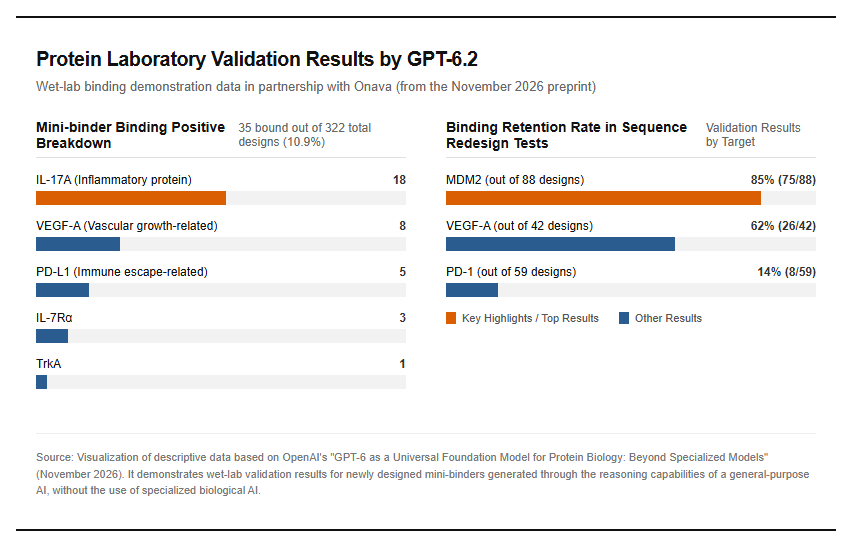
Moving beyond theoretical design, testing was conducted to synthesize and validate proteins in an actual laboratory (wet lab) through a partnership with biotechnology company Onava. Of the 322 minibinders (small binding proteins) designed by a pre-release version of GPT-6.2, 35 (10.9%) were confirmed to actually bind to the target protein. The breakdown of binding-positive results across the five validated targets consisted of 18 for the inflammatory protein IL-17A, 8 for VEGF-A (involved in blood vessel growth), 5 for PD-L1 (involved in immune evasion), 3 for IL-7Rα, and 1 for TrkA. Furthermore, in amino acid sequence redesign tests based on known three-dimensional structures, binding capacity was maintained for 75 out of 88 designs (85%) in MDM2, 26 out of 42 designs (62%) in VEGF-A, and 8 out of 59 designs (14%) in PD-1. Notably, the demonstration of binding with amino acid sequences significantly different from the original sequences in an undisclosed PD-L1 structure is seen as strong evidence that AI possesses generalization performance to adapt to unknown structures rather than merely rote-memorizing training data. The figure below illustrates the binding process and results for each target in the laboratory validation.
Computational performance comparison and division of roles with specialized AI
Computational benchmark evaluation in structure prediction and docking
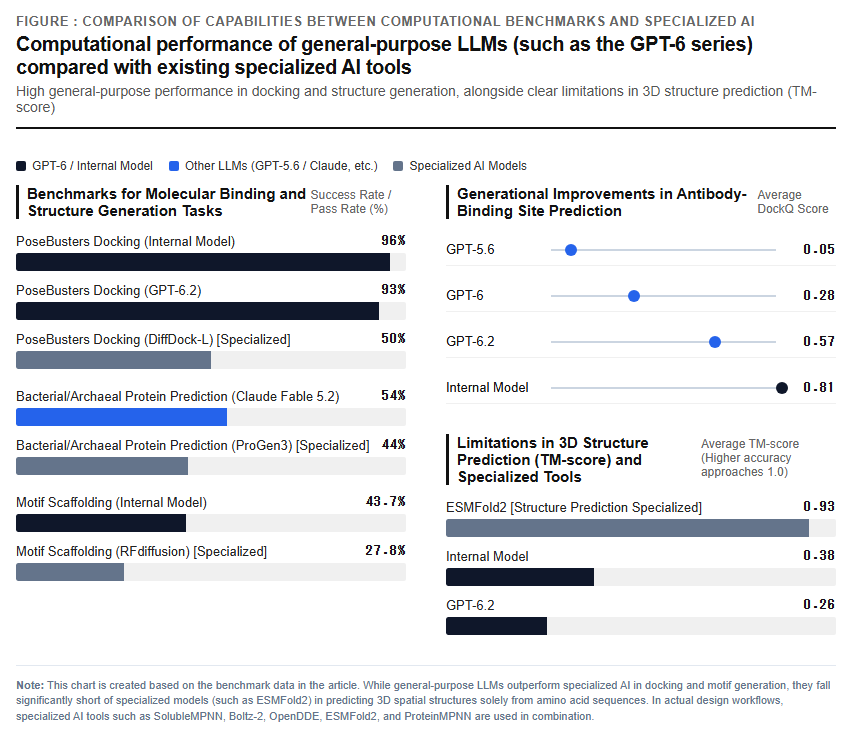
In computational benchmark tests, the GPT-6 series demonstrated high performance equivalent to or exceeding that of specialized AI across various biological tasks. In the “PoseBusters” docking test, which predicts the binding modes between molecules, GPT-6.2 achieved a success rate of 93% and the internal research model achieved 96%, significantly outperforming the specialized model DiffDock-L at 50%. In motif scaffolding tasks—which involve constructing an entire structure while maintaining a specific functional structure—the internal model recorded a pass rate of 43.7%, surpassing RFdiffusion’s 27.8%. Furthermore, the average DockQ score for antibody binding site prediction showed a dramatic improvement across generations, going from 0.05 for GPT-5.6 to 0.28 for GPT-6, 0.57 for GPT-6.2, and 0.81 for the internal model. The extension of capabilities across general-purpose LLMs as a whole has also been confirmed by competing Anthropic’s Claude Fable 5.2, which recorded 54% accuracy in amino acid prediction for 668 unknown bacterial and archaeal proteins, outperforming the specialized model ProGen3 at 44%.
Combination with specialized AI tools and current limitations
On the other hand, general-purpose AI has clear weaknesses and limitations. In evaluations predicting overall three-dimensional structures solely from amino acid sequences (TM-score), GPT-6.2 averaged 0.26 and the internal model reached only 0.38, results that fall far short of ESMFold2’s 0.93 as a structure-prediction-specialized model. In addition, the entire design process this time was not completed entirely “without specialized AI”; specialized AI tools such as SolubleMPNN, Boltz-2, OpenDDE, ESMFold2, and ProteinMPNN were used in combination for sequence generation and candidate filtering. OpenAI itself acknowledges that complete de novo design was not achieved single-handedly without the help of specialized models, and that in vitro binding confirmation is only an initial stage, with further research required to verify the specificity, stability, biological activity, and safety necessary for actual drug discovery. The architectural diagram below depicts the cooperative workflow between general-purpose AI and existing specialized tools.
Social significance and future outlook
Impact on Drug Discovery Pipelines and Precision Biology
The involvement of general-purpose AI in protein design through reasoning and prompt manipulation has the potential to bring a massive transformation to the traditional drug discovery pipelines of the pharmaceutical and biotechnology industries. An environment is being established where even researchers lacking the specialized expertise to master complex software can specify molecular properties in plain natural language to perform initial design proposals and candidate screening. According to forecasts by market research firm Astute Analytica, the global market for AI protein design is expected to expand rapidly from USD 1.5 billion in 2025 to USD 12.4 billion by 2035 (a CAGR of 23.2%), and the emergence of new development platforms that combine general-purpose AI with existing specialized models is expected to further accelerate this technological innovation and market growth.
Challenges Toward Practical Application and Future Focus Areas
To move toward practical application, OpenAI has identified three priority challenges to address: the discovery of minibinders for difficult targets that were hard to reach with conventional methods, the design of molecules with biological effects—such as the destruction of cancer cells upon binding—and the diversification of target molecules, including RNA, small molecules, and PROTACs (Proteolysis Targeting Chimeras). At the same time, to address concerns about the potential misuse of advanced molecular design capabilities, the assessment and management of biosecurity risks based on the Preparedness Framework are underway. Furthermore, in advancing generated biopharmaceuticals into actual preclinical and clinical trial stages, rigorous verification via comprehensive quality assurance frameworks like BioChk—which comply with FDA GMLP (Good Machine Learning Practice) and cGMP (current Good Manufacturing Practice)—and Human-in-the-Loop evaluation will be indispensable.
Reference Pages
- [OpenAI Official Announcement: Protein Design Capabilities in GPT-6 Models] https://openai.com/index/gpt-6-models-demonstrate-intrinsic-protein-design-capabilities/
- [Nature Article: New Biological Skills for Claude and ChatGPT] https://www.nature.com/articles/d41586-026-03836-z
[#GPT6 #ProteinDesign #GenerativeAI #DrugDiscoveryAI #Biotechnology #OpenAI]


コメント