Sumitomo Electric Industries has unveiled a mass-production system and high-precision fusion splicing technology at its Yokohama Works for submarine “2-core optical fibers” that double the transmission capacity of conventional fibers. The backdrop to this is the surge in international data communication traffic driven by the rapid adoption of generative AI, alongside the growing need to increase the capacity of submarine infrastructure, which faces constraints on installation space.
- Key points of the event and the mass production site unveiled at the Yokohama Plant
- How Multi-Core Technology Doubles Capacity Without Changing the Outer Diameter of a Single Fiber
- Proprietary Technology for Estimated Loss Detection and Tensile Testing to Prevent Subsea Disconnections
- The VAD Method Supporting Global Communications and the Bottlenecks in Optical Fiber Manufacturing
- The Surge in International Communication Traffic and Sumitomo Electric’s Business Restructuring
- Crosstalk Challenges in 4-Core Scaling and Future Prospects for High-Capacity Optical Communications
Key points of the event and the mass production site unveiled at the Yokohama Plant
Sumitomo Electric Industries, Ltd. (Sumitomo Electric) unveiled to the press at its Yokohama Works a mass production system for next-generation submarine “2-core optical fibers,” which achieve double the transmission capacity of conventional fibers, as well as advanced fusion splicing technology designed to withstand harsh marine environments. This media coverage was conducted as part of a press tour for foreign media titled “The Current State of Japan’s Submarine Cables Connecting the World,” hosted by the Ministry of Foreign Affairs and operated and assisted by the Foreign Press Center Japan (FPCJ). Currently, only three manufacturers worldwide are capable of supplying optical fibers for submarine optical cables that connect continents across oceans, with Sumitomo Electric boasting a world-class market share of approximately 40% among them. The company announced that it will supply 2-core optical fibers for “Petal,” a transatlantic commercial submarine cable project involving Meta, NEC, and others, in September 2026, and full-scale production of the commercial products is indeed underway at the showcased Yokohama Works. This event marked a clear demonstration that Japan’s material and manufacturing technologies—having pursued techniques to minimize optical signal loss to the absolute limit for some 40 years—have entered a practical implementation stage as the core of the international telecommunications infrastructure supporting the rapid expansion of generative AI.
How Multi-Core Technology Doubles Capacity Without Changing the Outer Diameter of a Single Fiber
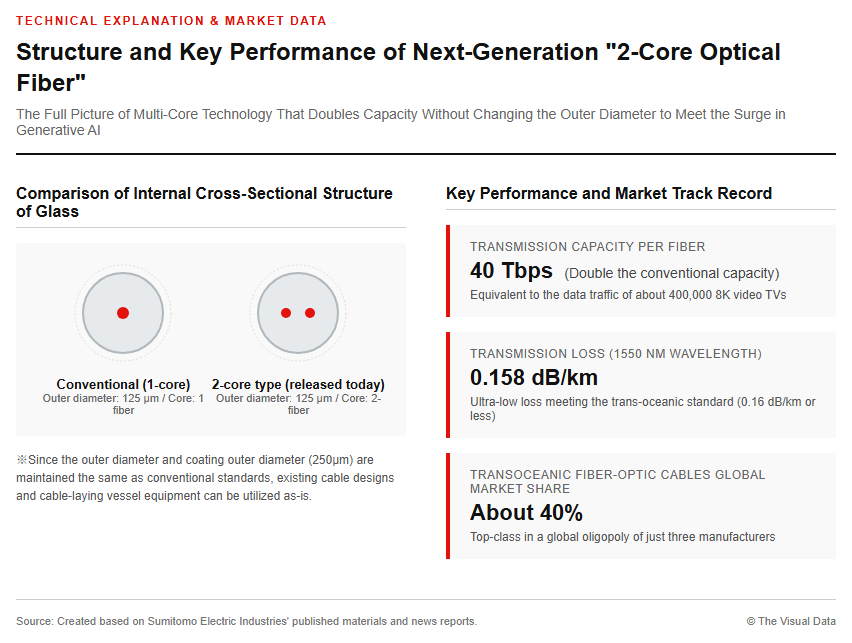
Typical communication optical fibers have only a single “core” with a diameter of about 10 micrometers—acting as the pathway for optical signals—located in the center of silica glass with an outer diameter of 125 micrometers (0.125 millimeters). In contrast, Sumitomo Electric’s “2C Z-PLUS Fiber ULL,” which has successfully achieved world-first mass production, incorporates two independent pure silica glass cores inside a glass structure with the same 125-micrometer outer diameter as conventional products. By increasing the number of optical pathways to two, the transmission capacity per fiber is, by simple calculation, doubled compared to conventional fibers. Its transmission capability reaches 40 terabits per second per fiber—equivalent to the data volume of about 400,000 8K TVs—and is capable of transmission over transoceanic distances of several thousand kilometers or more. Furthermore, the transmission loss at a wavelength of 1550 nanometers is an extremely low 0.158 dB/km, meeting the ultra-low loss standard of 0.16 dB/km or less applicable to transoceanic submarine fiber-optic cables. Another major practical advantage is that both the glass outer diameter and the coating outer diameter (250 micrometers) comply with standard specifications, allowing existing cable designs, production lines, and marine cable-laying vessel equipment to be used as-is. Please refer to the figure below for details on the cross-sectional structure and multiplexing.
.
High-Precision Connectivity and Manufacturing Infrastructure Tackling Harsh Subsea Environments
Proprietary Technology for Estimated Loss Detection and Tensile Testing to Prevent Subsea Disconnections
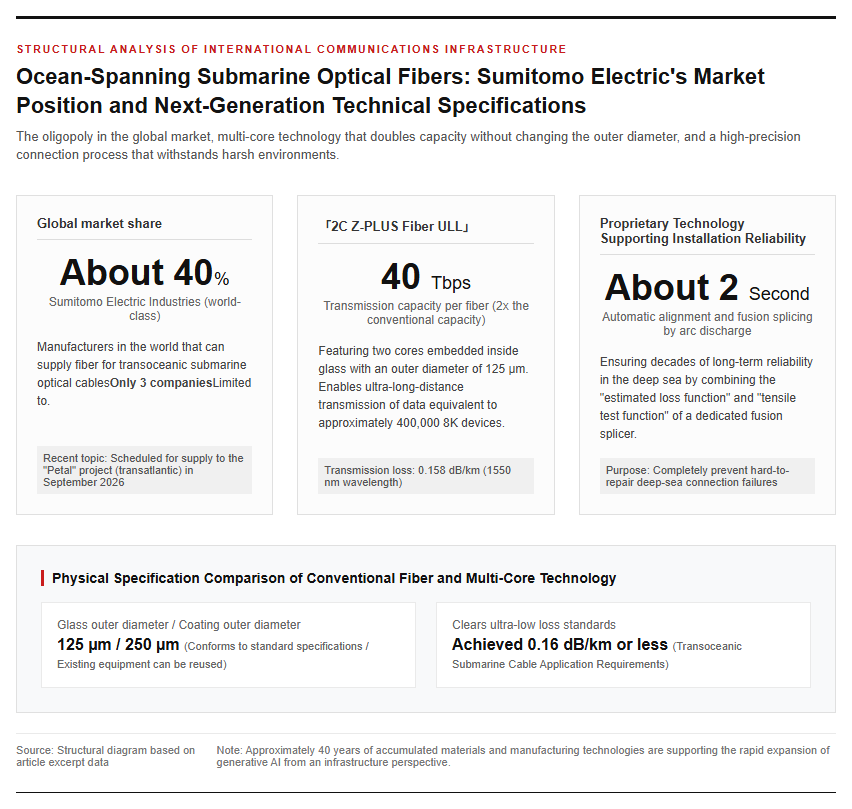
Subsea cable splicing work is performed in extremely harsh environments, such as on cable-laying vessels rocking in the waves. If a connection failure or breakage occurs in a cable once it has been laid thousands of meters deep on the ocean floor, retrieving and re-installing it takes several months and enormous costs, making it crucial to absolutely prevent operational errors during the construction phase. To address this challenge, Sumitomo Electric has incorporated two proprietary technologies into its newly developed fusion splicer exclusively designed for multi-core optical fibers. The first is the “estimated loss function,” which automatically aligns the positions of the two cores in the rotational direction while observing the end faces of the opposing fibers with a camera, performs fusion splicing via arc discharge in about two seconds, and then automatically analyzes the optical loss of each core with high precision. If the criteria are not met, the splice can be redone immediately on the spot. The second is the “tensile test function,” which rigorously inspects the physical strength of the spliced section by mechanically pulling the fiber immediately after splicing. This ensures long-term reliability, enabling the cable to withstand the strong tension applied during laying and years of stress from deep-sea currents without breaking underwater for decades. Please refer to the figure below for an overview of the splicing process.
.
The VAD Method Supporting Global Communications and the Bottlenecks in Optical Fiber Manufacturing
At the Yokohama Works tour, the preform manufacturing and drawing processes using the Vapor-phase Axial Deposition (VAD) method, which has supported Japan’s optical fiber industry, were also showcased. The VAD method was developed in Japan and is a technology used in approximately 60% of the world’s optical fiber manufacturing. It involves reacting raw materials such as silicon tetrachloride in an oxyhydrogen flame to deposit ultra-high-purity glass particles, forming a preform (soot) that is then vitrified into transparent glass at high temperatures. The completed preform is hung in a vertical drawing tower, melted in a high-temperature furnace at about 2,000 degrees Celsius, drawn into an extremely fine wire with an outer diameter of 0.125 millimeters, and coated with resin. However, dissecting the entire optical fiber supply chain reveals that the biggest supply bottleneck lies in the furnaces used to bake and solidify the preforms. Constructing or expanding these furnaces requires years of time and massive investment, and research reports as of 2026 point out that the preform and fiber drawing capacity in the United States is operating at full capacity. A situation has arisen where the demand for ultra-high-fiber-count cables—bundling thousands of fibers inside data centers—and the demand for ultra-low-loss submarine fibers connecting continents compete for the same preform furnaces, making Sumitomo Electric’s end-to-end supply capacity, spanning everything from preforms to fibers and connection equipment, a global focal point.
Social Implementation in the Generative AI Era and Prospects for Next-Generation Infrastructure
The Surge in International Communication Traffic and Sumitomo Electric’s Business Restructuring
Driven by the widespread adoption of video streaming and cloud services, as well as the rapid rise of generative AI, communication traffic flowing between large-scale data centers worldwide continues to grow at an annual rate of approximately 30%. Submarine optical cables account for a staggering 99% of international data communications, making the expansion of transcontinental transmission routes an urgent priority for sustaining the global economy’s digital infrastructure. Founded in 1897, Sumitomo Electric—with consolidated net sales of approximately ¥5.1 trillion and around 300,000 group employees—is rapidly focusing and reallocating its management resources against the backdrop of this massive technological wave. The company is currently driving structural business reforms to double the information and communications segment’s share of overall operating profit from approximately 20% in fiscal 2025 to about 40% in fiscal 2028. Furthermore, regarding overseas operations, it is making aggressive investments, including expanding production capacity for data center optical connectivity products at its manufacturing base in Da Nang, Vietnam, by 2.5 times by fiscal 2028. By capturing both its advantage as an oligopolistic supplier of submarine infrastructure and the surging demand for data center cabling, the company aims to transform its corporate structure into one centered on high-margin businesses.
Crosstalk Challenges in 4-Core Scaling and Future Prospects for High-Capacity Optical Communications
Following its commercialized 2-core optical fiber, Sumitomo Electric is advancing the development of 4-core optical fiber with an eye toward even greater capacity. However, the company faces a physical challenge: the more the number of cores is increased inside an optical fiber, the more susceptible it becomes to “crosstalk” (inter-core crosstalk), a phenomenon where optical signals leak from adjacent cores and cause noise. To achieve long-distance transmission, it is necessary to simultaneously maintain ultra-low transmission loss, strictly suppress crosstalk, and achieve advanced manufacturing precision capable of withstanding mass production. In cutting-edge research, Sumitomo Electric and the National Institute of Information and Communications Technology (NICT) have steadily pioneered the technological foundation for the future, such as achieving a world record for a 1.02 petabit-per-second, 1,808 km transmission using a 19-core optical fiber with a standard outer diameter of 125 micrometers. Furthermore, for terrestrial optical networks, NTT established side-image alignment technology for 4-core multi-core optical fibers and fan-in/fan-out (FIFO) devices using silica-based PLC waveguides in November 2024, setting a goal for practical deployment and international standardization around 2027. With the establishment of an ecosystem that integrates connection, wiring, and operational technologies in addition to improving the performance of the fiber itself, the renewal of global large-capacity communication infrastructure toward 2030 is expected to accelerate.
Reference Page
- [World’s First: Success in Mass Production of Ultra-Low-Loss Multi-Core Optical Fiber | Sumitomo Electric] https://sumitomoelectric.com/jp/press/2023/09/prs115
- 【Received the “MM Research Institute Award 2026 Special Jury Prize” ~World’s First Mass Production of Submarine Multi-Core Optical Fiber, Contributing to the Expansion of Global Communication Capacity~ | Sumitomo Electric】https://sumitomoelectric.com/jp/press/2026/08/prs097
- 【World Record Updated: Achieved 1,808 km Transmission at 1.02 Petabits per Second Using a 19-Core Optical Fiber with Standard Outer Diameter ~Hopes for Realizing Future Long-Distance, High-Capacity Optical Communication Infrastructure~ | Sumitomo Electric】https://sumitomoelectric.com/jp/press/2025/04/prs056
- 【NTT Introduces Lineup of Construction, Operation, and Maintenance Technologies for Multi-Core Optical Fiber, Achieving 4x Capacity with a Single Optical Fiber | NTT】https://group.ntt/jp/newsrelease/2024/11/15/241115a.html
【#SumitomoElectric #OpticalFiber #MultiCoreFiber #SubmarineCable #GenerativeAI #InformationAndCommunications #TelecomInfrastructure】


コメント