The restrictions on Anthropic’s cutting-edge AI models, “Claude Fable 5” and “Claude Mythos 5,” which had been suspended worldwide due to U.S. government export control directives, have been lifted and services have resumed. Behind this unusual halt and resumption is a geopolitical shift where cutting-edge AI has begun to be regarded as a strategic asset for national security.
- The dramatic comeback of the most powerful AI in history
- The Technical Standings of Fable 5 and Mythos 5
- National Security Intervention Triggered by ‘Jailbreak’
- AI Turning into a Strategic Resource and the Barrier of ‘Deemed Export’
- Exposed vulnerabilities in the AI supply chain
- Future Developments: Entering an Era Where Supply Stability Is Called into Question
The dramatic comeback of the most powerful AI in history
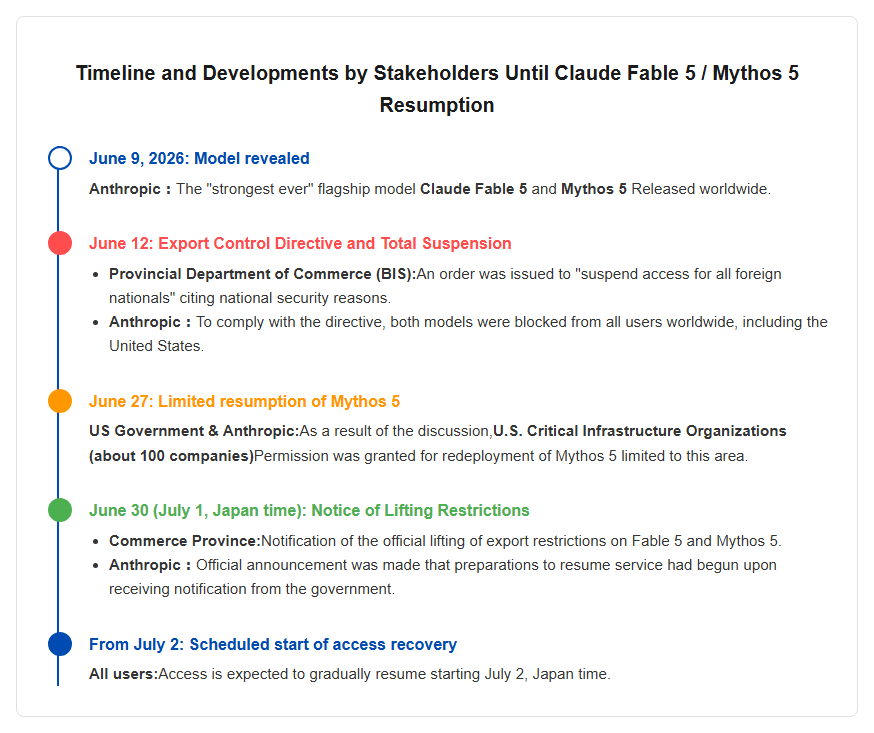
On July 1, 2026, Anthropic, a leading AI developer in the US, announced that export restrictions on “Claude Fable 5” and “Claude Mythos 5” by the U.S. Department of Commerce had been lifted. In Japan time, access is scheduled to gradually resume starting July 2, 2026. This model was the flagship model the company had just grandly released on June 9, 2026, as “the highest-performance model ever publicly unveiled.” However, just three days after the publication, at 5:21 p.m. (Eastern Time) on June 12, a letter from the Bureau of Industrial Security (BIS) of the U.S. Department of Commerce changed the situation. Based on national security authority, they were ordered to immediately suspend access to foreign users. To comply with this legal order, Anthropic was forced to temporarily suspend the global supply of both models. This regulatory release was achieved after about three weeks of discussions with the government, marking the return of the AI once hailed as the most powerful in history. The following images summarize the actions of various parties when the resumption of service was announced.
The Technical Standings of Fable 5 and Mythos 5
The two models subject to regulation and decided to resume are Anthropic’s top-tier model, the “Claude Fable 5,” and its sister model, the “Claude Mythos 5.” Both use the same base model but differ in their applications and safety designs. Fable 5 is a model made available to general users and enterprises, designed to activate a built-in safety classifier and reject answers in high-risk areas such as bio and cybersecurity. In contrast, Mythos 5 is a model offered exclusively to carefully selected and trusted organizations such as cybersecurity firms and critical infrastructure operators. To maximize defense capabilities, some restrictions have been lifted, and on June 26, 2026, it was reopened in a limited manner for about 100 critical infrastructure organizations in the United States, ahead of the general Fable 5. Fable 5 is known for its coding, complex financial and legal analysis, and massive context window processing power spanning one million tokens, and the market has been eagerly awaiting the return of its overwhelming reasoning capabilities.
Geopolitical risks highlighted by regulations
National Security Intervention Triggered by ‘Jailbreak’
The unprecedented situation where the government forcibly halted the provision of commercial AI models was triggered by the discovery of a “jailbreak” technique that bypassed Fable 5’s safety mechanisms. According to reports, the direct trigger for the ban was when Andy Jassie, CEO of Amazon and a competitor, demonstrated and reported to the White House a method to bypass the safety controls of the Fable 5. The government took the possibility that entering specific prompts could expose vulnerabilities that could be exploited for cyberattacks. In response, Anthropic argued that the identified vulnerabilities were minor and could be replicated in other public models, but as a result, the logic of “national security” outweighed business logic. The lifting of these restrictions was prompted by Anthropic’s close coordination with the government on strengthening security measures and addressing risks in order to obtain approval from the Department of Defense (Pentagon) and the National Security Agency (NSA).
AI Turning into a Strategic Resource and the Barrier of ‘Deemed Export’
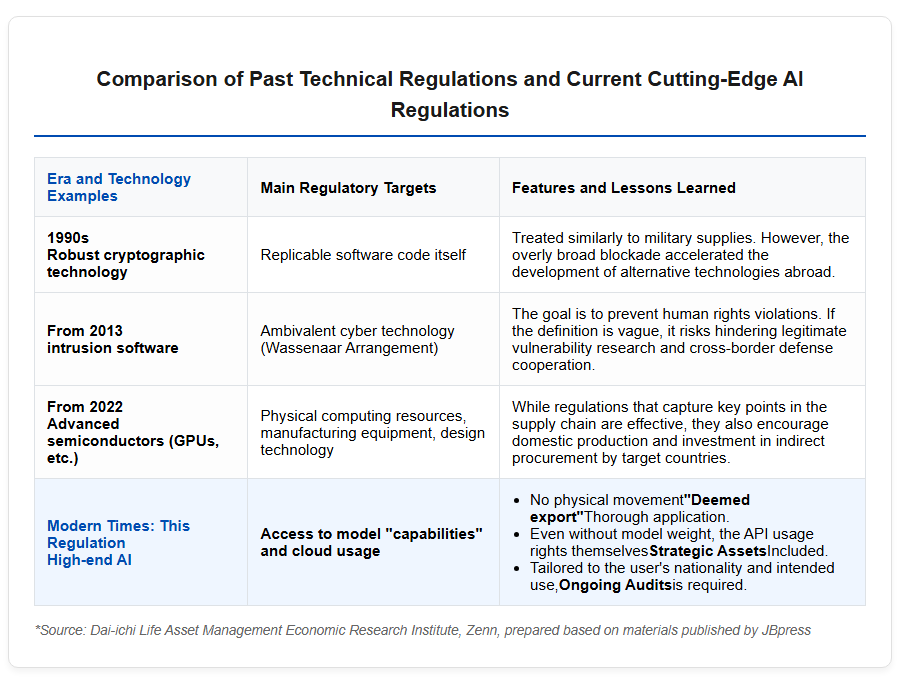
The most notable aspect of this incident was that the regulation extended not only to those outside the United States but also to foreigners residing within the United States. The U.S. government applied the concept of “deemed export,” banning even foreign employees working at Anthropic from accessing the eligible models. As a result, companies were forced to restrict access to technology based on nationality, putting the global development system itself at risk. High-end AI has now transformed into a “strategic technology” where the state manages distribution, much like the encryption technology and advanced semiconductors of the past. The U.S. positions AI capabilities as dual-use technologies for both military and civilian use, beginning to leverage access to cutting-edge models as bargaining assets in diplomacy and security. The table below compares the nature of past technology regulations with the current AI regulations.
Business and future lessons
Exposed vulnerabilities in the AI supply chain
The sudden shutdown of Claude Fable 5 shattered the AI market’s unconscious assumption that “if technically skilled, it can be freely available in the market.” In particular, it has become clear that for financial institutions and companies supporting critical infrastructure, excessive reliance on specific AI providers can become a “single point of failure.” In the pre-IPO market, where Anthropic’s unlisted valuation is traded, valuations temporarily dropped by about 3–3.7% following news of the suspension, prompting investors to factor in regulatory risks as a discount factor. AI models are no longer standalone software; they are built on a supply chain where cloud infrastructure, computing resources, and government regulations are intricately intertwined. Users no longer view situations like this as “temporary troubles,” but have entered an era where they must permanently consider the risk that AI infrastructure itself could become unusable in a short period due to geopolitical conflicts.
Future Developments: Entering an Era Where Supply Stability Is Called into Question
The resumption of Fable 5 will bring the confusion to a close, but the evaluation criteria for AI usage going forward will shift significantly. Until now, pure “performance” and “cost” have been emphasized, but going forward, “regulatory resistance” that can withstand government intervention and “supply stability” of services will become key selection criteria. For Japanese companies as well, rather than relying 100% on a specific U.S.-made AI model, securing a “multi-model strategy” that uses multiple models and securing “sovereign alternative pathways” that can maintain critical functions domestically is an essential challenge. Furthermore, as competitor OpenAI emphasizes close collaboration with the government through its cyber defense program “Daybreak,” AI companies will increasingly rely on how they align with national security policies and earn trust in the future. The revival of Fable 5 can be seen as a true event symbolizing the true dawn of the “AI geopolitical era,” where AI and the state have become inseparable.
[#Anthropic #Claude #生成AI #国家安全保障 #輸出規制 #地政学]
_en.png)
コメント