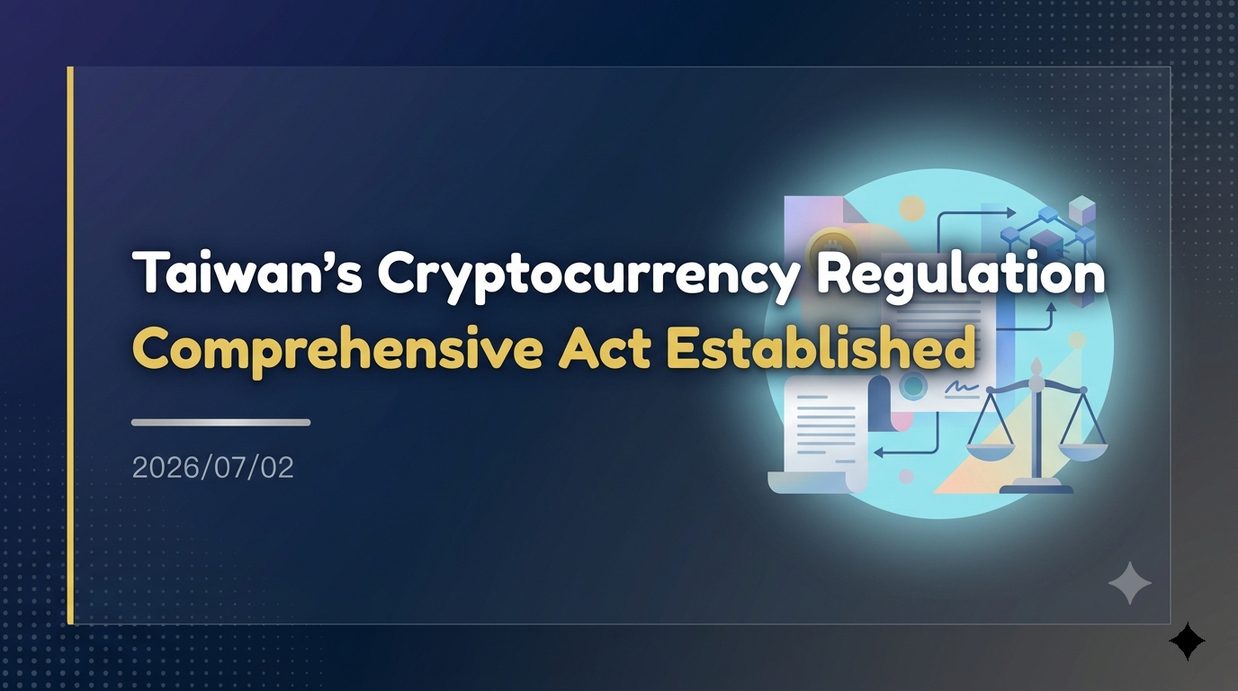
On June 30, 2026, Taiwan’s Legislative Yuan passed a new law comprehensively regulating cryptocurrency-related businesses, the Virtual Asset Services Act (Virtual Asset Services Act). This marks a major shift from traditional anti-money laundering regulations to a strict licensing system aimed at business operations and improving market order.
- Full transition from registration to permit system
- Mandatory internal controls and customer asset protection
- Dual Authorization System for Stablecoins
- Penalties for fraudulent acts at the highest level of financial legislation
- Lifting restrictions on financial institutions and industry restructuring
- Schedule for full-scale operation in 2027
Full transition from registration to permit system
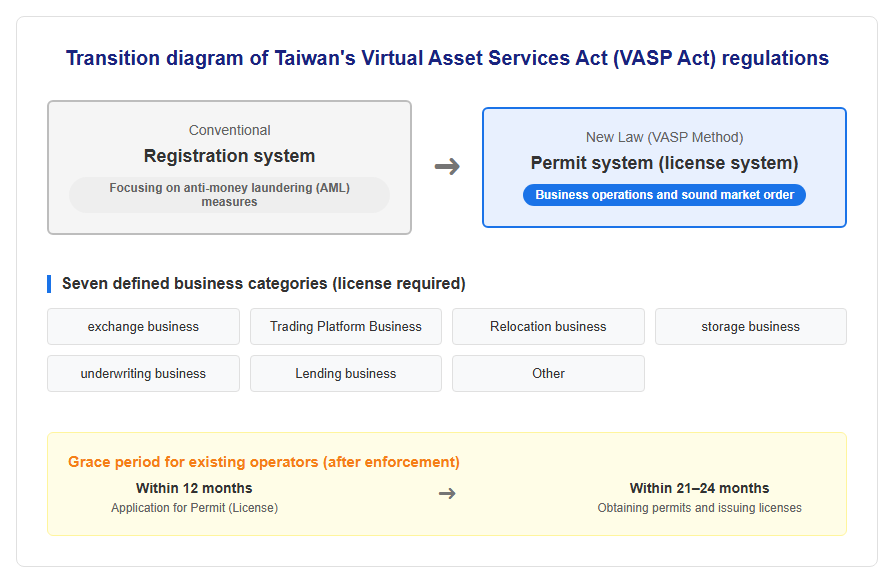
With this legislation, regulations on Virtual Asset Service Providers (VASPs) in Taiwan have been fully upgraded from a mere “registration system” aimed at anti-money laundering to a “permit system” involving prior review by financial authorities. The new law clearly defines businesses into seven categories: exchange businesses, trading platform businesses, transfer businesses, custody businesses, underwriting businesses, lending businesses, and others. To operate these businesses, it is mandatory to obtain licenses from Taiwan’s Financial Supervisory Commission (FSC) according to the specific types of operations. With this transition to a licensing system, business structures that previously operated in regulatory gray zones will no longer be permitted, and market transparency is expected to improve significantly. For existing businesses, there is a grace period to apply for a permit within one year after enforcement and to obtain a license within a total of 21 to 24 months. Please refer to the diagram below.
Mandatory internal controls and customer asset protection
Under the new legal system, not only is the financial and operational appropriateness of businesses accountable, but the qualifications of management and business personnel are also strictly reviewed. Businesses will be required to establish internal controls and audit systems, build cybersecurity management frameworks, and even formulate business continuity plans. A particularly important point is that it has become mandatory to clearly separate and manage customer assets and the operator’s own assets. Additionally, establishing objective review mechanisms for cryptocurrency listings and delistings, as well as submitting regular financial reports, are also mandatory. These measures aim to fully protect consumer assets and raise the level of governance for operators to the level of traditional financial institutions, following incidents like the FTX scandal in the past. Furthermore, businesses are required to join industry associations (self-regulatory groups), establishing a system that ensures market integrity from both public and self-regulatory perspectives.
Maintaining Market Health and Strict Penalties
Dual Authorization System for Stablecoins
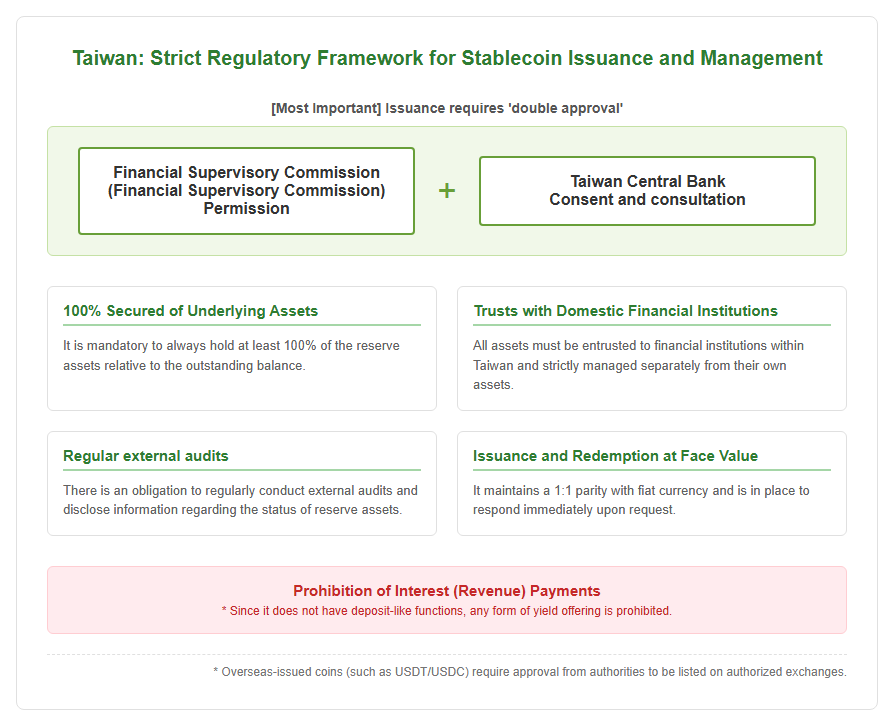
Regarding stablecoin regulation, a particularly strict “dedicated chapter” has been established to protect financial stability and currency sovereignty. To issue and manage stablecoins pegged to fiat currency within Taiwan, in addition to approval from the Financial Supervisory Commission, “dual authorization” is required, involving the consent of the Taiwan Central Bank. Issuers are required to hold at least 100% of their reserve assets relative to their outstanding balances and to entrust them fully with domestic financial institutions for segregated management. Additionally, to prevent stablecoins from having deposit-like functions, any form of interest or income payment was explicitly prohibited. Stablecoins issued overseas, such as USDT and USDC, are also subject to regulation, and listing on authorized exchanges requires approval from authorities. By establishing such strict rules, the aim is to ensure the reliability of the payment method while preventing systemic risks from occurring in advance. Please refer to the diagram below.
Penalties for fraudulent acts at the highest level of financial legislation
Acts that undermine market fairness are subject to some of the most severe criminal penalties within Taiwan’s financial legislation. In particular, for market manipulation such as price manipulation, spreading false information, and fraudulent acts, the penalty is imprisonment of 3 to 10 years, and additional fines ranging from 10 million to 200 million Taiwan dollars (about 1 billion yen) may be imposed. Providing virtual asset services without permission or issuing stablecoins without approval can result in up to seven years in prison or a fine of 100 million Taiwan dollars (about 500 million yen). These stricter penalties are intended to strongly deter underground trading and opaque market manipulation. Legislative Yuan Vice President Chiang Chi-chen stated that this legal amendment marks a new milestone in the legalization of virtual asset regulation and comprehensively strengthens the protection of citizens’ assets.
Transformation of the Financial Ecosystem and Future Outlook
Lifting restrictions on financial institutions and industry restructuring
One major change accompanying the enactment of the new law is the lifting of the ban on traditional financial institutions such as banks and securities firms offering virtual asset services concurrently. This allows financial institutions that meet certain conditions to obtain licenses themselves and enter operations such as exchange and custody operations. For existing crypto-native companies, traditional financial institutions with strong capital and reliability will become competitors, leading to fierce market competition. On the other hand, there are also concerns that financial holding companies may enter the market through subsidiaries, and partnerships between existing compliant platforms and financial institutions may advance. However, since financial institutions are subject to strict capital adequacy requirements based on Basel Bank Supervisory Commission standards, each company must carefully balance risk management capabilities with costs. This transformation can be seen as a symbolic move to incorporate cryptocurrencies into formal financial markets.
Schedule for full-scale operation in 2027
The enactment of the Virtual Asset Services Act has propelled Taiwan to the status of an advanced region with a clear legal framework for digital assets, alongside Japan, Singapore, and Hong Kong. Looking ahead, the FSC will need to formulate about nine subordinate laws (enforcement regulations) for full enforcement by early 2027. Additionally, the Legislative Yuan has passed a resolution requiring licensed businesses to submit plans within one year to enable them to offer crypto asset derivatives, laying the groundwork for future service expansion. In the short term, strict regulations may place a burden on operators, but in the medium to long term, establishing rules will create an environment that makes it easier for institutional investors to enter. In addition to the semiconductor industry, Taiwan aims to become a core hub in the Asia-Pacific region in next-generation financial infrastructure fields such as Web3 and fintech, and this legislation is analyzed to serve as a strategic “milestone” for that purpose.
[#仮想通貨 #台湾 #経済ニュース #フィンテック #ステーブルコイン #ブロックチェーン #規制法 #投資家保護]


コメント