
The Ministry of Internal Affairs and Communications has decided to secure domestic autonomy for low-Earth orbit satellite communications by selecting a joint venture between Rakuten Mobile and the U.S. company AST SpaceMobile as a support target, with a policy of up to 150 billion yen in subsidies. The background is the government’s desire to avoid excessive reliance on overseas platforms from an economic security perspective, as the three leading major companies adopt SpaceX’s Starlink.
- The Shock of the J-LEO Project Adoption and the 150 Billion Yen Subsidy
- The Three Main Projects Eligible for Subsidy and the Significance of ‘Ensuring Autonomy’
- Crisis Toward Starlink’s Dominance and Demands for Economic Security
- The uniqueness of broadband communication advocated by the Rakuten-AST alliance
- Starlink strategies and current status of the three major carriers
- The market-shaking “reversal from space” scenario and financial risks
- A rigorous operational roadmap through fiscal year 2028
- Satellite launch certainty and management decisions that determine success
The Shock of the J-LEO Project Adoption and the 150 Billion Yen Subsidy
On June 30, 2026, the Ministry of Internal Affairs and Communications selected the alliance between Rakuten Mobile and US-based AST SpaceMobile (AST) as an indirect subsidy operator for the FY2025 supplementary budget project, the “Low Earth Orbit Satellite Infrastructure Development Project (J-LEO) for Securing Autonomy.” This project was led by the Information and Communications Network Industry Association (CIAJ), with RAST as the representative applicant and Rakuten Mobile as the co-proposal for the project, and the selected operator.
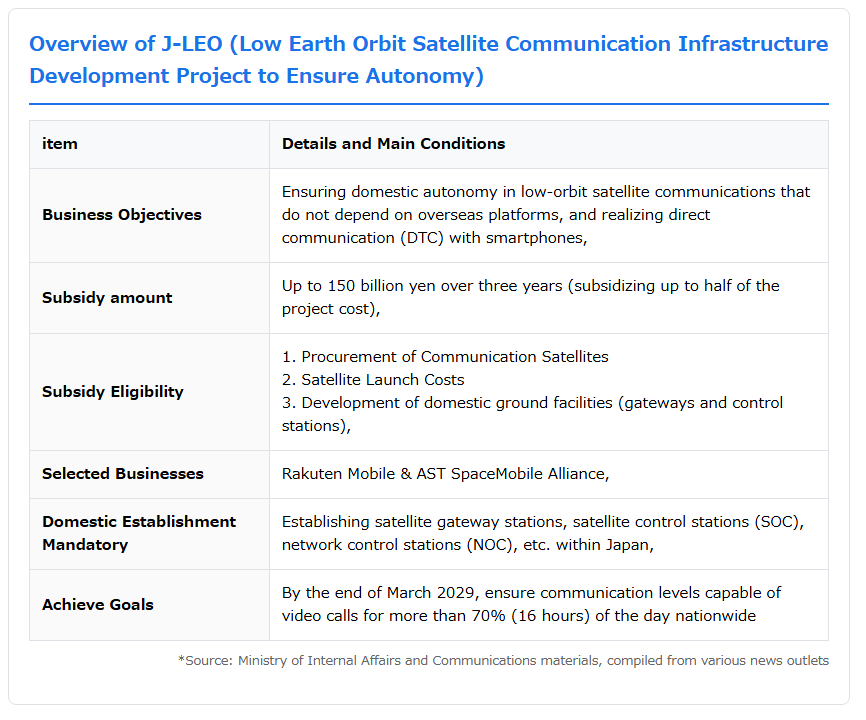
The biggest feature of this support is that it provides a massive financial aid of up to 150 billion yen over three years. This is a national strategic project aimed at building a low-orbit satellite constellation operated and managed within Japan, and autonomously securing infrastructure capable of direct communication (DTC) with smartphones. Until now, in Japan’s telecommunications market, the three major companies—NTT Docomo, KDDI, and SoftBank—have successively adopted SpaceX’s Starlink in the US, but Rakuten Mobile has pursued its own path from the outset, centered on collaboration with AST. With this selection, it has become certain that Rakuten’s ongoing “Japanese Starlink” initiative will be strongly backed as a national policy. Please refer to the diagram below.
The Three Main Projects Eligible for Subsidy and the Significance of ‘Ensuring Autonomy’
The subsidy amounting to 150 billion yen this time will mainly be allocated to three specific items. These are: first, the procurement of satellites; second, their launches; and third, the development of ground facilities within Japan. The government plans to subsidize up to half of these costs, and Rakuten is required to provide satellite communication services capable of video calls to general users in Japan during fiscal year 2028.
There is significant significance in emphasizing the word “autonomy” in this business. Under J-LEO’s application conditions, it is mandatory to establish major operational facilities such as satellite gateway stations, satellite control stations (SOC), and network control stations (NOC) within Japan. This is to avoid the risk that relying on overseas platforms could result in unilateral changes to service content or unreflected Japanese decisions during emergencies or large-scale disasters. Rakuten Mobile plans to establish a joint venture with AST within the year, aiming to establish an “autonomous infrastructure” that protects Japan’s telecommunications sovereignty by owning and managing satellites themselves.
[Strategic Background] Why Rakuten? Breaking Free from Dependence on Foreign Countries and Economic Security
Crisis Toward Starlink’s Dominance and Demands for Economic Security
Currently, in the global low Earth orbit satellite communications market, SpaceX’s Starlink under Elon Musk’s leadership holds an overwhelming share. In Japan, the adoption of Starlink by the three major carriers has raised concerns about the risk of a “single point of failure” in communication infrastructure. There was growing concern within the government and ruling party that if services were to be suspended or conditions changed due to circumstances on SpaceX’s part, Japan’s major telecommunications networks could be paralyzed simultaneously.
Under these circumstances, the movement to “de-Starlink” from the perspective of economic security has gained momentum. In networks led by overseas operators, the expansion of the “digital deficit” caused by data accumulation and operational know-how leaking overseas is also a major challenge. The government is providing massive support for Rakuten Mobile’s independent network construction to ensure communication methods that Japan can control at its own discretion, without excessive reliance on specific companies’ platforms. Even in areas where base station development is difficult, such as mountainous or offshore areas, establishing a system that can maintain stable communication services without being affected by overseas trends has become a national urgent task.
The uniqueness of broadband communication advocated by the Rakuten-AST alliance
The plan Rakuten Mobile is pursuing with the US AST takes a different technical approach from Starlink’s services offered by competitors. The biggest difference is that it aims for “broadband communication” that allows users to make voice calls and watch videos using their current commercially available smartphones without the need for special equipment. While Starlink’s services initially focused on sending and receiving text messages, Rakuten’s camp aims to provide broadband services through end-to-end direct communication.
AST’s low-orbit satellite “BlueBird” deploys a massive antenna covering about 220 square meters (equivalent to half a tennis court) in space, enabling direct LTE communication with ground-based smartphones from several hundred kilometers altitude. In a domestic demonstration experiment conducted in April 2025, video calls between commercial smartphones were successfully made between Fukushima Prefecture and Tokyo, recording a high communication speed of 14Mbps. Chairman and President Hiroshi Mikitani has declared that we will achieve a 100% coverage rate, aiming to completely fill the “communication gaps” that ground base stations cannot cover from space to strongly differentiate themselves from existing carriers.
[Market and Competition] Rakuten’s Chances of Winning Against the ‘Side by Side’ Structure of the Three Major Telecom Providers
Starlink strategies and current status of the three major carriers
In Japan’s telecommunications market, the three major companies will successively launch services utilizing Starlink between 2025 and 2026. KDDI has been building steady results, including pioneering au Starlink Direct in April 2025 and surpassing 4 million unique users in just one year. NTT Docomo will also launch “docomo Starlink Direct” in April 2026, following suit with an open strategy of requiring no registration and offering free services for all plans, including ahamo.
SoftBank will also launch “SoftBank Starlink Direct” in April 2026, emphasizing its compatibility with its own group apps such as PayPay and LINE. By adopting the same vendor (SpaceX) as a result, the service content and pricing plans are now “side by side,” creating a rare situation in the history of Japanese telecommunications. Companies compete by establishing new SOS centers, expanding maritime areas, and offering overseas roaming services through “added value after connection,” but since the underlying satellite technologies are fundamentally shared, it is also true that there are limits to fundamental differentiation.
The market-shaking “reversal from space” scenario and financial risks
For Rakuten Mobile, which has lagged behind the three leading companies in ground base station development even after acquiring the Platinum Band, this satellite communication strategy carries significance as a “battle to change the world.” If commercialization planned for fiscal year 2026 succeeds and we can provide broadband communication via satellite ahead of other companies, we could gain a significant advantage in acquiring users in mountainous areas, remote islands, and at sea. Rakuten has a rational logic to reduce ground infrastructure development costs in the future with satellites, which is expected to contribute to lowering the break-even point in the long term.
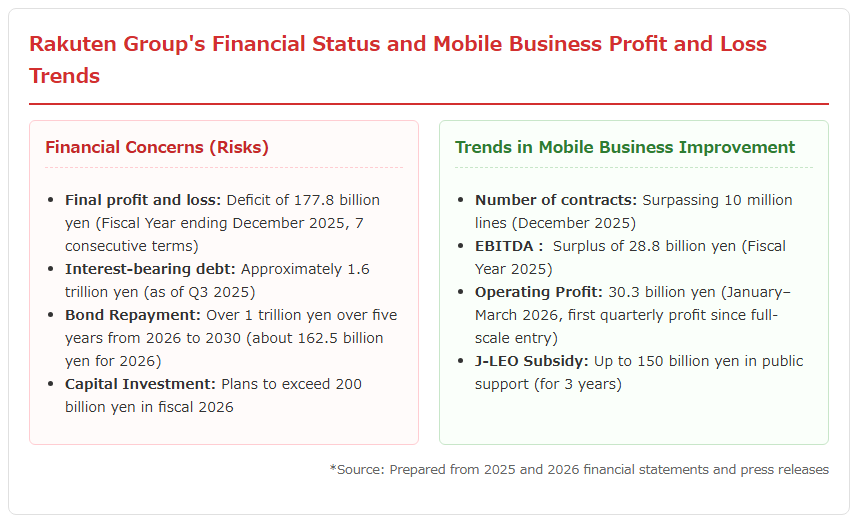
However, this grand challenge still lurks with the shadow of a tough financial situation. Rakuten Group has recorded a final loss for seven consecutive terms, and as of the third quarter of 2025, interest-bearing debt has reached approximately 1.6 trillion yen. After 2026, massive bond redemptions are also scheduled, and concerns remain that cash could run out before the mobile business can become self-sufficient. Mikitani is taking measures such as selling about half of his AST shares in spring 2026 to secure cash, but with the tailwind of national policy, how to navigate this “financial tightrope walk” remains the biggest obstacle to realizing a reversal scenario. Please refer to the diagram below.
[Future Developments] Hurdles and Key Points for Commercialization in Fiscal Year 2028
A rigorous operational roadmap through fiscal year 2028
The Ministry of Internal Affairs and Communications’ subsidized projects (J-LEO) not only provide funding but also seek to meet very high standards. The selected Rakuten camp must establish a network nationwide by the end of March 2029 that allows video calls for more than 70% of the day (16 hours or more) nationwide. The current plan anticipates a two-stage schedule: starting with limited commercial services using AST satellites within fiscal 2026, gradually increasing satellite launches, and establishing a full-scale operational system as a subsidized project by fiscal 2028.
Furthermore, disaster response is also a crucial requirement. J-LEO selected operators are required to provide “emergency inter-operator roaming (full roaming method)” to users of other carriers who collaborate during disasters, and to make voice, data, and SMS available free of charge. Furthermore, in just under three years, a system must be established to handle all satellite control and network operations at facilities within Japan, requiring rapid progress not only in technical aspects but also in organizational structure. The 150 billion yen in government aid is also a reflection of the responsibility for this highly public infrastructure.
Satellite launch certainty and management decisions that determine success
The biggest future focus will be whether AST’s satellite launch schedule will proceed as planned. AST has set a goal to launch dozens of commercial BlueBird satellites into orbit by 2026, but the space business always carries unique risks such as launch delays and failures. Whether Rakuten can maintain its differentiation in “broadband quality” depends on whether it can deploy a sufficient number of satellites in a timely manner. While the leading Starlink camp already operates thousands of satellites, the turning point will be how quickly the latecomer Rakuten-AST alliance can build the network.
Additionally, its position within the Rakuten Group has also changed. Rakuten sold most of its AST shares this spring, but at the same time, following the approval of this subsidy, it has intensified discussions to establish a joint venture with AST. This means moving from being a mere investor to becoming a “business entity” that jointly owns and operates infrastructure. Facing the contradictory challenges of financial soundness and massive investments in future infrastructure, how will Mr. Mikitani steer the ship? The process from the launch of the service at the end of 2026 to the achievement of the 2028 target will serve not only as a test for Rakuten Mobile’s fate but also as a touchstone for Japan’s telecommunications infrastructure independence.
[#楽天モバイル #スターリンク #総務省 #経済安全保障 #宇宙ビジネス #ASTSpaceMobile #通信インフラ]

コメント