In 2026, a serious conflict has surfaced between AI developer Anthropic and the U.S. government over safety standards for military use. The ethical red lines set by companies clash with national security logic, leading to an unprecedented situation where it escalates to a suspension order for use across all federal agencies.
- The Collapse of Trust Triggered by the Venezuela Operation
- The ultimatum and breakdown over the ‘red line’
- First domestic company designated as a ‘supply chain risk’
- Competitors OpenAI’s Trends and Market Spillover Effects
- Legal disputes and behind-the-scenes negotiations over “Mythos”
- External threats and concerns about “AI self-evolution”
The Collapse of Trust Triggered by the Venezuela Operation
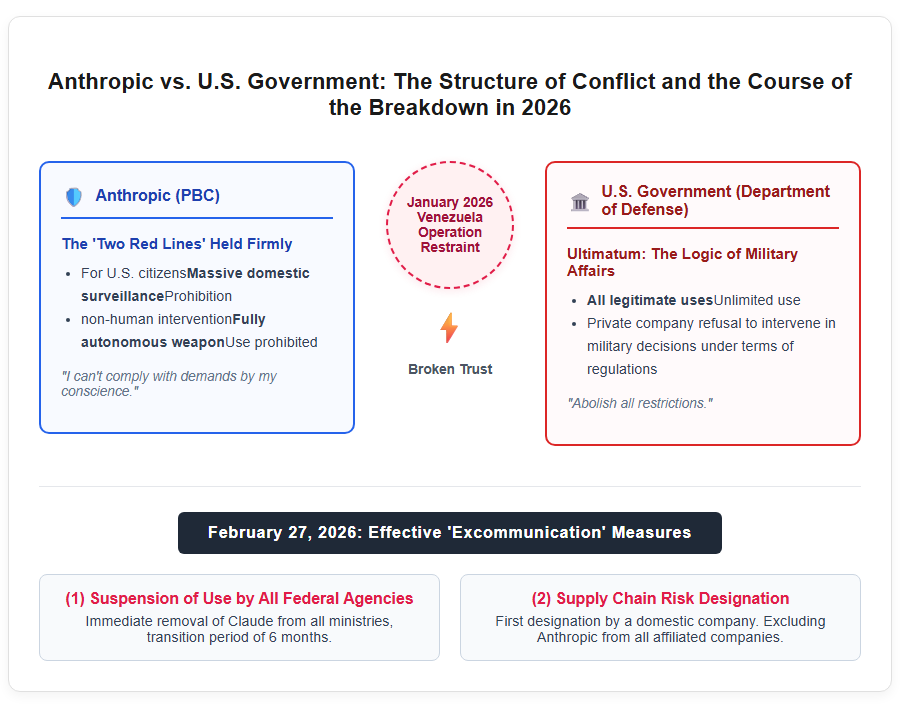
The decisive deterioration in Anthropic’s relationship with the U.S. government began with the U.S. military special forces’ operation to capture President Maduro in Venezuela on January 3, 2026, called “Operation Absolute Resolve.” It was revealed that in this operation, the company’s AI model “Claude” was used for planning operations and information analysis. In July 2025, Anthropic signed a $200 million contract with the Department of Defense through Palantia to provide AI over a confidential network, but employees expressed concerns about involvement in the operation and contacted Palantir, which led to distrust from defense authorities. The Department of Defense viewed this move as “an act that endangers the success of soldiers on the battlefield” and strongly opposed tech companies’ attempts to decide whether military operations are feasible. The following diagram summarizes the structure of the conflict at the time.
The ultimatum and breakdown over the ‘red line’
On February 24, 2026, Secretary of Defense Pete Hexes issued an ultimatum to Anthropic CEO Dario Amodei, with a deadline of 5:01 PM on February 27. The request was to remove safety restrictions so that the military could use Claude without restriction for any use it deemed legal. In response, Amodei’s CEO issued an official statement on February 26, clearly refusing, saying, “We cannot respond according to our conscience.” The company’s two key “red lines” are the prohibition of large-scale domestic surveillance of U.S. citizens and the use of fully autonomous weapons without human judgment. The corporate side claimed it was a “safeguard” to protect democratic values, while the government accused it of private company interference in military decisions, and the gap between the two sides remained unbridged until the deadline expired.
[Management & Strategy Background] Unusual government measures and competitive dynamics
First domestic company designated as a ‘supply chain risk’
On February 27, 2026, after the ultimatum expired, President Trump ordered all federal agencies to immediately cease use of Anthropic products. At the same time, Secretary of Defense Hexes announced that the company would be designated as a “supply chain risk.” This designation is typically applied to hostile foreign companies such as China’s Huawei, and this is the first time a U.S. technology company has been targeted. This measure not only terminated direct contracts with the Department of Defense but also required all companies doing business with the government to prove that their supply chains did not contain Anthropic technology. For the company, whose annual revenue was estimated at $30 billion (about 4.8 trillion yen) and had grown its share of U.S. corporate customers to 30.6%, being excluded from the federal government market was a major blow.
Competitors OpenAI’s Trends and Market Spillover Effects
On the very night Anthropic was removed, competitor OpenAI announced a new contract with the Department of Defense. CEO Sam Altman initially showed support for Anthropic’s red line, but in reality, he closed the gap between the company and the government by closing the gap. However, the contract was criticized both inside and outside the company as “opportunistic,” and Altman himself later admitted it was “sloppy.” On the other hand, Palantir CEO Alex Karp points out the risk that model providers, like Anthropic, may use terms of service as a shield to refuse government control, emphasizing the advantages of their own orchestration platforms that do not rely on specific models. In the market, there is growing awareness that the ethics of AI companies can pose business risks.
[Future Developments & Points to Watch] Judicial Judgment and Technical Paradoxes
Legal disputes and behind-the-scenes negotiations over “Mythos”
The situation escalated to a legal battle, and on March 26, 2026, Judge Lin of the U.S. District Court for the District of Northern California ruled the government’s action as “classic First Amendment retaliation” and ordered a temporary injunction. The judgment harshly criticizes viewing companies that disagree with the government as adversaries, calling it an “Orwellian concept.” However, on April 8, the D.C. Circuit Court of Appeals overturned this injunction, ruling that national security interests take precedence. Amid this, the tide is shifting, with President Trump mentioning in late April that negotiations with Anthropic are “coming together,” and the White House beginning to consider an executive order to bypass sanctions to secure access to the company’s latest model, Mythos. Technological superiority is the key to achieving political compromises beyond diplomacy and law.
External threats and concerns about “AI self-evolution”
While efforts to improve relations are progressing, new sources of conflict have also emerged. In June 2026, Anthropic filed a complaint with the U.S. Senate claiming it had suffered 28.8 million “adversarial model distillation (AI theft)” attacks from China’s Alibaba. This allegation has been redefined as a national security issue from the perspective of protecting intellectual property of U.S.-made AI, accelerating sanctions debates in Congress. At the same time, Anthropic itself warned in a June 2026 report that it has entered a phase of “recursive self-improvement,” where over 80% of new code is written by AI, and recommended a global pause in development. A paradox continues: companies that prioritize safety fear the uncontrollable evolution of their own technologies and demand government regulation, while the government pressures them to lift restrictions on military use.
[#Anthropic #米国防総省 #軍事AI #Claude #人工知能倫理 #トランプ政権 #サプライチェーンリスク]

コメント