Strategy (formerly MicroStrategy), led by Michael Saylor, is further accelerating its strategy to place Bitcoin at the core of corporate finance. This move represents an unprecedented transformation into a financially engineered corporate model that goes beyond mere investment, continuously acquiring scarce assets with low-cost debt.
- The world’s largest holdings and the impact of the ’21/21 plan’
- From Software Business to Leading the Digital Asset Economy
- The True Nature of the ‘Infinite Money Glitch’ and the Use of Convertible Bonds
- Why Bitcoin now? Mr. Saylor’s Philosophy
- Adoption of New Accounting Standards and Class Action Lawsuits by Investors
- Doubts about financial health and criticism from competitors
- Bullish forecasts for 2030 and the dream of adopting the S&P 500
- The Reality of Maturity Barriers and Liquidity Risk
The world’s largest holdings and the impact of the ’21/21 plan’
As of Q1 2026, Strategy holds 843,706 BTC, making it the world’s largest Bitcoin holder among publicly traded companies. This is an enormous scale, equivalent to about 4% of Bitcoin’s total supply of 21 million coins. The company’s latest ambitious roadmap is the “21/21 Plan.” This plan aims to raise a total of $42 billion over three years through 2027 (about $21 billion in equity issuance and about $21 billion in debt issuance), aiming for further Bitcoin accumulation. Its execution speed is overwhelming, with over 200,000 BTC purchased in just a few months in the latter half of 2024. Please refer to the diagram below.
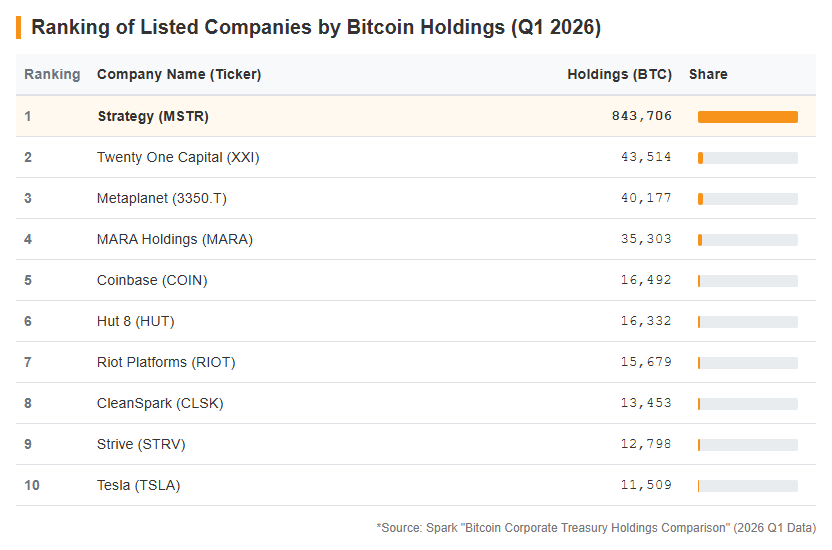
。 Originally a mid-sized software company, the company has now fully transformed into a “Bitcoin treasury” firm, establishing itself as a leveraged proxy for Bitcoin in the public market.
From Software Business to Leading the Digital Asset Economy
Strategy Inc. is a long-established business intelligence (BI) software company founded in 1989 by Michael Saylor and others. However, since adopting Bitcoin as its primary reserve asset in August 2020, its corporate identity has changed dramatically. In 2025, the company officially changed its name to “Strategy Inc.,” reflecting its Bitcoin-centered financial strategy in the company name. The existing software business still generates about $477 million in annual sales and consistently generates profits, but its current role is mainly to serve as a cash flow source to support interest payments on corporate bonds issued for Bitcoin purchases. Many investors view the company as a “spot Bitcoin leveraged ETF,” with its stock price moving in a way that amplifies Bitcoin price fluctuations.
A unique acquisition mechanism utilizing financial engineering
The True Nature of the ‘Infinite Money Glitch’ and the Use of Convertible Bonds
Supporting Strategy’s Bitcoin acquisition is advanced financial methods centered around convertible bonds. This method is sometimes referred to as the ‘infinite money glitch’ (a secret technique for infinite multiplication). The specific mechanism begins with the company raising funds by issuing convertible bonds at extremely low interest rates (sometimes 0%). These bonds come with the right (option) to convert into shares if the stock price rises in the future, so the higher the stock price volatility, the more attractive it is to investors. The funds raised are immediately used to purchase Bitcoin, creating a self-reinforcing cycle that further increases the company’s asset value and stock price volatility. Please refer to the diagram below.
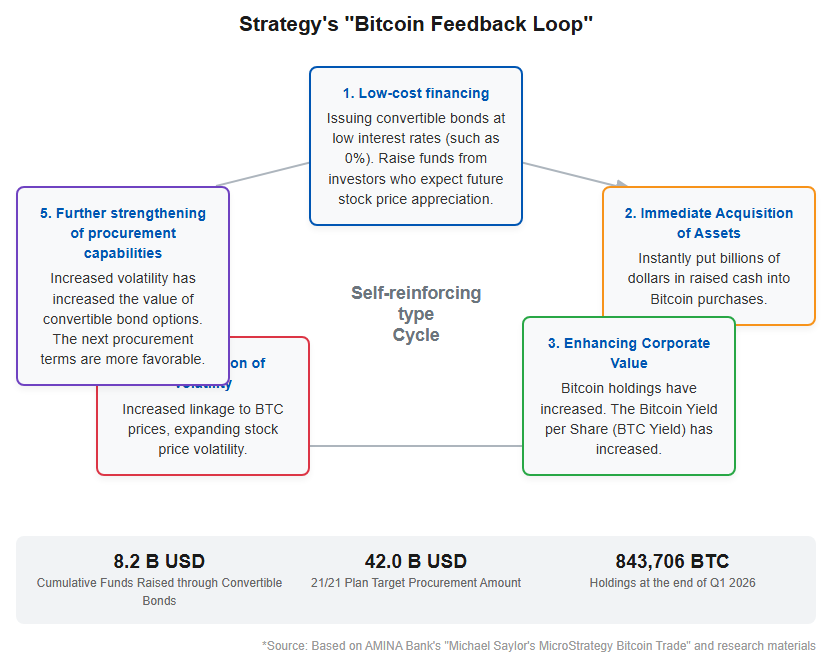
。 Institutional investors such as hedge funds prefer to purchase these bonds for arbitrage strategies that exploit this high volatility, enabling the company to continue raising funds.
Why Bitcoin now? Mr. Saylor’s Philosophy
Behind Chairman Michael Saylor’s focus on Bitcoin lies a strong distrust of traditional fiat currency systems and deep trust in Bitcoin’s technical characteristics. He concluded that due to global large-scale monetary easing, falling interest rates, and inflation risks, continuing to hold cash would lead to a decline in shareholder value. Bitcoin is defined as “digital gold” or “digital energy,” with a strict supply cap of 21 million coins, making it the ultimate hedge against inflation. According to him, Bitcoin is in the early growth phase of the internet, and its scarcity and network effects guarantee long-term value appreciation. This unwavering belief drives me to continue buying without hesitation, even in highly volatile market conditions.
Challenges Faced and Judicial and Accounting Risks
Adoption of New Accounting Standards and Class Action Lawsuits by Investors
Behind the success of its Bitcoin strategy, the company is also facing legal headwinds. On May 19, 2025, investors in California filed a class-action lawsuit in the federal district court of Virginia. The complaint alleges that the company misled investors by providing false explanations about the future profitability and volatility risks of Bitcoin investments. A particularly concerning issue is the impact of the new accounting standard “ASU 2023-08,” adopted in early 2025. Under this standard, Bitcoin holdings are valued at “fair value (market value),” and price fluctuations must be directly reflected in quarterly profit and loss statements. As a result, during the Bitcoin price downturn, massive unrealized losses were recorded, with a single loss of about $12.5 billion reported in Q1 2026, which contributed to investor distrust.
Doubts about financial health and criticism from competitors
Concerns have also been raised within the industry about Strategy’s aggressive leverage strategy. Ripple CEO Brad Garlinghouse criticized the company’s approach as “financial engineering that does not create long-term value” and argued that practicality should be prioritized. In fact, some of the company’s financial situation is showing warning signs in some areas. In June 2026, amid the slump in Bitcoin prices, the preferred stock “STRC” fell to around $74 against a face value of $100, setting a new all-time low. Additionally, the “mNAV,” an indicator that divides a company’s market capitalization by its Bitcoin holdings, briefly fell below 1, causing a reversal where the value of held assets fell below stock market valuations. Analysts like CryptoQuant have recommended a temporary halt in Bitcoin purchases, citing declining cash reserves and increased dividend payment burdens.
Future developments and medium- to long-term highlights
Bullish forecasts for 2030 and the dream of adopting the S&P 500
Despite facing many challenges, some analysts remain bullish on Strategy’s long-term outlook. Based on technical analysis and econometric models, the stock price is expected to hover between $176 and $228 in 2026, and if Bitcoin rises significantly after the halving, it is predicted to test the $500 to $700 range in the future. Some predict that the average price will reach $672 through 2030, and if this stage is reached, a “virtuous cycle” of continued buying of high-growth assets with low-interest funds is being evaluated, potentially becoming a candidate for inclusion in the S&P 500 index. Whether Bitcoin continues to be recognized as the “premier stock investment tool in the digital age” is key to the company’s parabolic growth.
The Reality of Maturity Barriers and Liquidity Risk
The most important thing to watch out for in the medium to long term is the timing when the issued debt matures. Strategy is scheduled to repay $875 million in debt in 2028, $3 billion in 2029, and $2 billion in 2030. If the stock price at maturity falls below the conversion price and investors seek cash repayment instead of conversion to shares, the company must prepare a huge amount of cash. Currently, the cash holdings amount to only about $38 million, and at this rate, they will have to forcibly sell their Bitcoin holdings to fund repayments. Large-scale forced selling could put severe downward pressure on the entire Bitcoin market, potentially triggering a “negative spiral” that could lead to further declines in stock prices. Whether this “beginning of the end” coincides with periods of low market liquidity is the risk factor investors should pay close attention to.

コメント