
A major information breach in Apple’s history has occurred, with a total of 630GB of confidential data related to the upcoming iPhone 18 Pro leaked from Tata Electronics, a major manufacturing partner in India. This situation has exposed supply chain vulnerabilities associated with the company’s ongoing de-China strategy, raising concerns that it could have a significant impact on new product marketing and pricing strategies.
- The full story of the large-scale cyberattack that hit Tata Electronics
- Leaked technical details of the next-generation chip “A20 Pro” and In-House modem “C2”
- Spread of actual device videos and unusual content removal by social media platforms
- The security paradox caused by the rapid shift to Indian manufacturing
- The full disclosure of the supply chain dealt a severe blow to Apple’s price negotiation power.
- Significant price hike forecast for iPhone 18 due to soaring memory prices and rising component costs
- Indian Government Intervention and Future Outlook for Supply Chain Restructuring
The full story of the large-scale cyberattack that hit Tata Electronics
In late June 2026, the ransomware group World Leaks announced that it had breached the systems of Tata Electronics, Apple’s major manufacturing partner in India, stealing vast amounts of confidential data. The total amount of leaked data reached approximately 630GB, with over 200,000 files. Among these documents is highly confidential documents related to the iPhone 18 Pro and iPhone 18 Pro Max, which are expected to be announced in September 2026.
Specifically, it includes a map linking the components of the iPhone 18 Pro with a detailed list of suppliers supplying them, which can be called a “holy grail” of information that Apple has never released before. Furthermore, the leaked data has reached not only Apple products but also classified documents from other Tata customers such as Tesla, TSMC, and Qualcomm, escalating into a massive information disaster that engulfs the entire tech industry. It is said that the hackers had already distributed data on the dark web as early as June 10, fundamentally shaking Apple’s trust in operational security.
Leaked technical details of the next-generation chip “A20 Pro” and In-House modem “C2”
Among the leaked data, the most notable are detailed blueprints and datasheets for Apple’s next-generation processor, the A20 Pro (codename: Borneo), and Apple’s first in-house 5G modem, the C2 (codename: Ganymede). These documents include a complete layout of the motherboard (logic board) designed with Siemens NX software, detailing the electrical connections between components and the internal configuration of the terminal. Please refer to the diagram below.
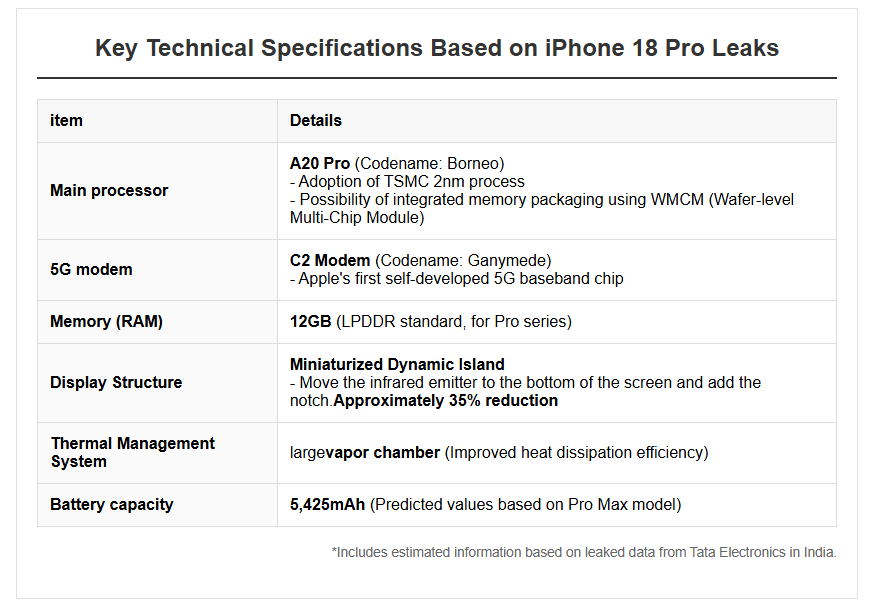
In particular, it has been pointed out that the A20 Pro chip may adopt a new implementation method called “WMCM,” which integrates memory within the package rather than the traditional structure of stacking memory on top of the SoC. While this method contributes to heat dissipation design and improved performance, it also faces many manufacturing constraints, so leaked blueprints can become extremely valuable reverse engineering materials for competitors. Additionally, the exposure of technical documentation regarding Apple’s in-house modem “C2” exposes Apple’s long-term strategy to optimize communication functions in-house, which has traditionally relied on Qualcomm chips, posing risks of shortening technical lead times.
Spread of actual device videos and unusual content removal by social media platforms
The leaked data included not only technical documents but also videos and photos of the actual iPhone 18 Pro drop tests, which were said to have been conducted at Tata Electronics’ factory. The device shown in the video features a silver-gray color scheme and is equipped with a larger triple-lens camera on the back, presumed to be a sample from the Engineering Validation Test (EVT) stage. The back panel abandons the traditional two-tone design, featuring a more uniform and unified finish.
When the leaked video spread on social media platforms like X (formerly Twitter), Apple issued an unprecedented large-scale takedown request under the Digital Millennium Copyright Act (DMCA). Accounts that post videos are immediately suspended, and related posts are deleted one after another, taking a tough stance that sets them apart from past leak incidents. However, once the original file is published on the dark web, it is now in an unrecoverable state, and the prevailing view is that its value as a secret has been lost forever.
Risks Exposed by Geographic Fragmentation of Supply Chains
The security paradox caused by the rapid shift to Indian manufacturing
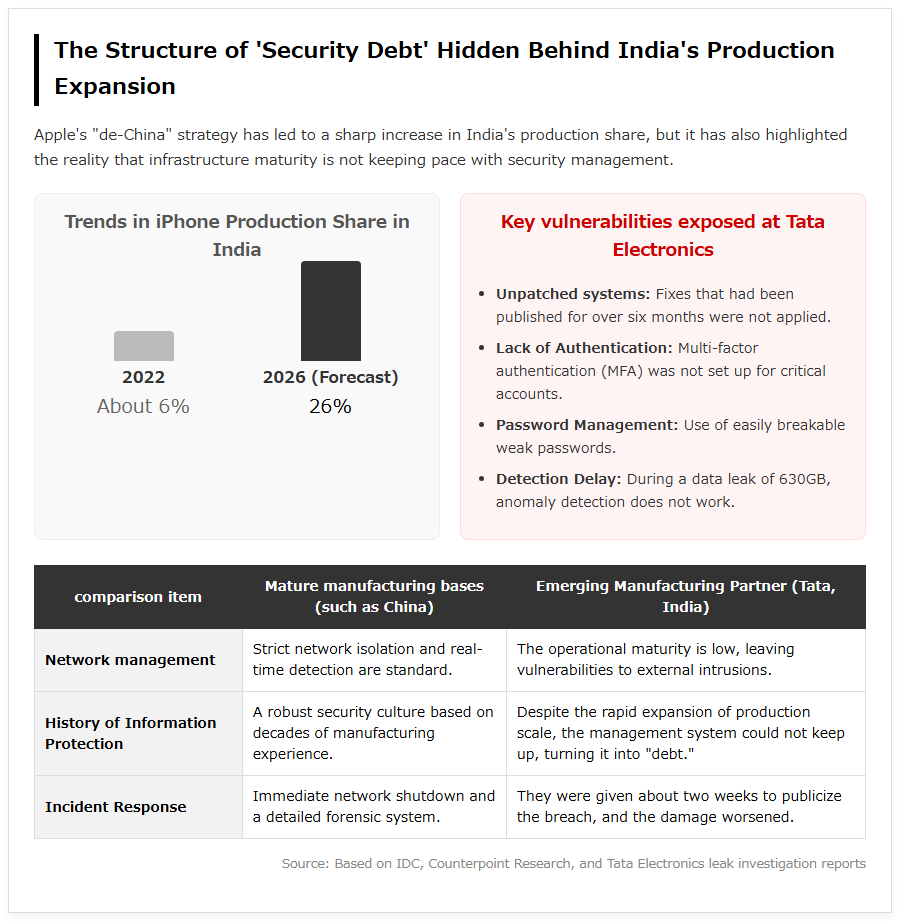
This incident has exposed major pitfalls in Apple’s “de-China” strategy, the so-called “China Plus One” strategy, which Apple has promoted to avoid geopolitical risks such as US-China confrontation. The share of iPhone production in India is expected to surge from about 6% in 2022 to about 26% by 2026, with Tata Electronics nurturing itself as the core “leading manufacturing partner” at the core of this effort. However, this hack revealed that the security management system had not kept pace with the rapid expansion of manufacturing capacity.
According to the investigation report, hackers exploited vulnerabilities in systems that had not been applied even though patches had been provided for over six months. Furthermore, some critical accounts lacked even multi-factor authentication (MFA) and used easily guessable passwords, highlighting surprisingly basic security flaws. Compared to China, where the manufacturing ecosystem is mature and strict network isolation is standardized, India’s supply chain “security debt” has led to this catastrophic outflow. Please refer to the diagram below.
The full disclosure of the supply chain dealt a severe blow to Apple’s price negotiation power.
Apple publishes a list of its main suppliers every year, but details about which companies supply which specific products and parts have been strictly controlled as trade secrets. The leaked data includes hundreds of iPhone 18 Pro components and supplier correspondence charts, fully exposing the “hand” of which parts Apple sources from multiple companies to compete on price or depends on a single company.
This information leak would undermine Apple’s overwhelming advantage in future price negotiations with partner companies. Competitors will be able to pinpoint Apple suppliers for pull-and-pull tactics, and counterfeit manufacturers will try to source parts exactly as shown in the drawings from legitimate suppliers. Apple’s entire product cycle, which had been meticulously managed to maximize surprise and premiumity, was disrupted just months before the official announcement, which is expected to significantly shorten strategic lead times for new product launches.
Market Impact and Future Outlook
Significant price hike forecast for iPhone 18 due to soaring memory prices and rising component costs
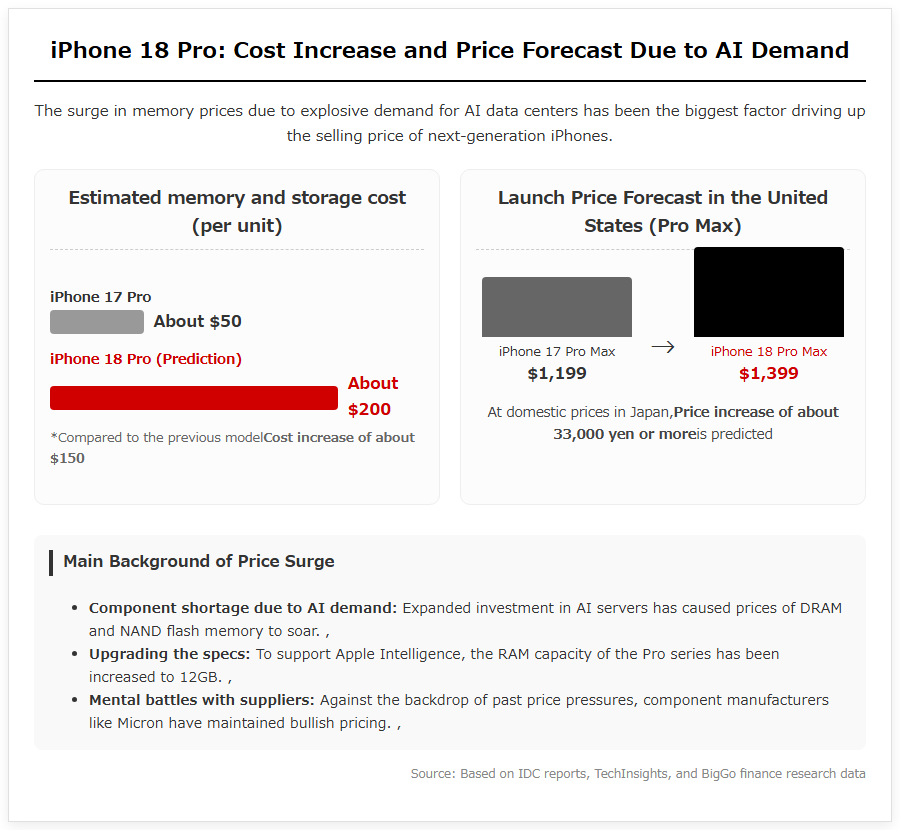
Alongside the shock of the leak, there are numerous predictions that the prices of the iPhone 18 series will reach new all-time highs. According to reports from research firm IDC and others, the rising demand for AI data centers has led to a sharp rise in DRAM and NAND flash memory prices, significantly driving up component costs. The iPhone 18 Pro series is expected to come with 12GB of RAM, but just the costs related to memory and storage are estimated to be about $150 higher than the previous model, approaching $200.
Reflecting this cost increase, the starting price of the iPhone 18 Pro Max in the US could reach $1,399, and a price increase of over 30,000 yen is expected in markets like South Korea and Japan. Apple’s attempt to expand the adoption of its own C2 modems and A20 Pro chips was partly to reduce dependence on external suppliers and control costs, but this leak casts a shadow over the execution of that strategy. Consumers may be burdened with the “AI premium” of rising hardware prices before they fully experience the benefits of AI features, which could further prolong the replacement cycle. Please refer to the diagram below.
Indian Government Intervention and Future Outlook for Supply Chain Restructuring
Taking the situation seriously, the Indian government announced its first official investigation into the hacking incident involving Tata Electronics on July 3, 2026. Minister of Electronics and Information Technology S. Krishnan has reported to the national Computer Emergency Response Team (CERT-In) and revealed that they have begun investigating the cause and taking countermeasures. This suggests that this case is not just a private company accident, but also a major matter related to the national strategy to grow India into a global manufacturing hub.
Apple has already sent a security team to India and is working with Tata on internal audits and fundamental system improvements. However, this incident, which occurred in a rush to break away from dependence on China, has made the world aware that geographic decentralization of supply chains is adjacent to “security vulnerabilities.” Going forward, while maintaining its production ratio in India, Apple will be forced to apply stricter security standards and conduct audits of partner companies. Ahead of the official announcement scheduled for September, a major focus will be on how to regain lost trust and secrecy while keeping consumer expectations alive.
[#iPhone18 #Apple #セキュリティ #インド #半導体 #情報流出 #サイバーセキュリティ #テックニュース]

コメント