He succeeded in reconstructing theory using only real numbers, without using the ‘imaginary numbers’ that form the foundation of quantum mechanics. In 2021, it seemed that the indispensability of imaginary numbers had been proven, but recent research between 2025 and 2026 overturns that assumption and redefines the degree of freedom in mathematical representation in the description of the natural world.
- 1-1: Schrödinger’s Dissatisfaction and Refuting Conventional Views
- 1-2: New Insights in Physics from 2025 to 2026
- 2-1: Redefining the tensor product and maintaining locality
- 2-2: Comparison with the 2021 ‘Imaginary Number Essentialism’ and Pointing Out Errors
- 3-1: Conceptual Significance for the Unification of Physics
- 3-2: Impact of the U.S. Executive Order Aiming for Practical Use in 2028
1-1: Schrödinger’s Dissatisfaction and Refuting Conventional Views
Quantum mechanics was born about a century ago as a theory to describe the strange behavior of atoms and elementary particles. A major feature of this is that the Schrödinger equation contains an imaginary number i, which becomes minus 1 when squared. In physics, measurable physical quantities such as mass and momentum are always expressed as real numbers. Nevertheless, the fact that the wave function describing quantum states must be a complex number (a combination of real and imaginary numbers) has puzzled physicists for many years.
Erwin Schrödinger, one of the founders of quantum mechanics, expressed strong displeasure in a 1926 letter about using imaginary numbers in his formula and reportedly hoped to eventually replace it with a version using only real numbers. However, calculations using complex numbers were mathematically very concise and elegant, so subsequent generations of physicists accepted this form without deeply pursuing rewriting into real numbers.
In November 2025, a series of papers were published to put an end to this deadlock. Research teams from Germany and France have reported successful formulations using only real numbers, which are mathematically equivalent to standard quantum mechanics using complex numbers. This highlighted the possibility that imaginary numbers are not an essential component of quantum mechanics, but merely a ‘grammar’ meant to simplify descriptions.
1-2: New Insights in Physics from 2025 to 2026
Recent research achievements have fundamentally reexamined the mathematical foundations of quantum mechanics. As of 2021, the mainstream conclusion was that “theory of real numbers alone cannot explain reality” through specific experimental protocols, but new findings between 2025 and 2026 reject this conclusion as “premature.” Hofreumon and Woods from France’s Inria (National Institute for Informatics and Automatic Control), along with a German research team, reached the same conclusion from an independent path: “complex numbers are unnecessary.”
Specifically, methods for mapping 2d-dimensional complex Hilbert spaces to 2d-dimensional or 4d-dimensional real Hilbert spaces have been refined. In the early theories proposed by Stückelberg in the 1960s, the individual systems aligned with complex theory, but inconsistencies occurred in descriptions when multiple systems intertwined. However, recent research has established “real-number quantum mechanics (RNQT)” that returns predictions in all experimental results the same as standard quantum mechanics by properly defining the synthesis rules of the system.
This is similar to the difference between describing land using a coordinate system of latitude and longitude versus describing distances east and north from a station. Even if the methods of description differ, since the same place is being pointed, it is impossible to determine which is the “true nature of the land” by measurement alone. This discovery has reignited a deeper physical-philosophical question: is the essence of the quantum world within the formula itself, or in a ‘structure’ independent of formulas?
Chapter 2: Mathematical Breakthroughs That Made Formulation Possible
2-1: Redefining the tensor product and maintaining locality
The biggest barrier to describing quantum mechanics using only real numbers was the description of ‘complex systems’ in which multiple particles interact. In standard complex quantum mechanics, the mathematical ‘tensor product’ is used to combine two systems, usually using the calculation rule known as the ‘Kronecker product.’ The 2021 ‘Virtuality Essentialism’ prerequisites the application of the Kronecker product directly to real number theory.
However, the latest research team pointed out that this assumption is actually mistaken. They introduced a new combinatorial rule called “otimes_r” and proved that “locality” could be maintained even in real number theory. Locality is a fundamental principle in physics that operations performed on one system do not directly alter the state description of another system located far away. The following figure shows how this local representation is maintained.
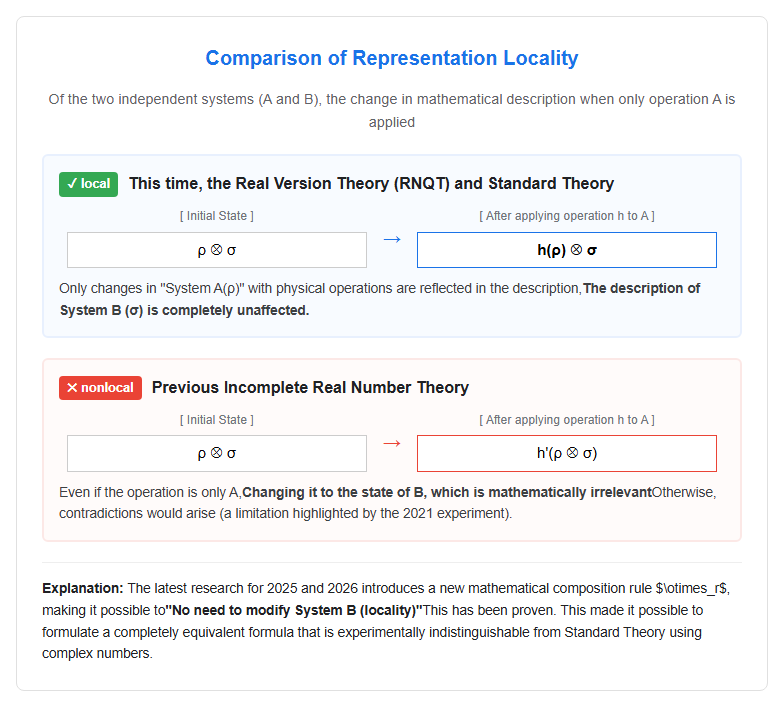
The new rules replace the property of the complex number unit i with 2×2 execution sequences and process them statistically to eliminate noise and inconsistencies. Thanks to this mathematical ingenuity, it became possible to describe complex processes where photons emitted from independent light sources cause quantum entanglement using only real numbers without contradiction.
2-2: Comparison with the 2021 ‘Imaginary Number Essentialism’ and Pointing Out Errors
The significance of this achievement lies in its logical overcoming of the widely reported empirical experiment on the “necessity of complex numbers” from 2021 to 2022. Back in 2021, Lennow and colleagues devised a three-way quantum game that extended Bell’s inequality, and had determined that the upper limit of scores achievable by real number theory was about 7.66. On the other hand, complex theory allows for “about 8.49,” and experimental teams such as those at the University of Science and Technology of China reported breaking this real-number limit with an overwhelming precision of 43 standard deviations using superconducting qubits.
However, according to a 2025 study, this “7.66” limit was based on the mistaken assumption that real number theory uses the “standard Kronecker product.” It became clear that by adopting properly defined new synthesis rules, even real number theory could achieve exactly the same score as in complex theory.
In other words, past experiments did not prove the “indispensability of imaginary numbers” but only exposed “the limitations of adopting traditional composition rules in real number theory.” This paradigm shift has once again brought the fundamental question of “Does nature really use imaginary numbers?” into an open debate within the physics community.
Chapter 3: The Future of Quantum Computing and International Technology Competition
3-1: Conceptual Significance for the Unification of Physics
The fact that quantum mechanics can be described using only real numbers holds significance beyond mere mathematical rewriting. The greatest advantage is the advancement of “conceptual unification” with other fields of physics. For example, Einstein’s general theory of relativity, statistical mechanics, and classical mechanics are all described using only real numbers. Until now, quantum mechanics existed like a “singular island” where complex numbers were essential, but with the formulation of real numbers, one obstacle to the ultimate challenge of integrating quantum mechanics and gravity theory has been removed.
Additionally, the real-number version of the theory suggests that manipulating time reversal can be more intuitively expressed. In complex theory, ‘anti-unitary operations,’ which tend to be considered non-physical, are gaining attention for their secondary effects, such as enabling linear representations in real spaces.
However, if you try to write using only real numbers, the required computational complexity tends to be much greater than in the complex version. For example, if you write a wave function of two particles as a complex number, you only need four elements, but a real version requires sixteen elements. Therefore, while it is unlikely that real number theory will replace practical calculations, it is expected to serve as a powerful theoretical tool for exploring the “true nature” of the quantum world and serve as the foundation for research over the coming decades.
3-2: Impact of the U.S. Executive Order Aiming for Practical Use in 2028
Alongside the deepening of theoretical physics, the international struggle for supremacy in the social implementation of quantum technology is accelerating. On June 22, 2026, U.S. President Trump signed two important executive orders aimed at promoting the development of quantum computers and strengthening cybersecurity. This plan aims to realize a practical quantum computer by 2028 through public-private cooperation, with particular focus on technological competition with China.
Another pillar of this executive order is addressing the risk that current cryptographic technologies could be deciphered by future quantum computers. The plan to transition to “post-quantum cryptography (PQC)” was moved forward by four years from the original 2035 plan. Following this, on June 23, 2026, at the Tokyo Stock Exchange, HPC Systems, a company specializing in high-performance computing systems, hit the daily limit high, indicating intensified capital inflows into related stocks.
The theoretical advancement that quantum mechanics can be described without imaginary numbers could also influence the development of such hardware and cryptography. In particular, new perspectives using real numbers may offer hints for breaking down the ‘wall of error,’ especially in optimizing quantum computing algorithms and developing control methods with high noise tolerance. The practical application of quantum technology is no longer a distant dream; as of 2026, it stands at the forefront of national security and economic strategy.
[#量子力学 #虚数 #実数定式化 #物理学 #量子コンピュータ #科学技術ニュース #サイバーセキュリティ]


コメント