A corporate alliance including Mitsui Fudosan has embarked on the development of Japan’s first commercial underground AI data center by utilizing a former belt conveyor tunnel in Kobe. To meet the rapidly expanding demand for generative AI, this massive civil engineering heritage that had lain dormant for roughly 20 years is being repurposed as cutting-edge digital infrastructure.
- Key Points of the Event and the Full Picture of the Project
- Business Promotion Structure and Public-Private Partnership Framework
- A cool year-round space of 15–20°C and circulating groundwater water cooling
- Robust Physical Security and Disaster Resilience
- The History and Rebirth of the Civil Engineering Heritage That Shaped Kobe
Key Points of the Event and the Full Picture of the Project
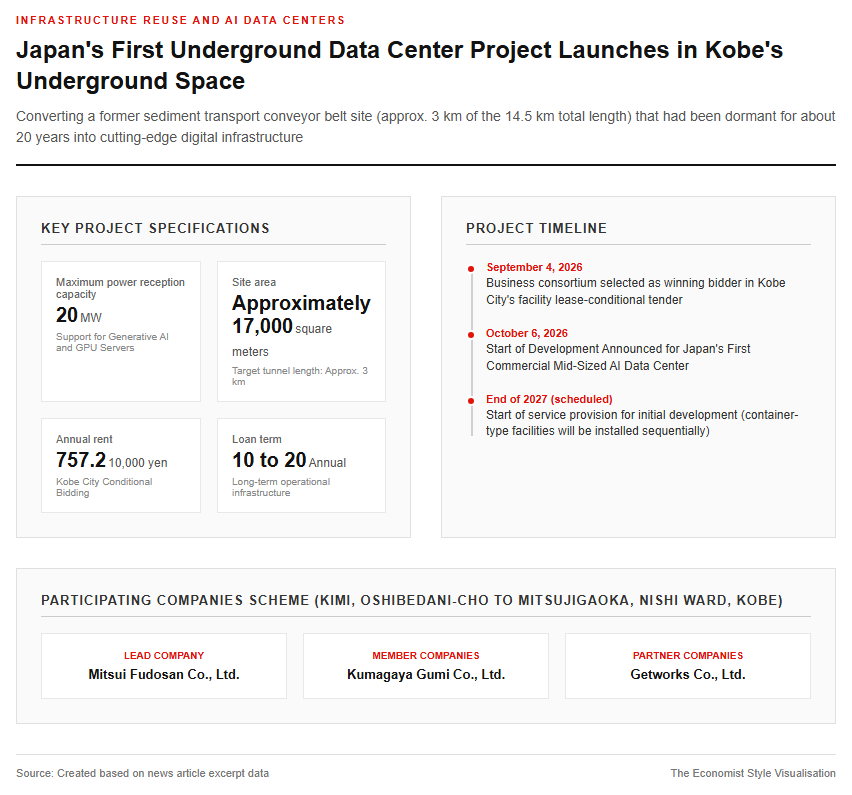
On October 6, 2026, Mitsui Fudosan Co., Ltd., Kumagai Gumi Co., Ltd., and Getworks Co., Ltd. announced that they are launching the development of an underground data center utilizing an existing underground tunnel located in Nishi-ku, Kobe City, Hyogo Prefecture. This marks the first initiative in Japan to provide commercial data center services to external customers by utilizing existing tunnel space.
The facility in question is the former earth-and-sand conveyor belt tunnel located between Kimi, Oshibedani-cho, Nishi-ku, Kobe City and Mitsugaoka. In a conditional bidding process for the facility lease conducted by the City of Kobe, a group consisting of Mitsui Fudosan as the representative company and Kumagai Gumi as a member company was selected as the winning bidder on September 4, 2026. The area subject to the lease covers approximately 3 km of the 14.5 km total length, with a site area of roughly 17,000 square meters. The annual rent is set at 7,572,000 yen, and the lease period ranges from 10 to 20 years.
Under this initiative, containerized data center facilities will be sequentially installed inside tunnels located deep underground, with the provision of services from the initial development scheduled to begin by the end of 2027. In the future, the project aims to operate with a maximum power reception capacity of 20 megawatts (20MW), meeting the computational demands of the latest GPU (graphics processing unit) servers in the era of generative AI.
Please refer to the figure below.
Business Promotion Structure and Public-Private Partnership Framework
To realize this project, companies with expertise in real estate development, construction and civil engineering, containerized data center operations, and technical design are building a robust implementation structure.
Mitsui Fudosan and Kumagai Gumi, the project’s primary business entities, will be responsible for developing the site by utilizing the underground space. Kumagai Gumi, in particular, is in charge of construction, backed by its proven track record of having been involved in the actual construction and execution of this tunnel approximately 60 years ago. Its technical expertise, which thoroughly understands underground spaces as civil engineering structures, will be leveraged in the construction and reinforcement work. Furthermore, Getworks—which has a track record of a cumulative total of over 380 buildings—will be responsible for constructing and operating the container-type data center in-house. In addition, Pacific Consultants Co., Ltd. is participating as a cooperating partner, providing business feasibility studies and design support.
In terms of public-sector collaboration, the initiative stems from a public tender issued by the City of Kobe aimed at making effective use of long-unused infrastructure assets. This public-private partnership model—whereby private enterprises lease idle assets owned by the local government and transform them into cutting-edge digital infrastructure—serves as an advanced example of successfully balancing the resolution of regional challenges with the creation of new industrial value.
Why Underground: The Technical Advantages and Environmental Performance of Subterranean Spaces
A cool year-round space of 15–20°C and circulating groundwater water cooling
With the explosive spread of generative AI technology, GPU servers that perform massive computational processing consume vast amounts of power and generate extremely high heat, making ensuring cooling efficiency the greatest challenge in data center operations. In conventional data centers with buildings constructed on land, the power consumption of air conditioning equipment, the acquisition of vast tracts of land, and soaring material costs have been bottlenecks.
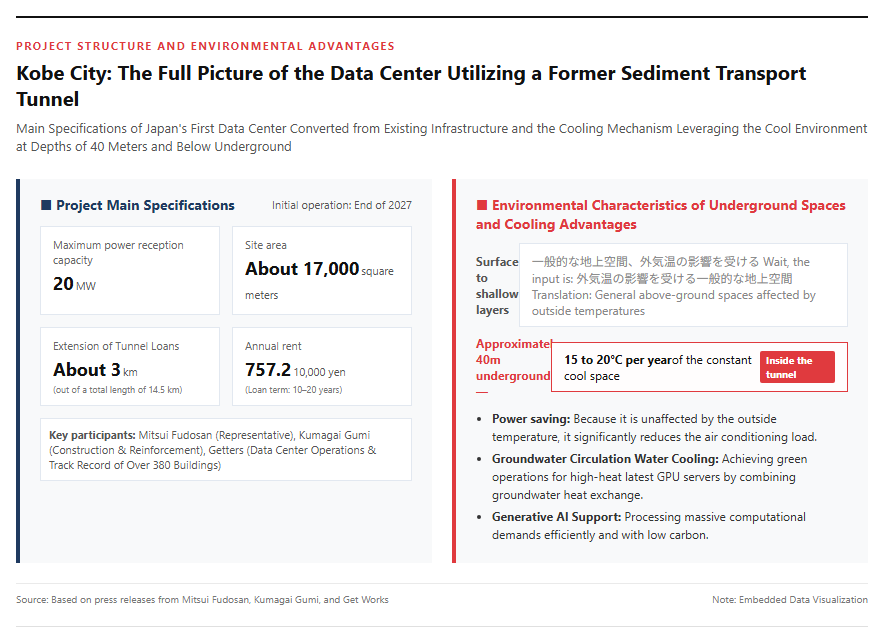
In contrast, the interior of this tunnel, located at a depth of more than approximately 40 meters underground, maintains a cool environment where the temperature is kept constant at approximately 15 to 20 degrees Celsius throughout the year. By utilizing the thermal characteristics of the underground space, which is unaffected by outside temperatures, it becomes possible to significantly reduce the power load required for air conditioning and cooling.
Furthermore, the cooling system will employ a water-cooling method that recirculates groundwater. For high-heat GPU servers, combining the stable underground temperature environment with groundwater heat exchange achieves both improved energy efficiency (PUE) and low-carbon green operations.
Please refer to the figure below.
Robust Physical Security and Disaster Resilience
Another major strength of underground spaces is their overwhelming robustness and resilience (disaster resistance) against earthquakes and external physical risks.
Compared to above-ground structures, structures located deep underground vibrate together with the surrounding ground, resulting in minimal amplification of shaking during an earthquake and exhibiting high seismic performance. Furthermore, because tunnel facilities have limited entrances and exits, external access and trespassing are restricted, making them an exceptionally ideal environment for storing critical data that requires advanced physical security.
In this project, GetWorks’ 100% domestically manufactured shelter-type container data center technology will be introduced. In addition to high seismic and impact resistance, these shelter-type containers are also equipped with electromagnetic pulse (EMP) protection, building a resilient digital infrastructure capable of maintaining communication and computing infrastructure functions even in the event of large-scale disasters or emergencies.
“From Mountains to the Sea” to the AI Era: Infrastructure Reuse and National Strategy
The History and Rebirth of the Civil Engineering Heritage That Shaped Kobe
The existing tunnel being reborn as a data center this time is deeply connected to the history of grand urban development in Kobe City during the rapid economic growth era.
Since the 1960s, Kobe has carried out a unique urban development initiative known as “Mountains Go to the Sea,” in which the mountains of the Rokko range were leveled to develop residential and industrial complexes like Seishin New Town, while the massive amounts of earth and sand generated during the process were transported to the sea for land reclamation. Serving as the main player in this earth transport was the 14.5-kilometer-long Suma Belt Conveyor, which was laid in 1963 and began operations in 1964, laying the groundwork for Port Island, Rokko Island, and Kobe Airport.
The massive tunnel, which had fallen silent after concluding its roughly 41-year service life in September 2005, had in recent years also been used as a filming location for works such as the movie City Hunter, but through this project, this civil engineering heritage that once transported physical “earth and sand” to build cities is being reborn as digital infrastructure supporting 21st-century “data” and the AI society.
The government is currently promoting “watt-bit collaboration,” which involves the integrated development and deployment of power infrastructure (watts) and communication/data infrastructure (bits), advancing the regional decentralization of data centers and the efficient allocation of grid capacity.
In this project, GetWorks has announced a vision to collaborate with “IOWN APN (docomo business APN Plus),” a high-speed, ultra-low-latency network leveraging optical technology that NTT Docomo Business is rolling out nationwide. It aims to establish a model for the integrated operation of a distributed container data center network by connecting Yuzawa Town in Niigata Prefecture, Kagoshima Prefecture, Hokkaido, and the newly established Kobe base via a high-speed communication network.
Mitsui Fudosan positions this project in Kobe as the first model for utilizing idle underground spaces scattered across Japan. Moving forward, the company plans to horizontally deploy this model to retired railway and road tunnels, former mine sites, and other locations existing nationwide. Through establishing multiple sites for underground data centers, the vision is to promote the development of sustainable and resilient next-generation infrastructure on a nationwide scale.
Reference page
- [Mitsui Fudosan News Release] https://www.mitsuifudosan.co.jp/corporate/news/2026/1006/
- [Kobe City: Lease of Former Belt Conveyor Tunnel Facilities] https://www.city.kobe.lg.jp/a26136/business/recruit/kobe_beltconveyor.html
[#KobeCity #UndergroundDataCenter #AIDataCenter #MitsuiFudosan #WattBitCollaboration #InfrastructureReuse]
コメント